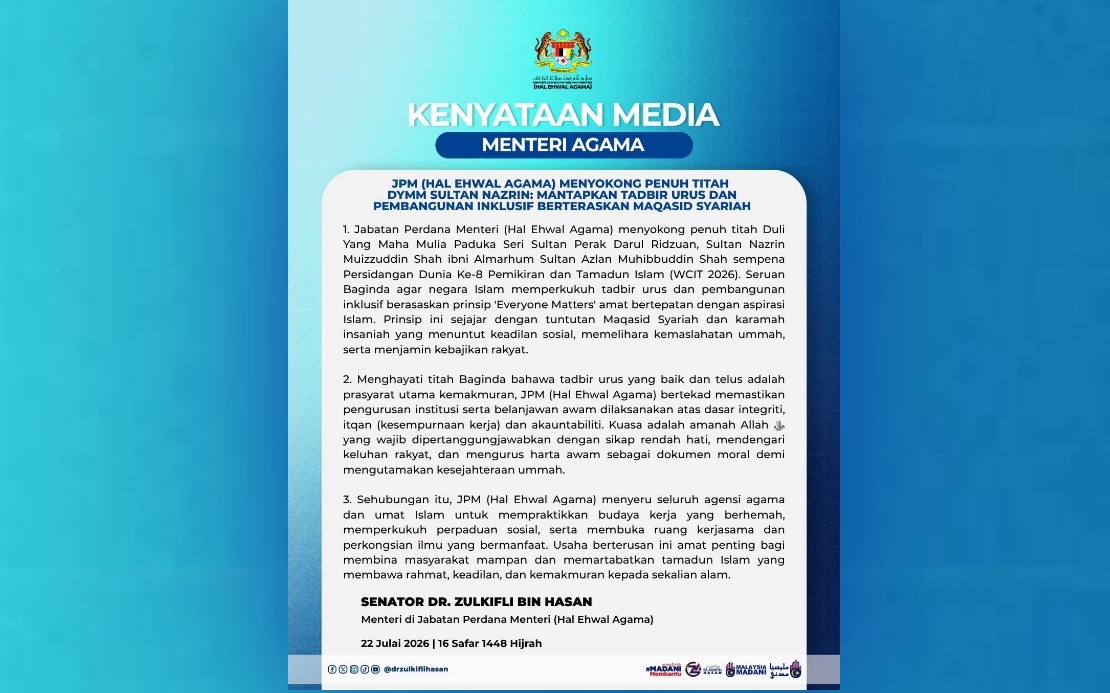
Malaysia's approach to religious governance is being recalibrated around Sultan Nazrin Shah's call for Muslim-majority nations to adopt inclusive development models that serve all citizens regardless of faith or political affiliation. Speaking through the Prime Minister's Department (Religious Affairs), the government has signalled a commitment to translate the Perak Sultan's vision into institutional practice, moving beyond traditional administrative structures toward what officials describe as people-centred religious leadership.
The pivot centres on a principle articulated as "Everyone Matters"—a framework Sultan Nazrin presented at the 8th World Conference on Islamic Thought and Civilisation. His Royal Highness argued that public institutions reflecting national unity and responsive leadership form the bedrock of sustainable prosperity. For Malaysia, a multi-religious federation navigating complex social cohesion challenges, this positioning carries particular weight. The Sultan's emphasis on leaders who listen before legislating speaks implicitly to concerns about governance legitimacy and public trust, issues that resonate across Southeast Asian democracies grappling with institutional credibility.
Minister in the Prime Minister's Department (Religious Affairs) Dr Zulkifli Hasan has positioned this governance framework as philosophically rooted in Islamic jurisprudence rather than imported from secular governance theory. He argues the principle aligns with Maqasid Syariah—the foundational objectives of Islamic law concerned with protecting faith, life, intellect, lineage and property—and karamah insaniah, the Islamic concept of inherent human dignity. This theological grounding matters strategically: by anchoring governance reform within Islamic scholarly tradition, Malaysian officials avoid framing institutional accountability as Western imposition, a politically sensitive distinction in Muslim-majority contexts where governance innovation can trigger resistance if perceived as externally driven.
The integration of inclusive development into religious institutional management addresses a particular Malaysian context. The country's religious affairs bureaucracy operates within a federal structure where Islam receives constitutional prominence, yet the nation remains diverse and pluralistic. The "Everyone Matters" framing acknowledges this tension by suggesting religious institutions must serve not only Muslim citizens but contribute to broader national cohesion. This reflects growing regional recognition that religious governance divorced from inclusive principles can destabilize societies, a lesson other Southeast Asian nations have absorbed from periods of religious polarization.
Dr Zulkifli's emphasis on integrity and accountability in public budgeting carries fiscal and moral dimensions. Religious institutions in Malaysia manage substantial resources through various endowment systems, zakat collections and state allocations. Framing these funds as trusts requiring humble stewardship rather than instruments of institutional power represents a conceptual shift toward transparency. The minister's invocation of itqan—excellence in work—alongside integrity suggests quality service delivery becomes a religious obligation, not merely administrative procedure, potentially raising performance expectations across religious agencies.
Sultan Nazrin's observation that no nation can isolate itself from global economic and technological flows provides context for why Malaysia's religious governance is adopting more inclusive frameworks. The Sultan acknowledged that development requires openness to trade, investment and knowledge exchange—realities that demand institutional structures capable of engaging diverse stakeholders. For Malaysia particularly, which hosts significant Chinese and Indian populations alongside Muslim-majority demographics, and functions as a regional hub for Islamic finance and thought, governance models that bridge rather than divide communities offer competitive advantage in attracting investment and talent.
The call for religious agencies to embrace courteous workplace culture and strengthen social collaboration signals awareness that institutional behaviour shapes public perception of Islam itself. In plural societies, how religious bureaucracies interact with citizens of other faiths becomes a proxy for national religious tolerance. Malaysia's positioning here contrasts with approaches in some neighbouring jurisdictions where religious institutions operate through more hierarchical, closed frameworks. By explicitly promoting collaborative knowledge-sharing and civil engagement, the ministry projects an Islam compatible with democratic participation and social pluralism.
For Southeast Asian observers, this Malaysian development carries broader significance. The region contains multiple Muslim-majority and Muslim-minority nations negotiating the relationship between religious identity and inclusive governance. Indonesia, the world's largest Muslim democracy, has grappled with similar tensions between religious institutional autonomy and pluralistic citizenship. Thailand, with its Buddhist-majority framework, faces comparable questions about religious governance legitimacy. Malaysia's explicit adoption of "Everyone Matters" as an organizing principle for religious institutions offers a template suggesting inclusive governance need not compromise religious authenticity or institutional independence.
Implementing these principles operationally presents challenges beyond rhetorical commitment. Religious institutions across the region often function with limited transparency regarding funding and decision-making. Translating accountability language into concrete reforms—published budgets, community consultation mechanisms, independent oversight—requires sustained political will and potentially difficult conversations with established religious hierarchies protective of traditional prerogatives. Whether Malaysia's religious affairs ministry can navigate these institutional tensions while maintaining both religious credibility and public trust remains the substantive test of these governance aspirations.
The timing reflects broader regional currents. Post-pandemic, Southeast Asian governments across religious and political spectrums recognize that institutional legitimacy depends on demonstrable responsiveness to citizen welfare. Religious institutions that appear disconnected from public concerns face erosion of influence, while those successfully positioning themselves as community stewards strengthen their social role. Malaysia's embrace of Sultan Nazrin's principles positions the country as attempting to model how religious governance can serve modern, diverse societies while remaining grounded in Islamic scholarly tradition—a balance many Muslim-majority nations aspire toward but few have clearly articulated as formal policy.

