Malaysia's communications and multimedia sector has entered a critical juncture as the country grapples with regulating an increasingly complex digital landscape. The International Regulatory Conference (IRC) 2026, which began in Kuala Lumpur on July 21, represents a pivotal moment in that journey—a gathering designed to help establish Malaysia's position as a thoughtful regulator navigating the intersection of technological innovation, consumer protection, and economic growth. The two-day symposium, organized by the Malaysian Communications and Multimedia Commission (MCMC) under the banner 'Shaping the Next Digital Era: Regulation, Resilience and Trust', brings together regulators, policymakers, and technology leaders from across Southeast Asia and beyond to tackle the most pressing challenges facing the digital economy today.
Communications Minister Datuk Seri Fahmi Fadzil is overseeing the conference's opening proceedings, signalling the government's commitment to this regulatory agenda. The decision to position MCMC at the forefront of these discussions underscores how seriously Malaysia takes its evolving role as a digital economy participant. The conference serves multiple purposes simultaneously: it functions as a platform for Malaysia to showcase its regulatory thinking to international peers, while also allowing the country to learn from global best practices and benchmark its approach against other nations grappling with similar challenges.
The opening session tackled one of the most urgent concerns facing digital platforms today: child safety and platform accountability. Titled 'Online Safety by Design: Platform Accountability and Child Protection in an Age of User Vulnerability', this dialogue brought together Dr Farah Nini Dusuki from the Human Rights Commission of Malaysia (SUHAKAM), Saskia Blume from the United Nations Children's Fund (UNICEF) Malaysia, and Australian High Commissioner Danielle Heinecke. The presence of international child protection experts signals that Malaysia recognizes online safety as a shared regional and global responsibility rather than an isolated national concern. The discussion focused on how digital platform design itself can embed protective mechanisms, rather than relying solely on reactive enforcement after harm occurs.
Another substantive session examined the delicate question of data sovereignty and consumer privacy as Malaysia accelerates its digital transformation. Featuring voices from telecommunications companies like Maxis and technology consultants including Ericsson, this panel explored how Malaysia can balance its ambition to build a competitive digital economy with the imperative to protect citizen data and privacy rights. This tension—between economic openness and data protectionism—has become a defining feature of Southeast Asian digital policy, and Malaysia's approach could influence how the region structures its data governance frameworks.
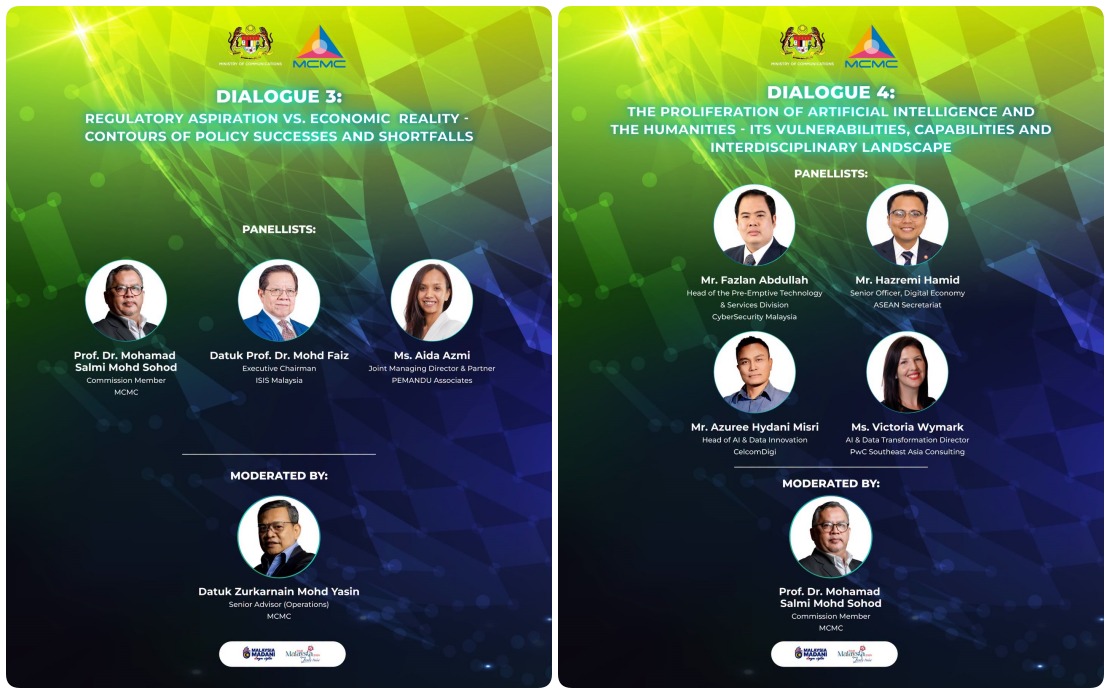
The conference also addressed a fundamental challenge facing all regulators: how to create effective rules without stifling the innovation that drives economic growth. A session exploring regulatory successes and failures brought together think tanks including the Institute of Strategic & International Studies (ISIS) Malaysia and PEMANDU Associates, attempting to extract lessons from both domestic and international regulatory efforts. This reflects a growing sophistication in how policymakers approach regulation—moving away from purely prescriptive approaches toward more evidence-based, iterative frameworks that can adapt as technologies evolve.
Artificial intelligence emerged as a central concern throughout the conference's programming. One session specifically examined AI's societal implications through a deliberately interdisciplinary lens, bringing together experts from the ASEAN Secretariat, academic institutions like Universiti Kebangsaan Malaysia (UKM), and major technology firms. This approach acknowledges that AI regulation cannot be purely technical; it requires input from humanities scholars, social scientists, and ethicists alongside engineers and computer scientists. The recognition of AI's vulnerabilities and capabilities as requiring multifaceted analysis reflects the maturation of regulatory thinking around emerging technologies.
The conference's second day pivoted toward future-frontier technologies that are beginning to enter the mainstream regulatory consciousness. Quantum technology, increasingly discussed in cybersecurity circles as a potential both disruptor and solution, featured prominently, with IBM Quantum representatives and Malaysian university partners exploring how regulators might approach this emerging field. The inclusion of robotics regulation and discussions around digital dependency demonstrates the breadth of Malaysia's regulatory ambitions—the country is not simply reacting to current technological challenges but attempting to anticipate and shape how emerging technologies will be governed before they become widespread.
The IRC 2026 represents the third iteration of this conference since its inception in 2024, reflecting how quickly Malaysia's regulatory framework has begun institutionalizing international dialogue. The timing is particularly significant because it coincides with Malaysia's implementation of the Online Safety Act 2025 (ONSA), which entered force on January 1, 2025. This legislation represents Malaysia's most comprehensive attempt to establish a coherent online safety regime, and IRC 2026 provides a forum for testing how that legislation is performing while building international consensus around regulatory approaches.
The diversity of participants attending—drawn from over seven countries and spanning regulators, corporate leaders, and civil society—illustrates how Malaysia has positioned itself within regional and global regulatory networks. This is not an inward-looking exercise but rather Malaysia actively shaping conversations about how the digital world should be governed. The presence of multilateral organizations like UNICEF and the ASEAN Secretariat reflects Malaysia's understanding that digital governance challenges transcend national borders and require coordinated regional responses.
For Malaysian businesses operating in the digital space, this conference signals important strategic information about the regulatory environment in which they operate. The topics being debated—data sovereignty, consumer protection, child safety, platform accountability—will likely inform future policy refinements. Companies engaged in cloud services, telecommunications, cybersecurity, and emerging technologies are essentially watching how Malaysian regulators are thinking about their sectors' futures. The involvement of companies like CelcomDigi, Maxis, and others suggests that Malaysia's approach is being calibrated with industry input, though balancing commercial interests against public protection remains an ongoing negotiation.
Deputy Communications Minister Teo Nie Ching will formally conclude the conference on the second day, with her closing remarks likely to signal the government's takeaways and potential next steps for regulatory evolution. The government's decision to maintain high-level ministerial involvement throughout suggests this conference is not merely a technical exercise but rather a significant policy-setting occasion. The outcomes—in terms of recommendations, policy insights, and international coordination mechanisms—will likely ripple through Malaysia's regulatory agencies for months to come. This conference represents Malaysia's determination to govern its digital future actively rather than passively accepting global technological trajectories.

