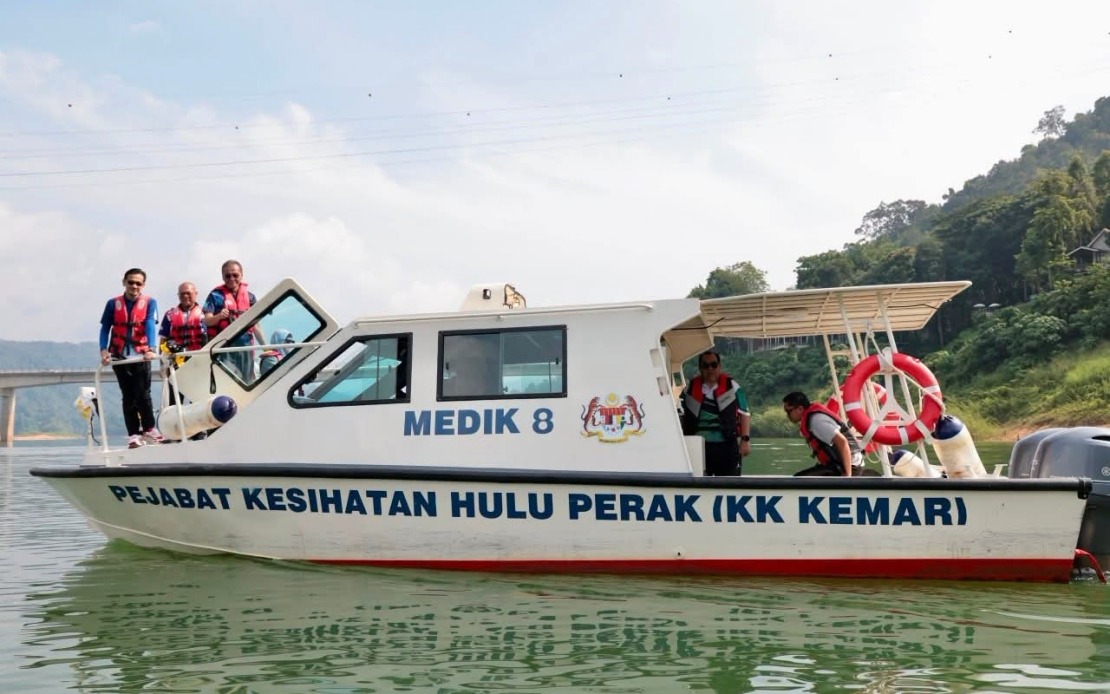
The Ministry of Health has expanded its medical transportation fleet in Hulu Perak with the introduction of Medic Boat 8, a RM350,000 multipurpose vessel designed to enhance healthcare accessibility for indigenous communities dependent on river networks for daily mobility. The 12-passenger boat represents a significant infrastructure investment aimed at reducing critical response times for emergency medical cases across the Kemar Resettlement Scheme in Gerik, where over 4,500 Orang Asli residents have historically faced substantial barriers to timely medical intervention.
Health Minister Datuk Seri Dr Dzulkefly Ahmad launched the service at Belum Rainforest Resort jetty during a working visit to the region, emphasizing that technological and material assets gain genuine value only through the commitment and expertise of frontline healthcare workers. The minister acknowledged that sophisticated equipment becomes meaningful only when coupled with dedicated personnel willing to navigate challenging river conditions and unpredictable weather patterns to deliver care. His remarks reflected a recognition that infrastructure alone cannot bridge the gap between policy intentions and ground-level service delivery in Malaysia's most remote communities.
The addition of Medic Boat 8 augments the MOH's existing fleet of six vessels operating in the region, thereby expanding the geographical coverage and reducing response latency for medical emergencies. Waterways represent the primary transportation corridor for indigenous settlements in Hulu Perak's interior, making water-based medical services not merely convenient but essential infrastructure. The previous six-boat fleet, while valuable, has operated at capacity limits that occasionally created delays during concurrent emergency situations or routine medical outreach activities. The new vessel addresses these operational constraints by providing redundancy and expanded service hours.
The strategic deployment reflects broader policy alignment with Malaysia MADANI's healthcare equity principles, which position universal access to quality medical services as a fundamental entitlement rather than a privilege dependent on geographical proximity to urban centres. This philosophical framing has concrete implications for resource allocation, requiring the government to invest in specialized transport solutions for communities where conventional ambulance networks prove impractical or impossible. The Hulu Perak initiative demonstrates how the framework translates into actionable projects targeting specific vulnerable populations facing documented healthcare access disparities.
Orang Asli communities in the Kemar Resettlement Scheme have traditionally experienced longer delays between symptom onset and medical assessment compared to urban populations, with implications for treatment outcomes in acute conditions. The challenging terrain and monsoon-dependent river systems create seasonal variations in accessibility, with certain months restricting safe waterway navigation. Emergency obstetric complications, acute infections, and trauma cases have previously required extended transport times that potentially compromised clinical outcomes. The additional boat capacity addresses these historical patterns by distributing demand across a larger fleet, thereby smoothing service delivery across seasonal fluctuations.
The minister's recognition of healthcare worker dedication underscores an often-overlooked dimension of rural health service provision in Southeast Asia. Medical personnel operating these boat services routinely encounter working conditions that extend far beyond standard occupational expectations, including exposure to unpredictable river conditions, isolation from peer professional networks, and limited backup support during emergencies. Doctors, nurses, and boat operators working in these settings frequently demonstrate exceptional commitment driven by professional ethics rather than material incentives. Their continued willingness to serve remote communities despite inherent risks represents a form of social capital that no boat purchase can generate independently.
The RM350,000 investment reflects proportionate resource commitment for a population segment comprising less than one percent of Malaysia's total population yet facing healthcare inequities disproportionate to their demographic size. Budget allocations for indigenous health initiatives remain substantially smaller than per-capita expenditures for urban medical infrastructure, yet the absolute investment in Medic Boat 8 signals genuine policy priority for equity-oriented healthcare development. The figure also encompasses not merely vessel acquisition but operational training, maintenance protocols, and integration into the broader MOH logistics network.
Geographically, Hulu Perak presents one of Malaysia's most complex healthcare delivery environments, combining rugged terrain, dense rainforest, river-dependent settlements, and limited road infrastructure that makes conventional ambulance services functionally impossible in many locations. The Belum-Temengor region encompasses some of Malaysia's last remaining primary tropical rainforest, constraining development options and perpetuating waterway dependence. Previous health interventions in this region often encountered structural barriers requiring creative adaptation of standard urban-based protocols. The boat service innovation demonstrates how constraint-driven problem-solving can yield solutions specifically calibrated to local environmental realities.
For Southeast Asian healthcare systems more broadly, Malaysia's Hulu Perak initiative offers a comparative policy model relevant to other nations serving indigenous or riverine populations across the region. Thailand, Laos, and Cambodia similarly maintain communities for which waterway transport represents the primary access route, yet medical boat services remain underdeveloped or absent in many jurisdictions. Malaysia's documentation and scaling of this model potentially provides replicable frameworks for regional peers seeking to improve service delivery within fiscal constraints and geographical constraints.
The broader implications for indigenous health equity in Malaysia extend beyond transportation logistics to questions of health literacy, culturally appropriate service delivery, and integration of traditional health knowledge with biomedical systems. While boat access represents a prerequisite for healthcare engagement, it does not automatically translate into health-seeking behavior or treatment adherence among populations with different health conceptualizations and traditional healing practices. Successful health interventions in Orang Asli communities typically require concurrent attention to social determinants, community engagement strategies, and culturally competent clinical approaches alongside infrastructure improvements.
Operational sustainability emerges as a critical consideration for long-term success of the expanded boat fleet. Maintenance costs, fuel expenses, personnel compensation, and seasonal vessel deployment require reliable budget allocation across multiple fiscal years. Government health systems across the region frequently encounter challenges sustaining specialized infrastructure once initial donor funding or political attention diminishes. The MOH's commitment to integrating Medic Boat 8 into permanent operational structures rather than treating it as a pilot project will determine whether the initiative generates lasting health improvements or becomes another underutilized asset within months of launch.
Looking forward, the Medic Boat 8 deployment should incorporate systematic monitoring of health outcomes, response times, and service utilization patterns to generate evidence regarding effectiveness and identify optimization opportunities. Comparative analysis of pre- and post-implementation health indicators across the Kemar Resettlement Scheme would provide valuable data for policy evaluation and regional replication. Such documentation would transform this initiative from an isolated infrastructure project into a documented practice case contributing to evidence-based health systems development.

