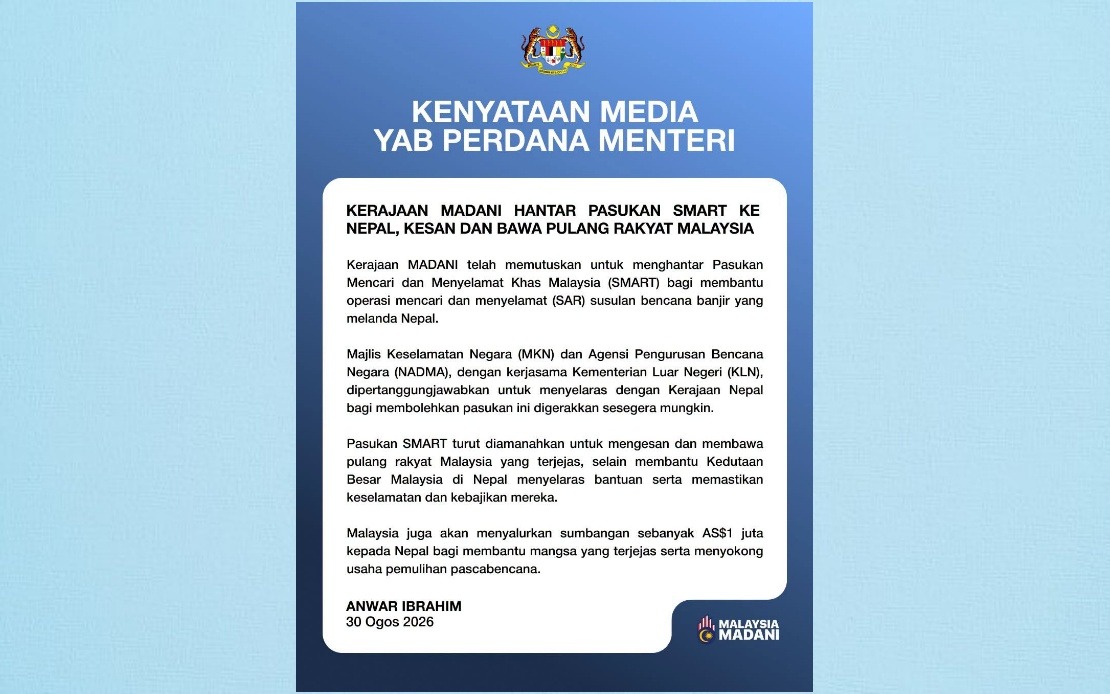
Malaysia has activated its emergency disaster response machinery to assist Nepal in the aftermath of devastating floods and landslides that struck the Himalayan nation this week, with Prime Minister Datuk Seri Anwar Ibrahim announcing the immediate deployment of the Special Malaysian Disaster Assistance and Rescue Team (SMART) and a financial contribution of US$1 million to support relief and recovery operations.
The decision reflects the Malaysian government's commitment to regional humanitarian cooperation and its responsibility to protect its citizens abroad during natural disasters. Nepal experienced severe flash floods and catastrophic landslides in Rasuwa district on August 26, an event that has triggered regional alarm bells given the mountainous terrain's vulnerability to weather-related disasters and the significant Malaysian expatriate community in the country.
According to statements from the Foreign Ministry, 55 Malaysian nationals remain uncontactable in the aftermath of the disaster, raising significant concern about their safety and prompting the need for coordinated search and rescue efforts. These missing individuals represent a range of Malaysian citizens—tourists, expatriate workers, students, and business people—scattered across affected areas, making the task of locating and assisting them a complex logistical challenge.
The deployment of SMART represents Malaysia's most direct intervention tool in foreign disaster scenarios. The team, which specialises in search and rescue operations in challenging environments, has been tasked with three interconnected missions: conducting active rescue operations to locate survivors, identifying and bringing home Malaysians affected by the flooding, and working with the Malaysian Embassy in Nepal to coordinate broader humanitarian assistance efforts and ensure the welfare of surviving nationals.
Coordination between multiple Malaysian government agencies underscores the gravity with which authorities are treating the situation. The National Security Council and the National Disaster Management Agency are collaborating with the Foreign Ministry to liaise with Nepalese authorities, a necessary step given that cross-border disaster response requires host country permission, infrastructure access, and operational coordination. This bureaucratic framework, while essential, also highlights the time-sensitive nature of rescue operations where delays in coordination can have tragic consequences.
The US$1 million financial pledge addresses the immediate and medium-term humanitarian needs of Nepal's affected population. This contribution targets both emergency response—medical care, shelter, food provisions—and the longer-term post-disaster recovery infrastructure that communities require to rebuild. For a developing country like Nepal, already grappling with limited disaster management resources and a significant rural population vulnerable to natural hazards, foreign assistance proves crucial in bridging gaps between immediate needs and recovery capacity.
The incident underscores a growing reality for Southeast Asian nations: cross-border disaster impacts are becoming more frequent and severe, requiring governments to maintain operational readiness for international rescue missions. Malaysia's proactive stance sets a precedent within the region and reflects both humanitarian values and strategic pragmatism—maintaining strong ties with neighbouring countries during crises builds diplomatic goodwill and regional stability.
For Malaysian citizens and their families, the deployment of SMART provides tangible reassurance that the government is mobilising resources to ensure their safety. The team's mandate to prioritise locating and returning affected Malaysians demonstrates that consular obligations extend beyond paperwork to active rescue operations when citizens face extreme circumstances abroad.
Nepal's mountainous geography and monsoon season create recurring natural disaster vulnerabilities that international aid networks have repeatedly confronted. The Rasuwa district, located in the central Himalayas north of Kathmandu, is particularly susceptible to flash flooding and landslides during heavy rainfall, making it a frequent site of seasonal disasters. The August 26 event that caught so many Malaysians unaware reflects the unpredictability of such events despite seasonal patterns.
Malaysia's dual-track response—deploying specialist personnel while providing financial support—reflects international best practice in humanitarian assistance. While SMART provides immediate operational capacity and demonstrates direct governmental commitment, the monetary contribution addresses systemic recovery needs that single rescue teams cannot resolve. This combined approach maximises Malaysia's ability to help both its own nationals and Nepal's broader population.
The regional implications extend beyond bilateral relations. Countries across Southeast Asia with significant citizens in Nepal, Bhutan, and other high-risk disaster zones are likely observing Malaysia's response model. The readiness to deploy SMART internationally signals that Malaysian governments take extraterritorial citizen protection seriously, which may influence both emergency preparedness discussions at regional forums and individual decisions about travel and relocation to high-risk areas.
In the coming days, the focus will shift to operational updates on SMART's activities, the status of missing Malaysians, and coordination outcomes between Malaysian and Nepalese authorities. The success of this deployment will be measured not only in lives saved and nationals recovered but also in how effectively Malaysia contributes to Nepal's broader disaster response and reconstruction efforts.

