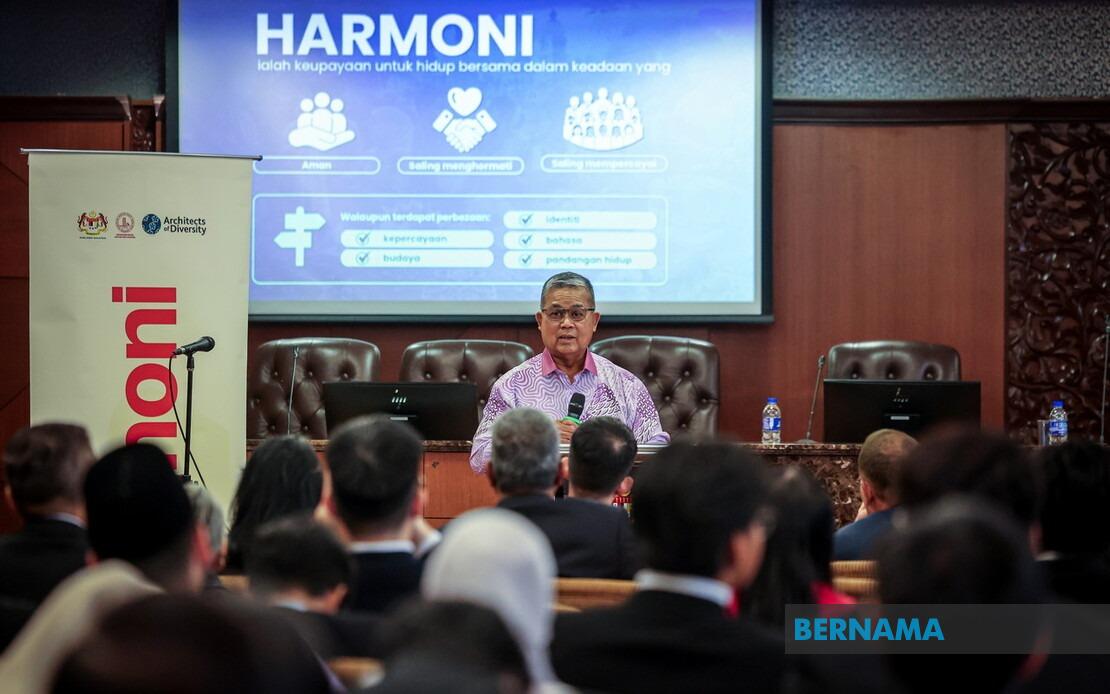
The Department of National Unity and National Integration (JPNIN) has initiated a comprehensive research programme to construct a Community Tension Index that will quantify levels of social cohesion across Malaysia and provide systematic monitoring of matters touching on racial, religious and royalty sensitivities. Minister of National Unity Datuk Aaron Ago Dagang unveiled the undertaking while addressing the 2026 Harmony Symposium, organised by the Secretariat of the Malaysian Parliamentary Cross-Party Group on Racial and Religious Harmony at Parliament Building here today, positioning the research as a timely response to evolving threats to national unity.
The development of this index represents a methodological shift in how the government approaches the measurement and early detection of communal tensions. Rather than relying solely on anecdotal reports or reactive crisis management, JPNIN aims to establish quantifiable benchmarks that capture the pulse of inter-community relations across the country. The resulting data architecture will enable policymakers to identify emerging friction points before they escalate into larger social conflicts, allowing for preventive intervention rather than damage control after tensions have crystallised into public disputes.
According to Aaron, the findings generated by this index will serve as a foundational strategic reference point guiding the government's approach to formulating early intervention programmes and crafting nuanced responses to delicate issues within Malaysia's pluralistic society. This framework becomes particularly valuable in a nation where religious affiliation, ethnic composition and respect for constitutional institutions intersect in ways that demand sophisticated, evidence-based policy approaches. The index promises to replace intuition-driven governance with data-informed decision-making when addressing matters that carry high emotional resonance across different communities.
A critical catalyst for this initiative is the documented surge in online threats to national harmony. Between January 1, 2025 and January 31, 2026, the Malaysian Communications and Multimedia Commission (MCMC) took enforcement action to remove 1,493 pieces of digital content linked to religion, royalty and race concerns. These figures underscore the substantial volume of problematic material circulating through digital channels and highlight the degree to which the traditional boundaries of community tensions have expanded into the virtual realm, where speed of dissemination and algorithmic amplification magnify potential damage.
The migration of divisive discourse to social media platforms introduces structural complications that distinguish contemporary challenges from earlier patterns of communal tension. As Aaron noted, social media algorithms routinely engineer "filter bubbles" and "echo chambers" that reinforce existing viewpoints while systematically excluding contrary perspectives. This technological architecture narrows opportunities for genuine dialogue, compresses the intellectual space available for nuanced discussion and incrementally widens the comprehension gaps separating different demographic groups. What emerges is a landscape where communities increasingly inhabit separate informational universes, each furnished with algorithmic reinforcement of pre-existing beliefs and suspicions about other groups.
The polarisation dynamics unleashed by algorithmic content curation pose challenges that regulatory mechanisms alone cannot adequately address. While MCMC's content removal efforts tackle the symptom of inflammatory material, they do not address the underlying technological incentives that promote divisive content in the first place. This recognition appears to have influenced JPNIN's broader strategic thinking, driving the department toward establishing institutional mechanisms capable of addressing deeper fractures in social understanding rather than merely suppressing their most visible manifestations.
In parallel with the Community Tension Index initiative, JPNIN has been conducting extensive consultation sessions with diverse stakeholders to gather preliminary feedback regarding a proposed National Harmony Commission (SKN). This prospective institutional body would function as a dedicated mechanism for early prevention of conflicts, mediation between aggrieved parties and structured conflict resolution processes that emphasise harmony and constructive engagement. The commission would also carry investigative authority over matters suspected of jeopardising national cohesion, positioning it as both a preventive institution and a fact-finding body with enforcement implications.
The establishment of such a commission would represent Malaysia's most substantial institutional commitment to proactive harmony management in recent years. Rather than responding to crises through ad hoc ministerial intervention or emergency proclamations, a dedicated commission would embed harmony preservation into the machinery of government as a permanent function. This approach echoes successful models deployed in other plural societies that have institutionalised inter-community dialogue and conflict prevention, recognising that social cohesion requires continuous institutional attention rather than episodic government action.
For Malaysian stakeholders invested in national unity, these initiatives signal a recognition that the threats facing social harmony have both multiplied in number and transformed in character. The shift toward digital spaces means that regional sensitivities can be activated and amplified with unprecedented speed, requiring government capacity to monitor, understand and respond at a pace that matches technological dynamics. The combination of the Community Tension Index and the proposed National Harmony Commission suggests an integrated approach combining measurement with institutional response mechanisms.
The timing of these developments also reflects awareness within the government that Malaysia's demographic composition and constitutional provisions create unique vulnerabilities. The Federal Constitution's recognition of Islam's position, the special status of the Malay and Bumiputera communities, and the guarantees accorded to non-Muslim minorities create a delicate constitutional balance that requires deliberate stewardship. As Malaysia becomes more digitally integrated and as global movements around religious identity, minority rights and national sovereignty gain increasing online resonance, maintaining the constitutional bargain underlying Malaysian unity demands increasingly sophisticated policy instruments.
For the broader Southeast Asian region, Malaysia's investment in measuring social cohesion and establishing harmony institutions carries broader implications. Neighbouring countries facing similar pluralistic challenges and comparable exposure to algorithmic polarisation may perceive Malaysia's methodological innovations as potential models worth studying. The Community Tension Index framework, if successfully operationalised, could offer templates applicable to regional contexts struggling to maintain unity amid rapid digitalisation and global information flows that destabilise local consensus.

