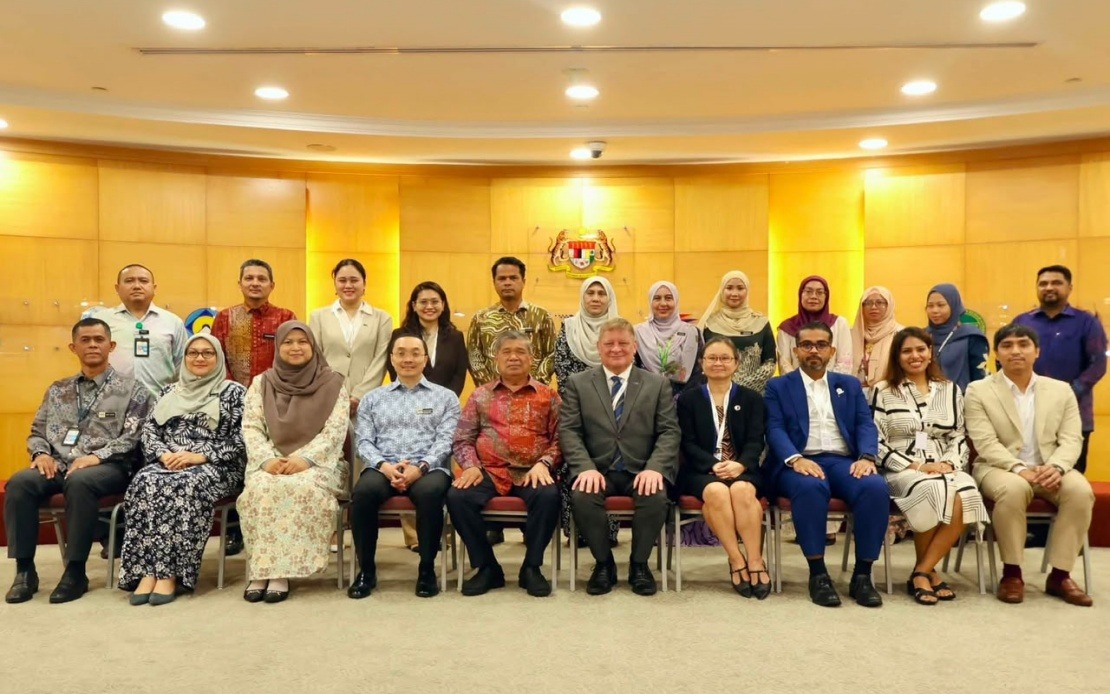
Malaysia is deepening its agricultural partnership with the European Union, signalling a strategic pivot towards technology-driven farming and modernised food systems. During a meeting yesterday at Wisma Tani in Putrajaya, Minister of Agriculture and Food Security Datuk Seri Mohamad Sabu engaged with Chris Humphrey, executive director of the EU-ASEAN Business Council (EU-ABC), and his delegation on a range of initiatives aimed at transforming the nation's agri-food landscape.
The conversation centred on the rollout of Malaysia's National Agro-Food Policy 2.0 (DAN 2.0), a comprehensive framework designed to fortify domestic food security whilst accelerating the adoption of advanced farming technologies and artificial intelligence across the sector. The emphasis on DAN 2.0 reflects growing recognition within Malaysia's agricultural establishment that traditional farming methods alone cannot sustain the nation's food production needs in an era of climate volatility and supply chain disruptions. By integrating AI-powered systems—from precision irrigation to predictive pest management—Malaysia aims to boost yields and efficiency while reducing environmental pressure.
Beyond policy frameworks, the discussions examined ways to reinforce Malaysia's dairy industry through more robust local supply chains. The dairy sector holds particular importance for Southeast Asia, as regional demand for dairy products continues climbing with rising incomes and urbanisation. Currently, Malaysia imports substantial quantities of dairy products, creating both a trade deficit and supply vulnerability. Strengthening upstream and downstream linkages—from feed production to cold-chain logistics—could help reduce reliance on imports and enhance food sovereignty, issues increasingly salient given recent global supply disruptions.
Animal health standards and biosecurity protocols also featured prominently in the agenda, underscoring Malaysia's commitment to meeting international benchmarks. As agricultural trade becomes more stringent regarding health certifications, upgrading these frameworks is essential for Malaysian producers seeking access to premium markets, particularly within the EU itself. The EU's own high standards for animal welfare and disease prevention make this convergence mutually beneficial, allowing Malaysian exporters to compete more effectively in European markets whilst assuring consumers of quality and safety.
Minister Mohamad characterised the EU as one of Malaysia's most valuable partners in this agricultural transformation, recognising both the bloc's technological prowess and its regulatory expertise. The EU has pioneered sustainable intensification—producing more food with fewer inputs whilst minimising environmental harm—making European knowledge transfer invaluable for a tropical nation facing climate pressures. From drone technology to soil analytics platforms, European firms possess innovations that Malaysian enterprises could adapt and deploy across different agroecological zones.
The Minister articulated clear expectations for European companies, requesting they bolster Malaysia and ASEAN's farmer capacity through training programmes focused on international quality standards and Sanitary and Phytosanitary (SPS) measures—the technical rules governing agricultural trade. Many small Malaysian farmers struggle with SPS compliance, limiting their export opportunities. Partnership programmes could bridge this gap, equipping producers with knowledge to meet export specifications and unlock markets in high-value segments. Similarly, assistance in identifying and accessing new markets would help Malaysian agri-products command premium prices internationally.
Significantly, both parties reaffirmed their backing for the ongoing Malaysia-European Union Free Trade Agreement (MEUFTA) negotiations, a bilateral accord that could liberalise agricultural trade and investment flows between Malaysia and the EU. A comprehensive FTA would remove tariff barriers on agricultural goods, potentially opening vast European markets to Malaysian producers of rubber, palm oil derivatives, cocoa, and processed foods. Conversely, EU firms would gain more predictable access to Malaysia's growing consumer market. Such an agreement would provide the institutional framework within which today's technical cooperation can flourish.
The Ministry of Agriculture and Food Security called for intensified strategic alliances between EU corporations and Malaysian counterparts, particularly in agricultural technology development and supply-chain modernisation. Such partnerships would likely take the form of joint ventures, technology licensing agreements, and knowledge exchanges rather than mere trade. By working together, European and Malaysian enterprises can co-develop solutions tailored to tropical conditions and local market realities, rather than simply importing off-the-shelf European products.
Mohamad seized the opportunity to extend an invitation to the EU-ABC delegation to participate in the Agriculture, Horticulture and Agro-Tourism Exhibition (MAHA) 2026, scheduled to run from August 28 to September 6 at the Malaysia Agricultural Expo Park (MAEPS) in Serdang, Selangor. MAHA is Southeast Asia's largest agri-industry showcase, attracting tens of thousands of farmers, businesses, and policymakers annually. European exhibitors' presence would raise the conference's international profile, facilitate networking with Malaysian stakeholders, and demonstrate EU commitment to the region's agricultural future.
For Malaysia and ASEAN broadly, this engagement reflects a broader recalibration of agricultural strategy away from commodity reliance towards value-addition and sustainability. Climate risks, population growth, and resource constraints mean that conventional expansion is no longer viable; instead, productivity gains through technology and best-practice adoption have become imperative. EU partnerships offer a relatively low-cost pathway to access such innovations, especially crucial for a nation where agricultural wage pressures and land scarcity constrain conventional growth.
The convergence of interests also underscores shifting geopolitical dynamics in the Indo-Pacific. The EU, seeking to diversify supply sources and strengthen economic ties beyond traditional European markets, views ASEAN as strategically important. Malaysia, positioned at the intersection of major global trade routes and possessing substantial agricultural potential, represents an attractive partner. Deepening bilateral ties in agriculture aligns with Malaysia's broader diversification efforts and reinforces its standing as a reliable international partner in food security—an increasingly critical dimension of global stability.

