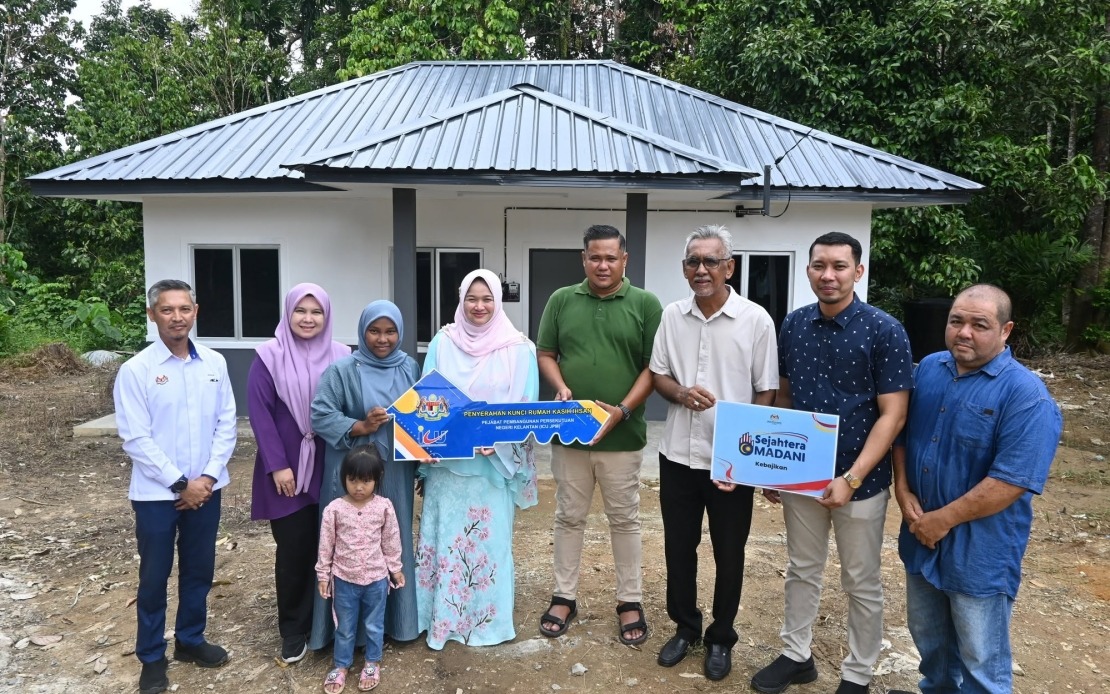
Malaysia's government has deepened its commitment to housing assistance by delivering two Rumah Kasih Ihsan homes to families in Jeli, Kelantan, reinforcing its broader agenda to lift vulnerable populations out of inadequate living conditions. The initiative represents a tangible effort to translate welfare rhetoric into concrete support that touches the lives of those struggling with substandard accommodation. Prime Minister Datuk Seri Anwar Ibrahim highlighted the milestone through a social media update, underscoring the administration's positioning of housing security as a cornerstone of national well-being strategy.
The programme was implemented through coordination between the Kelantan Implementation Coordination Unit operating under the Prime Minister's Department, alongside the PMX Coordination Team responsible for execution on the ground. Dr Wan Nur Ibtisam Wan Ismail, serving as director of Kelantan ICU JPM, officially transferred ownership of the homes during a ceremony that doubled as a public relations moment for the government's social welfare positioning. The dual handover in Kampung Renyut demonstrates how the administration is attempting to scale assistance across multiple beneficiaries simultaneously, though the modest numbers also highlight the gradual pace of such interventions.
Yusof Mohamed Nawawi, the first recipient, received formal documentation committing the government to construct an entirely new residence to replace his existing dwelling, which presumably fails to meet safety or comfort standards. This approach differs from the second case, where Shamsul Bahri Che Musa took possession of a completed property ready for immediate occupation. The variation in delivery timelines suggests the government maintains different tracks for implementation, adapting to individual circumstances while managing expectations around project completion horizons.
Beyond the residential structures themselves, both families received food baskets as symbolic gestures of state concern for their overall welfare. While such accompaniments might appear superficial, they serve as tangible markers of government attention during transitional moments when families relocate to new homes. The practice reflects a holistic conception of assistance that acknowledges immediate nutritional needs alongside longer-term housing security, though observers might question whether such provisions address systemic poverty rather than merely alleviating surface symptoms.
The Kelantan ICU JPM framed housing not merely as shelter but as a catalyst for broader human flourishing, arguing that adequate accommodation forms the foundation upon which families can build dignified, economically productive lives. This philosophical positioning attempts to justify the programme by connecting housing to downstream outcomes in health, education, and economic participation. The framing suggests that officials view housing poverty not in isolation but as interlinked with multiple deprivation dimensions that constrain opportunity and perpetuate intergenerational disadvantage.
Official commentary emphasized that genuine development should transcend physical infrastructure metrics to measure impact through direct benefits experienced by ordinary citizens. This rhetorical pivot acknowledges longstanding criticisms that development indices can mask persistent poverty and inequality even as headline growth statistics climb. By anchoring the programme narrative to lived experience rather than bureaucratic completion rates, the government attempts to redefine success criteria around human welfare rather than project throughput.
For Kelantan specifically, the initiative carries symbolic weight given the state's persistent struggles with poverty and infrastructure development compared to wealthier peninsular states. The concentration of Rumah Kasih Ihsan deployments in Kelantan reflects both genuine need and political calculation, as the state represents a competitive political landscape where welfare initiatives can influence electoral outcomes. Rural constituencies like Jeli typically lack the political leverage to demand services that urban centers take for granted, making targeted programmes one mechanism through which central government can assert presence and legitimacy in peripheral regions.
The programme also reflects broader Malaysian policy evolution toward directly addressing housing inadequacy as a poverty dimension. Unlike approaches that provide cash transfers or conditional assistance, housing programmes create fixed assets that theoretically persist across economic cycles and remain insulated from individual spending decisions. This preference for in-kind transfers over monetary support embodies particular assumptions about beneficiary behavior and government's appropriate role in determining how assistance manifests.
The expansion of Rumah Kasih Ihsan occurs within a broader Malaysian context where housing affordability and quality remain pressing concerns spanning income categories. While this particular initiative targets the most vulnerable, parallel challenges afflict young professionals and middle-income families struggling to access affordable housing in expanding urban centers. The government's differentiated approach—specialized programmes for the poorest alongside broader market interventions—reflects recognition that housing challenges operate across multiple socioeconomic tiers requiring distinct policy responses.
Sustainability questions inevitably accompany such initiatives, particularly regarding beneficiary selection processes, maintenance responsibilities, and whether similar cadence of handovers will continue across subsequent quarters. Government housing programmes often face criticism around transparent targeting criteria and equitable geographic distribution, concerns that Rumah Kasih Ihsan will require sustained scrutiny to address. Long-term programme success ultimately depends on consistent funding, effective local administration, and beneficiary support systems that extend beyond the initial handover ceremony to address inevitable challenges arising from relocation and settlement.
The initiative also intersects with Malaysia's commitment to sustainable development and regional cooperation frameworks that increasingly emphasize housing security as a human rights dimension. Within ASEAN contexts where multiple member states confront similar housing challenges for vulnerable populations, Malaysia's visible commitment to this agenda potentially positions the nation as a development model, though critics might argue that rhetorical emphasis often outpaces funding levels and implementation speed. Moving forward, scaling such programmes to reach Malaysia's estimated millions living in inadequate housing will require dramatically expanded resource commitments and institutional capacity beyond current deployment levels.

