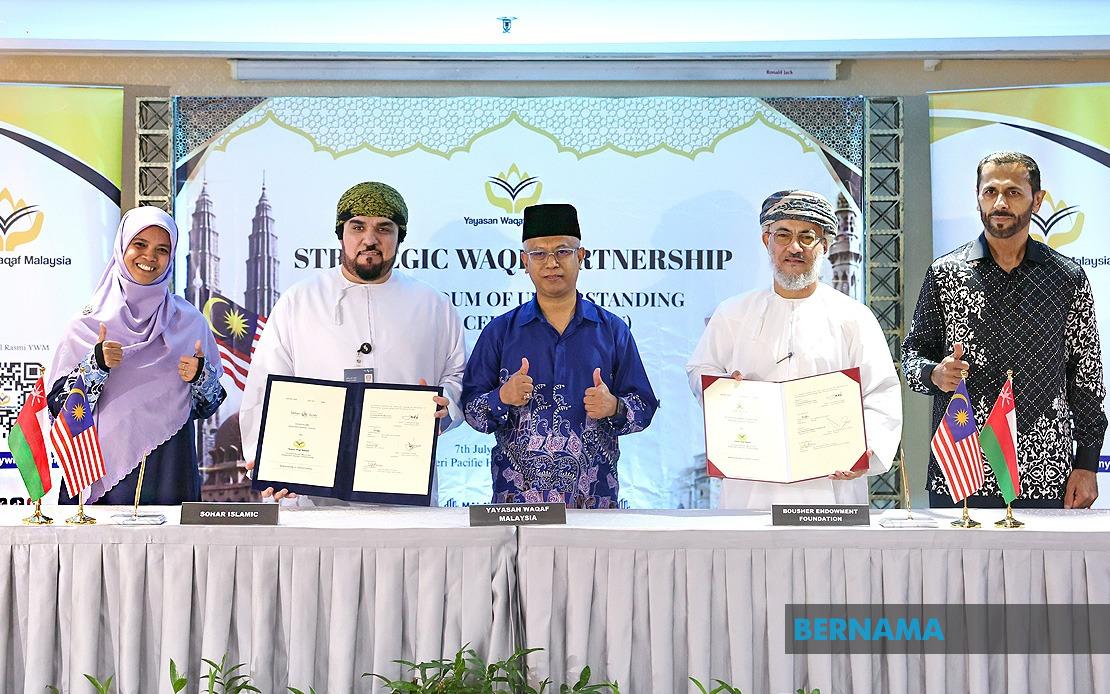
Malaysia is positioning itself as a centre of expertise in waqf development and Islamic social finance through a newly formalised collaboration with the Sultanate of Oman. The Malaysian Waqf Foundation (YWM) has entered into a memorandum of understanding with Sohar Islamic and the Boushar Endowment Foundation, creating a framework for knowledge exchange, technological innovation, and governance best practices in waqf management. The partnership signals growing international confidence in Malaysian models for structuring Islamic endowments and marks a strategic shift in how the country packages and exports its religious and financial expertise across the Muslim world.
The three-way MoU, signed in Kuala Lumpur on July 7, represents far more than a bilateral agreement between two countries. It embodies recognition of Malaysia's capability to develop sophisticated, scalable, and financially productive waqf systems that generate measurable community benefit. Rather than importing foreign expertise as is often the case, Malaysia is now the knowledge provider, a distinction that carries symbolic weight in positioning the country within the wider Islamic finance ecosystem. The arrangement highlights how decades of institutional investment in waqf governance and asset management have yielded frameworks that other nations view as worth adopting and adapting.
Deputy Minister in the Prime Minister's Department (Religious Affairs) Marhamah Rosli emphasised the accord's significance during the signing ceremony, framing the partnership as conferring international honour on Malaysia. She stressed that the bilateral arrangement transcends commercial transaction, instead reflecting Malaysia's ability to contribute meaningfully to broader Muslim community welfare and development. The collaboration demonstrates how religious affairs infrastructure, when managed professionally and innovatively, can become a source of soft power and regional leadership. For policymakers in Kuala Lumpur, the arrangement validates years of institutional building in the waqf sector and positions Malaysia as a thought leader rather than a follower in Islamic financial architecture.
A particularly notable element of the partnership involves the appointment of YWM chief executive officer Dr Ridzwan Bakar as Waqf Adviser to the Sultanate of Oman. This personal recognition of Malaysian expertise underscores that the partnership rests not merely on institutional frameworks but on demonstrated competence and proven track record. Ridzwan's advisory role signals that Omani authorities view Malaysian practitioners as capable guides in modernising waqf systems and maximising their economic and social impact. The precedent created here could serve as a template for similar advisory relationships across the Gulf Cooperation Council and wider Arab world, further elevating Malaysia's profile within Islamic finance circles.
The partnership emerged from active Malaysian outreach rather than passive receptiveness. Ridzwan revealed that YWM initiated engagement during visits to Oman in 2023 and 2024, approaching the process strategically to identify cooperation opportunities. This proactive approach proved successful, with Omani counterparts responding favourably to Malaysian proposals and subsequently inviting YWM representatives to serve as development advisers. The narrative of Malaysian initiative—rather than Oman seeking Malaysian assistance—emphasises agency and institutional confidence. It reflects a deliberate choice by YWM leadership to expand the foundation's international footprint by identifying jurisdictions where Malaysian expertise could add tangible value.
Beyond Oman, Malaysia is cultivating a broader waqf network spanning multiple Islamic finance centres. YWM is simultaneously developing partnerships with institutions in Kuwait, Qatar, and the United Arab Emirates, suggesting a coordinated strategy to establish Malaysia as the reference point for waqf innovation and development across the Gulf. This multi-country approach diversifies Malaysia's influence, prevents overreliance on any single market, and creates multiple channels through which Malaysian expertise and investment products can flow into the region. For Malaysian financial institutions, these relationships open pathways to channel capital into growth markets while building sustainable fee-generating advisory and investment relationships.
The collaboration promises material benefits to Malaysia's position as a hub for Islamic social finance. Ridzwan explicitly highlighted the potential to attract substantial strategic investments from Arab countries into Malaysia, leveraging waqf development partnerships as conduits for capital flow. This capital-raising strategy gains traction when combined with concrete investment products. YWM currently offers three investment vehicles through Kenanga Investors designed to channel international funds into Malaysia, providing international investors with regulatory clarity and professional asset management. As Arab investors increasingly seek exposure to Islamic finance jurisdictions, Malaysia's proven expertise in waqf systems and track record in generating returns positions it competitively against other aspiring financial hubs.
The economic philosophy underlying waqf development, as articulated by YWM leadership, emphasises patience and structured asset growth. Rather than viewing waqf as primarily charitable distribution mechanisms, the Malaysian approach prioritises building productive asset bases that generate returns enabling progressively broader community benefit. This framework enables waqf systems to support not only traditional beneficiary categories (asnaf) but increasingly extend assistance to households in the B40 and M40 income brackets facing economic stress. By strengthening asset bases first, waqf systems become engines for creating economic opportunity rather than merely alleviating poverty symptoms, embedding sustainability into social welfare architecture.
For Malaysian policymakers, the Oman collaboration carries strategic implications beyond immediate financial gain. It demonstrates that Malaysia's federal and state-level investments in waqf institutional development have generated internationally competitive capabilities. As countries worldwide grapple with funding social programmes amid fiscal constraints, Malaysia's experience in leveraging waqf systems offers valuable lessons. The country's willingness to share expertise and advise foreign governments strengthens its diplomatic relationships and creates goodwill within the broader Muslim world. This soft power dimension complements Malaysia's economic interests, positioning the country as a responsible steward of Islamic institutional knowledge.
The partnership also reflects evolving dynamics within Islamic finance. Traditional centres of Islamic banking expertise in the Gulf have not necessarily prioritised waqf development with the same intensity as Malaysia. By establishing itself as the preeminent waqf innovation hub, Malaysia occupies a differentiated position within regional finance architecture. This specialisation strategy allows Malaysia to avoid direct competition with established centres in conventional Islamic banking and takaful while creating distinctive competitive advantages in a rapidly expanding sector. As global interest in Islamic social finance accelerates, Malaysia's early investment in institutional capacity positions it to capture disproportionate share of advisory, training, and capital deployment opportunities.
The collaboration signals confidence that waqf-centred Islamic finance represents the future of social wealth creation within Muslim-majority economies. By formalising partnerships with credible Omani institutions and positioning Malaysian expertise as the reference standard, YWM and the Malaysian government are making a calculated bet on the sector's growth trajectory. For investors, development professionals, and policymakers watching these trends, the Oman partnership suggests that waqf-based models are transitioning from niche instruments to mainstream development approaches worthy of substantial international attention and capital allocation.

