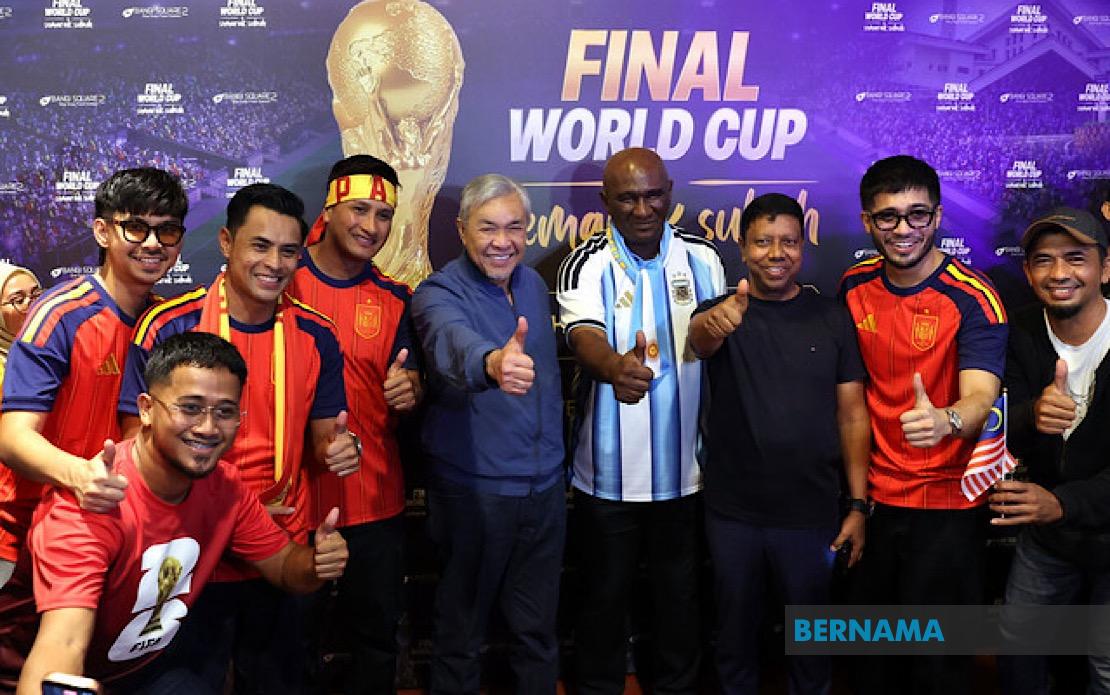
Malaysia harbours a significant sporting ambition: one day becoming the host nation for football's premier global competition. Deputy Prime Minister Datuk Seri Dr Ahmad Zahid Hamidi unveiled this long-term vision while attending a public screening of the World Cup final in Bangi, signalling the government's intent to elevate the country's status within international football. The declaration reflects broader efforts by Malaysia's leadership to position the nation as a serious contender in continental and global sporting events.
Ahmad Zahid, who also serves as Rural and Regional Development Minister, framed the World Cup hosting ambition alongside a parallel objective: ensuring that Malaysia's national squad competes at the tournament itself, serving as Southeast Asia's representative on football's grandest stage. His comments suggest that the government views football development not merely as a sporting pursuit but as an instrument of regional influence and national pride. The twin aspirations—hosting capacity and competitive participation—reveal an understanding that credible tournament hosting requires a competitive domestic team that can draw sustained public engagement.
The timing of Ahmad Zahid's remarks coincided with Malaysia's national football team, the Harimau Malaya, achieving modest progress in the latest FIFA world rankings. Climbing two positions to 136th globally, the squad accumulated 1,086.22 ranking points, reflecting gradual improvement within Southeast Asia's competitive landscape. While the absolute ranking remains relatively modest by global standards, the upward trajectory indicates that targeted investment and tactical development may be yielding results. For Malaysian football administrators, this incremental progress serves as validation that structured improvement plans can move the needle.
The deputy prime minister made his remarks during a vibrant public gathering at Bangi Square 2, where hundreds of football enthusiasts assembled to watch the Argentina versus Spain World Cup final on giant screens. The event transcended simple match viewing; it encompassed broader cultural programming designed to deepen public connection with football. By hosting such gatherings and participating directly, Ahmad Zahid demonstrated government commitment to nurturing grassroots enthusiasm—an essential foundation for any nation seriously considering World Cup hosting responsibilities.
Programming at the event featured interactions with Malaysian football heritage. Several legendary players from Malaysia's football history, including Datuk Zainal Abidin Hassan, Mohd Farizal Marlias, and Mohamad Zaquan Adha Abdul Radzak, participated in a discussion session that celebrated the nation's football tradition. These figures represent a generation when Malaysian football enjoyed greater continental prominence, and their presence symbolised continuity between past achievements and future aspirations. Such programming reinforces public memory of Malaysia's football capabilities while subtly messaging that championship-level performance remains within the realm of possibility.
The World Cup hosting aspiration carries substantial practical implications for Malaysia. Successful hosting requires world-class infrastructure, including multiple stadiums meeting international standards, accommodation facilities, transportation networks, and security arrangements. It demands significant capital investment and long-term planning. Yet for a middle-income nation in Southeast Asia, such undertakings have become increasingly viable, particularly when distributed across multiple cities. Regional precedent matters here; Indonesia's failed World Cup hosting bid and other Southeast Asian infrastructure developments demonstrate both the feasibility and the challenges inherent in major sporting events.
Malaysia's positioning within the broader FIFA and AFC frameworks shapes realistic timelines. Currently, the FIFA World Cup structure involves 32 teams, with expansion to 48 teams under discussion. Southeast Asia has never hosted the tournament, despite the region's substantial population and growing economic capacity. Competing bids from other Asian nations—including India's persistent interest and China's historical pursuit—suggest that Malaysia faces competition within its own continent. Differentiating Malaysia's bid through demonstrated football development at the domestic level thus becomes strategically important.
The Harimau Malaya's current trajectory, while positive, remains insufficient for competitive World Cup participation. Reaching the tournament itself would require dramatic improvements in player development, tactical sophistication, and international competition experience. Malaysia would need to establish sustainable football infrastructure that produces internationally competitive players consistently. This suggests that Ahmad Zahid's dual aspiration—hosting while competing—encompasses a multi-decade project requiring sustained investment across youth development, coaching education, and professional league quality enhancement.
Regional dynamics introduce additional context. Vietnam, Thailand, and Indonesia have invested heavily in football development with varying degrees of success. Southeast Asia's strongest teams currently compete respectably in Asian qualifiers but face steep obstacles in World Cup qualification. Malaysia's ability to differentiate itself depends on coherent long-term strategy rather than sporadic initiatives. The government's public articulation of World Cup ambitions serves partly as political messaging but also potentially as a framework for sustained resource allocation.
Ahmad Zahid's remarks reflect a calculation common among developing nations pursuing major sporting events: that tournament hosting generates infrastructure benefits, international attention, and potential economic returns justifying substantial upfront investment. Yet successful models typically combine hosting capacity with reasonable competitive teams, as demonstrated by Russia, Qatar, and other recent hosts. Malaysia faces the additional challenge of building both hosting readiness and competitive capability—a more demanding proposition than either objective pursued independently.
The deputy prime minister concluded his engagement by participating in the Semarak Subuh programme, a early-morning community gathering. This programmatic linkage between major international football and grassroots community activities demonstrates how government seeks to integrate sporting development into broader social programming. Such integration, if sustained across multiple initiatives, could create the foundation for genuine football culture transformation rather than episodic enthusiasm dependent on tournament moments.
Moving forward, Malaysia's World Cup ambition requires translation from political rhetoric into concrete institutional development. The government must establish clear timelines, funding mechanisms, and accountability structures for both hosting readiness and competitive team development. Success would position Malaysia as a leading Southeast Asian football nation while generating substantial infrastructure and economic benefits. However, the gap between aspiration and realisation remains substantial, demanding consistent investment and strategic execution across multiple government cycles.

