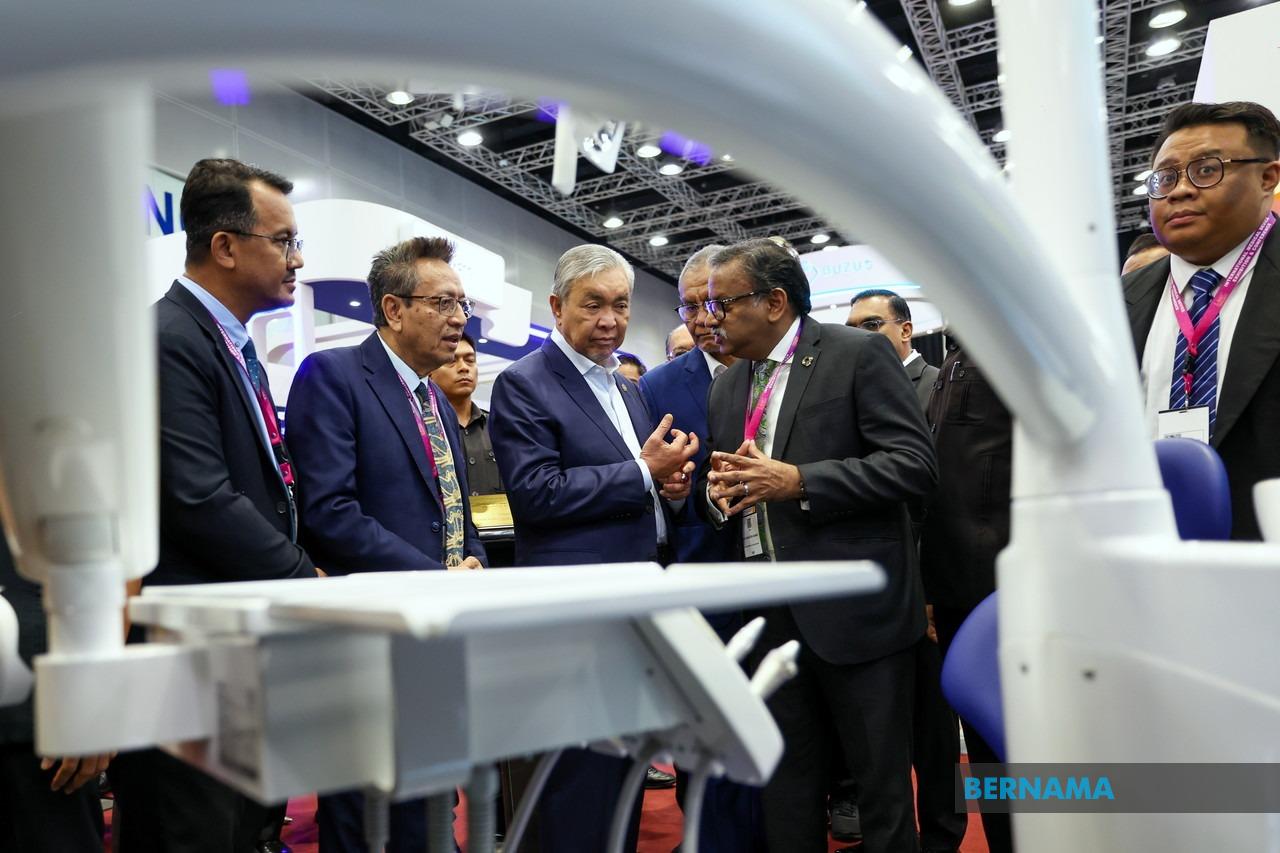
Malaysia has set its sights on nearly half a century of expansion in medical device exports, with Deputy Prime Minister Datuk Seri Dr Ahmad Zahid Hamidi calling for the sector to exceed RM50 billion in international sales within the next four years. This represents a substantial leap from the RM34.54 billion achieved in the previous year, signalling the government's determination to position the nation as a significant player in the rapidly expanding global medical technology landscape. Speaking at the closing ceremony of the International Medical Device Exhibition and Conference (IMDEC) 2026, Ahmad Zahid outlined an aspirational roadmap that extends beyond merely increasing export volumes, reflecting a deeper strategic pivot toward value creation and domestic capability building.
The foundation for Malaysia's medical device ambitions rests on existing competitive advantages that the country has cultivated over decades. The nation possesses an established manufacturing infrastructure, preferential market access through various trade agreements, and accumulated goodwill among international suppliers and buyers. Yet Ahmad Zahid made clear that future growth cannot rely solely on existing manufacturing capacity or cost competitiveness. Instead, Malaysia must progressively shift toward the development and export of higher-value medical technologies, reducing dependence on low-margin assembly and contract manufacturing that have historically characterised the sector. This transition reflects a broader regional and global trend where manufacturing-dependent economies seek to move up the value chain.
Central to the government's strategy is the creation of at least 10 Malaysian MedTech champions capable of competing not just domestically or regionally, but on the international stage. These homegrown companies would differ fundamentally from foreign operations in Malaysia; they would own intellectual property, lead product development, and drive innovation rather than serving primarily as manufacturing extensions of multinational corporations. The deputy prime minister articulated a vision in which Malaysia welcomes continued investment from leading international firms while simultaneously nurturing local enterprises with the capacity to innovate independently and capture global market share. This dual-track approach recognises that local champions require both the competitive pressure and knowledge spillovers generated by global industry leaders, while foreign investors benefit from a developed ecosystem of suppliers, talent, and regulatory expertise.
Employment quality emerges as perhaps the most striking pillar of Malaysia's MedTech vision. The government has set a target that at least half of all new jobs created by medical device investments by 2030 should be managerial, technical, and supervisory positions. This benchmark directly challenges the sector's current structure, where only 33.1 per cent of employment falls into these higher-value categories as of 2025. The disparity reflects a sector still heavily dependent on labour-intensive assembly and packaging work rather than design, engineering, and administrative functions. By insisting that capital inflows be accompanied by genuine capability development and knowledge retention, Ahmad Zahid signals that Malaysia's economic model is shifting. The message to investors is unmistakable: bringing manufacturing plants and jobs is welcome, but creating only low-skilled positions no longer meets national development objectives.
The deputy prime minister's remarks on talent development strategy carry particular significance for educational institutions and industry bodies across Malaysia and the broader Southeast Asian region. Rather than allowing companies to arrive first and then scrambling to train workers to fill skills gaps, Ahmad Zahid advocates for a proactive partnership model where international and local firms collaborate with vocational and technical training providers to design curricula that anticipate future requirements. This approach requires that companies engage early in the planning phase, provide industrial exposure to students, expand apprenticeship opportunities, and help shape the programmes that will eventually supply their workforce. Such collaboration addresses a chronic challenge facing developing economies: the mismatch between educational output and industry needs, which often results in either unemployment among graduates or persistent labour shortages despite high joblessness.
The scale of investment flowing into Malaysia's medical device sector provides grounds for optimism about the feasibility of these targets. During 2025 alone, RM4 billion in new investments was approved across 46 separate projects, generating approximately 3,400 employment opportunities. This activity demonstrates substantial confidence from both foreign and domestic investors in Malaysia's regulatory environment, cost structure, and business climate. However, the challenge lies not in attracting capital but in ensuring that such investments translate into the advanced capabilities and skilled employment the government seeks. The deputy prime minister's emphasis on this distinction suggests that previous investment cycles, while numerically impressive, may not have delivered the qualitative outcomes Malaysia now demands.
Context for Malaysia's ambitions emerges from the dramatic expansion of the global medical device market itself. Valued at more than USD572 billion in the previous year, the international sector is projected to nearly double to exceed USD1 trillion by 2034. This expansion reflects ageing populations in developed nations, growing healthcare spending in emerging markets, technological innovation in diagnostics and treatment, and increased demand for home-based and remote monitoring devices. For a country with Malaysia's manufacturing expertise and strategic location between major Asian markets, capturing an enlarged share of this expanding industry represents a compelling economic opportunity. The trajectory of growth in the global sector suggests that even modest improvements in Malaysia's market share could translate into substantial export gains.
The IMDEC 2026 event itself underscored the international dimensions of Malaysia's strategy. The three-day conference, running from August 26 to 28, attracted more than 160 exhibitors and over 50 regional and international speakers addressing regulation, innovation, and healthcare transformation. Such gatherings serve multiple functions beyond the immediate business conducted: they project Malaysia's credibility to global players, facilitate networking and technology transfer, and signal to the international investment community that the country remains committed to becoming a serious hub for medical technology. The breadth of participation and thematic coverage suggests an industry ecosystem with genuine depth and sophistication.
Implementing this vision requires coordination across multiple government agencies and closer collaboration between the public and private sectors. Ahmad Zahid's concurrent role as chairman of the National Technical and Vocational Education and Training Council positions him to influence talent development policy directly. Yet the success of the broader strategy depends on alignment across the Ministry of Investment, Trade and Industry, the Health Ministry, financial regulators, customs authorities, and other stakeholders. Investment incentives, regulatory pathways for medical devices, intellectual property protections, and R&D support mechanisms must all reinforce the central objective of building high-value capabilities within Malaysia rather than simply accumulating manufacturing capacity.
The emphasis on retaining capability within Malaysia reflects a sophisticated understanding of economic development dynamics. Many developing nations have discovered that hosting foreign manufacturing plants, while providing employment and foreign exchange, does not reliably generate the technological spillovers and skill development necessary for sustained progress. Companies that merely assemble components or perform labour-intensive processes according to specifications from headquarters develop little local expertise and remain vulnerable to relocation to lower-cost jurisdictions. By contrast, enterprises that undertake product development, quality control, process innovation, and management functions accumulate knowledge capital that strengthens the broader ecosystem and creates incentives for continued investment. Malaysia's focus on ensuring that investments involve genuine technology transfer and capability building suggests learning from both its own experience and that of comparable regional economies.
For neighbouring Southeast Asian nations, Malaysia's medical device strategy offers a model—or potential challenge—for competing in the same global supply chains. Countries like Thailand, Vietnam, and the Philippines also seek to attract medical device manufacturing and develop local champions. Malaysia's emphasis on quality employment, intellectual property ownership, and ecosystem development represents a potentially more ambitious approach than some competitors have adopted. This could position Malaysia advantageously for attracting sophisticated investments from global leaders, though it also means higher expectations for public investment in talent development and regulatory capacity. The regional competition for medical device industry leadership is intensifying, and Malaysia's articulated vision suggests the country intends to compete on capability and innovation rather than cost alone.
Achieving the RM50 billion export target and developing 10 MedTech champions by 2030 requires execution across multiple years and consistency despite political and economic cycles. The targets are specific and measurable, allowing future accountability, but also ambitious enough to demand sustained commitment and substantial investment from both government and industry. Success depends partly on external factors—global economic growth, healthcare spending trends, technology breakthroughs—beyond any nation's control. Yet the aspects within Malaysia's control—regulatory efficiency, talent development, intellectual property protection, business environment quality—remain within reach. Whether Malaysia achieves these particular metrics may matter less than whether the pursuit of them drives systemic improvements in how the country develops high-value industries and retains knowledge and capability within its borders.

