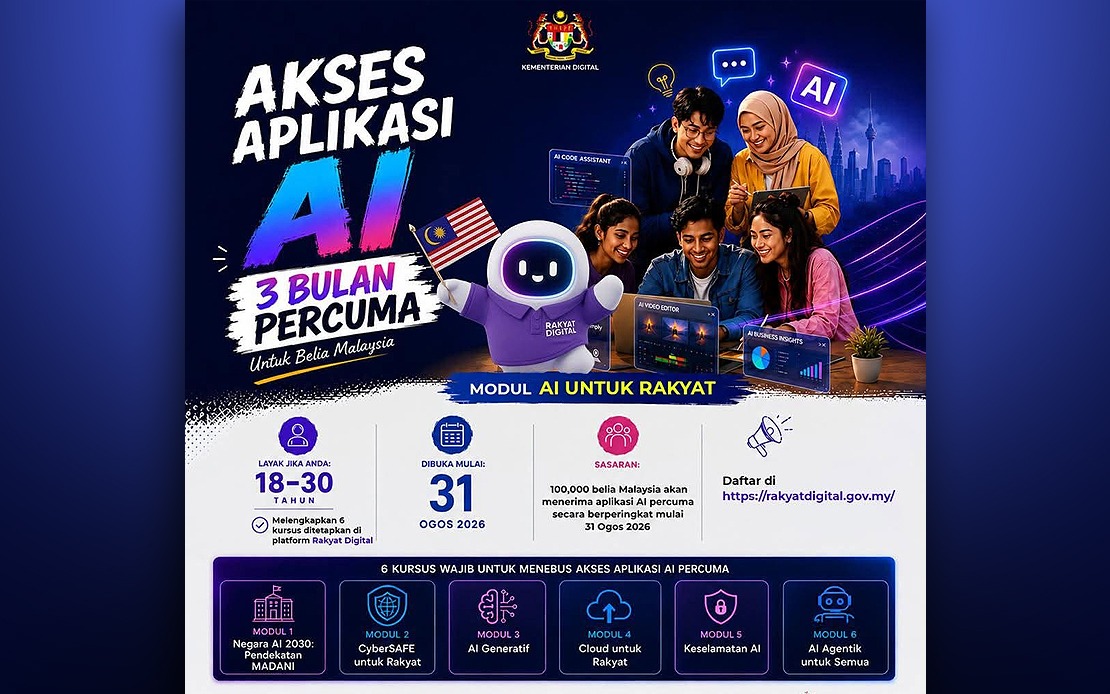
The Malaysian government has launched an ambitious digital initiative designed to democratise access to artificial intelligence technology among the nation's youth. The AI for the People (AI Untuk Rakyat) programme, unveiled by Prime Minister Datuk Seri Anwar Ibrahim in Putrajaya on August 30, aims to enrol 100,000 Malaysians aged between 18 and 30 by 2027, equipping them with both knowledge and practical tools in the rapidly evolving field of AI technology.
Registration for the initiative opened on August 30 through the Rakyat Digital portal at rakyatdigital.gov.my, with the programme being rolled out in phases across the country. The structure revolves around a mandatory curriculum comprising six specialised modules that participants must successfully complete and pass to unlock benefits. The Digital Ministry has designed these courses to provide comprehensive coverage of artificial intelligence across multiple dimensions: AI Nation 2030: The MADANI Approach, which contextualises AI within Malaysia's broader digital strategy; CYBERSAFE for the People, addressing security and responsible usage; Generative AI, covering the transformative technology behind tools like ChatGPT; AI Security, focusing on protective measures and best practices; Agentic AI for All, exploring autonomous AI systems; and Cloud for the People, introducing cloud computing fundamentals.
Upon successful completion of all six modules, participants gain eligibility for a three-month free subscription to carefully curated artificial intelligence applications and software. This benefit extends beyond theoretical knowledge, providing hands-on experience with enterprise-grade tools. The initial partners announced include YTL AI Labs offering IlmuChat, Alibaba providing Wonderclip and MuleRun, and Google delivering Gemini Enterprise. The Digital Ministry has committed to expanding this roster progressively, with additional AI software and tools from other technology companies being incorporated in phases to continuously enrich the learning experience.
The programme reflects a deliberate policy shift towards inclusive technology adoption in Malaysia. By targeting young adults specifically, the government recognises that this demographic will shape the nation's digital future and should possess foundational competency in AI applications. The initiative carries significant implications for workforce development, as young Malaysians equipped with both AI literacy and access to professional-grade tools will be better positioned for employment in technology-driven sectors. This could help address potential skills gaps as industries increasingly integrate AI into their operations across manufacturing, services, finance, and creative sectors.
Digital Ministry Secretary-General Datuk Fabian Bigar emphasised that the programme goes beyond theoretical education to ensure youths understand AI's practical applications for learning, creativity, and productivity enhancement. This balanced approach acknowledges that technological literacy must encompass both conceptual understanding and hands-on capability. By providing free access to premium tools, the programme removes financial barriers that might otherwise exclude talented individuals from lower-income backgrounds, thereby promoting digital equity across socioeconomic lines.
The initiative sits within Malaysia's broader Digital 2030 framework and the government's vision to establish an inclusive AI Nation by 2030. This positioning suggests that AI adoption is viewed not merely as a technological necessity but as integral to achieving sustainable development goals and improving quality of life for Malaysian citizens. The programme complements other digital opportunity schemes announced alongside it, creating a comprehensive ecosystem for youth digital empowerment.
Rakyat Digital, the national digital learning portal through which registrations occur, operates under the Digital Ministry and MyDIGITAL Corporation. This existing infrastructure allows the government to leverage established digital infrastructure rather than building new systems from scratch, improving efficiency and reducing implementation costs. The portal's integration with Malaysia's digital identity systems potentially enables streamlined verification and access management.
For Malaysian youth seeking to remain competitive in an increasingly AI-driven global economy, this programme offers a significant opportunity to gain practical experience without financial investment. The emphasis on both local providers like YTL AI Labs and international partners such as Google and Alibaba demonstrates Malaysia's positioning as an attractive market for technology companies while also supporting domestic innovation ecosystems. This balance between local and global partnership could stimulate knowledge transfer and help Malaysian tech companies develop competitive offerings.
The phased rollout approach suggests the government is learning and adapting as the programme matures, likely based on participant feedback and engagement metrics. This flexibility should enable improvements in module content, tool offerings, and delivery mechanisms as the initiative progresses toward its target of 100,000 participants. For educational institutions and employers, the certification upon module completion provides a standardised credential indicating participants' AI competency levels.
The programme's emphasis on MADANI framework alignment indicates that technological advancement in Malaysia is being deliberately connected to national development values, rather than pursuing AI adoption for its own sake. This ideological grounding may enhance public acceptance and ensures the technology serves broader societal goals.
For Southeast Asia more broadly, Malaysia's initiative represents significant commitment to AI democratisation among its youth. As regional economies compete for talent and technological leadership, such programmes may influence similar policies elsewhere in the region. The success of AI Untuk Rakyat could establish a model that other ASEAN nations might adapt to their own contexts and priorities.

