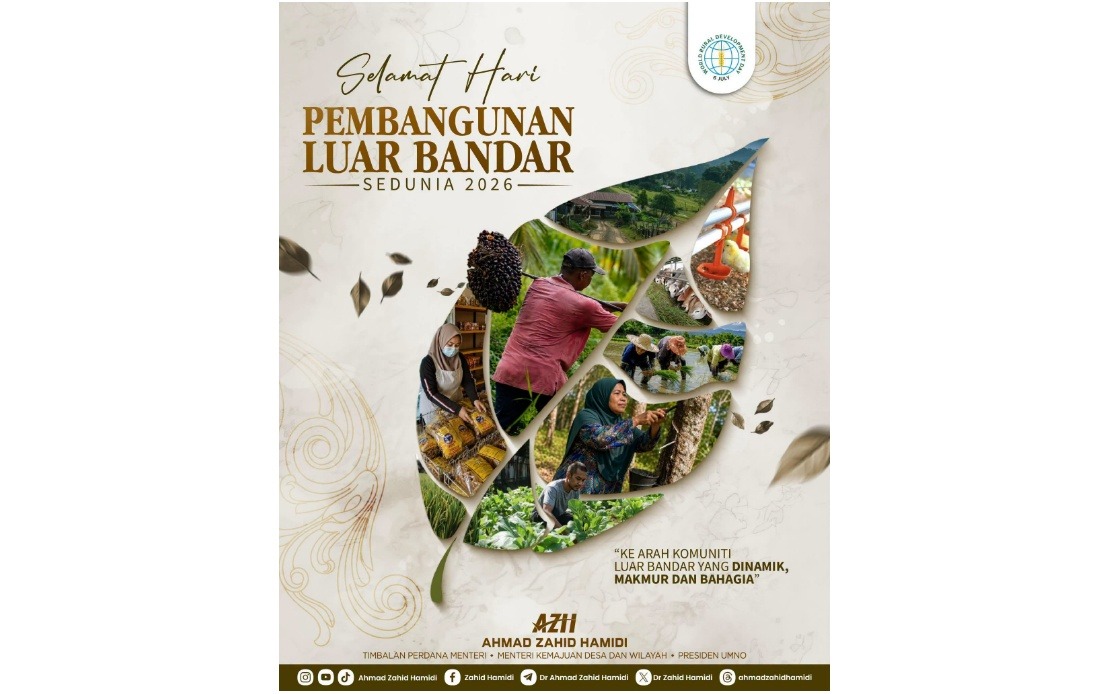
Malaysia marked a significant milestone on July 6 by observing World Rural Development Day for the inaugural time, signalling a heightened governmental focus on the nation's countryside communities and their economic advancement. Deputy Prime Minister Datuk Seri Dr Ahmad Zahid Hamidi, who also serves as Rural and Regional Development Minister, framed the celebration as an opportunity to reinforce the Ministry of Rural and Regional Development's (KKDW) comprehensive approach to rural revitalisation and uplift.
The establishment of July 6 as a dedicated observance carries symbolic weight beyond the immediate celebration. Ahmad Zahid pointed to the historical convergence with the founding of the Centre on Integrated Rural Development for Asia and the Pacific (CIRDAP), an institution that has long anchored regional cooperation on rural advancement across the Asia-Pacific. By anchoring Malaysia's commemoration to this date, the government positions domestic rural development efforts within a broader regional framework, connecting local initiatives to international best practices and collaborative networks that have proven instrumental in addressing cross-border development challenges.
The inaugural celebration took place at the Tun Abdul Razak Stadium in Jengka, located near Maran in Pahang, a choice of venue that itself underscores the administration's intent to bring national-level attention and resources to regional hubs beyond the federal capital. The selection of a rural Pahang location, rather than staging the event in Kuala Lumpur, sends a clear message about prioritising direct engagement with countryside populations and demonstrating tangible governmental presence in areas that historically receive less central policy focus.
Three pillars anchored the inaugural event's framework: community innovation, rural digitalisation, and rural entrepreneurship development. These thematic pillars reflect contemporary understanding that rural advancement cannot rely solely on traditional agricultural support or infrastructure spending. Instead, the government recognises that countryside communities must gain access to technological capabilities, business development resources, and platforms for creative problem-solving if they are to participate meaningfully in Malaysia's broader economic transition toward high-value activities.
Rural digitalisation emerges as particularly consequential for Malaysian countryside communities. Access to broadband connectivity, digital payment systems, e-commerce platforms, and online information resources has become foundational to rural economic participation, yet digital divides between urban and countryside areas persist significantly. By elevating digitalisation as a central pillar, the KKDW signals intent to bridge infrastructure gaps that have constrained rural entrepreneurs' ability to access wider markets, access financial services, or adopt productivity-enhancing technologies.
Community innovation, as a pillar, represents a departure from top-down rural development models that historically characterised government approaches. This framework acknowledges that rural communities themselves possess creative capacity and situated knowledge essential to solving local challenges. By recognizing and fostering grassroots innovation, the government positions rural populations as active agents in their own development rather than passive recipients of centralised programmes, potentially generating more sustainable and contextually appropriate solutions.
Rural entrepreneurship development addresses persistent underemployment and outmigration challenges that have drained countryside populations of younger, skilled residents over decades. By actively supporting business formation, providing training, and creating enabling environments for rural enterprises, the government seeks to generate local employment opportunities that can retain talent and reduce the economic disparities that push rural residents toward urban migration. This focus recognises that sustainable rural development requires endogenous economic dynamism, not merely subsidy or welfare provision.
Ahmad Zahid's articulation of the rural development agenda emphasises holistic advancement across multiple dimensions: economic opportunity expansion, infrastructure enhancement, and quality-of-life improvements. This multidimensional framing suggests recognition that rural communities face interconnected challenges spanning income generation, basic service delivery, and livelihood security. The government's commitment to comprehensive rural progress indicates understanding that isolated interventions addressing single sectors prove insufficient without coordinated attention to the broader ecosystem within which rural livelihoods operate.
The elevation of rural development to a dedicated national observance also carries implications for budget allocation and policy prioritisation in coming years. Institutionalising World Rural Development Day creates an annual occasion for accountability, review of progress, and recommitment to rural advancement objectives. This calendrical anchor potentially strengthens political commitment to rural issues that might otherwise become deprioritised amid competing policy demands, particularly given Malaysia's ongoing urbanisation and the political economy dynamics favouring urban constituencies.
For Southeast Asian regional context, Malaysia's inaugural celebration signals that countryside development remains a serious governmental concern despite broader economic transformation toward services and manufacturing. Other regional nations grappling with rural-urban disparities, agricultural transition, and the integration of countryside populations into modern economies may observe Malaysia's institutional approach and pillars with interest, particularly given Malaysia's relative institutional capacity and resources compared to some neighbours.
The commemorative focus on vibrant, prosperous, and happy rural communities addresses not merely economic metrics but also quality-of-life dimensions encompassing social cohesion, cultural vitality, and psychological wellbeing. This holistic framing acknowledges that rural development success cannot be measured solely through income statistics or infrastructure counts but requires attention to community satisfaction, social stability, and preservation of cultural identity amid rapid change.

