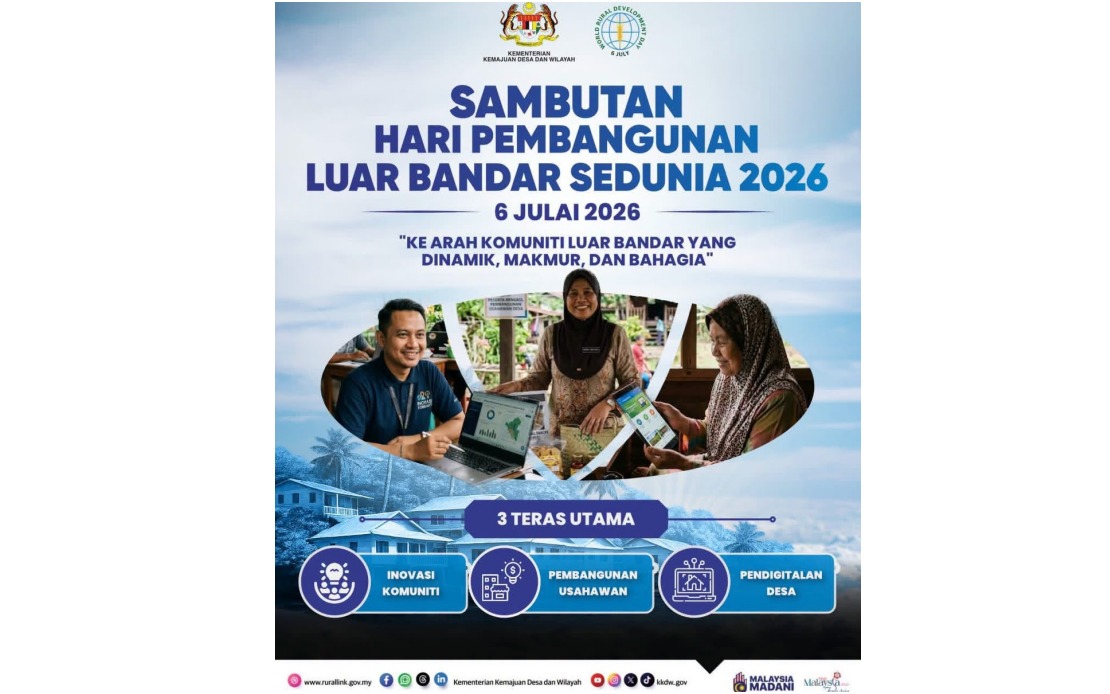
Malaysia steps into a global movement tomorrow as it becomes one of the first nations to officially celebrate World Rural Development Day, marking a significant recognition of the country's commitment to uplift communities beyond its urban centres. The inaugural celebration at Tun Abdul Razak Stadium in Jengka near Maran will be officiated by Deputy Prime Minister and Minister of Rural and Regional Development Datuk Seri Dr Ahmad Zahid Hamidi, underscoring the government's prioritisation of rural affairs at the highest political level.
The United Nations General Assembly formally declared World Rural Development Day in September 2024, designating July 6 as the annual observance date to commemorate the establishment of the Centre on Integrated Development for Asia and the Pacific (CIRDAP). The inaugural global celebration took place on July 6, 2025, and Malaysia's decision to implement the official observance beginning in 2026 positions the nation among early adopters of this UN initiative, reflecting growing international consensus on the importance of sustainable rural development in achieving broader sustainable development goals.
Organised under the banner "Toward Vibrant, Prosperous and Happy Rural Communities," the celebration represents more than ceremonial recognition. It reflects deliberate policy direction from the Ministry of Rural and Regional Development (KKDW) to address structural challenges that have historically limited rural prosperity. By formally observing this day, Malaysia signals that rural development is not a peripheral concern but central to national progress and the achievement of the Sustainable Development Goals.
The event's structural focus reveals the government's diagnostic approach to rural challenges. Three interconnected pillars will guide initiatives emerging from this celebration: community innovation, rural digitization, and rural entrepreneur development. These are not standalone concepts but represent an integrated strategy recognising that sustainable rural prosperity requires simultaneous advancement across multiple dimensions. Community innovation harnesses local knowledge and entrepreneurial spirit; digitization removes geographical barriers to market access and service delivery; and targeted entrepreneurship support transforms potential into viable economic activity.
The economic dimension carries particular weight for Malaysian policymakers. Rural communities have historically faced constrained access to markets, capital, and information networks—disadvantages that compound over time. By expanding economic opportunities through these three thrusts, the initiative aims to create pathways for rural residents to participate more fully in the national economy. Digital technology access, in particular, can be transformative for small farmers and entrepreneurs who previously relied on intermediaries, allowing direct connections to supply chains and customers.
The celebration will feature several substantive announcements and awards, including the Rural Aspiration Award MADANI and Felda Plan Excellence Award, alongside the launch of the My Rural Insight Journal. Additionally, Felcra Bhd will announce its Interim Distributable Profit Distribution for the first half of 2026, concrete indicators of resource allocation and institutional performance in rural development infrastructure.
These programme elements carry significance for Malaysia's substantial rural population. Felcra Bhd, the Federal Land Consolidation and Rehabilitation Authority, has long been a primary vehicle for consolidating smallholder interests and improving agricultural productivity. The announcement of profit distribution directly affects livelihoods for members of federal land schemes scattered across the peninsula and Sabah and Sarawak. Similarly, the Rural Aspiration Award MADANI and Felda Plan Excellence Award mechanism incentivise and recognise excellence, potentially catalysing competitive improvement across rural development programmes.
For Malaysian readers, the timing and positioning of this celebration reflect broader regional trends. Throughout Southeast Asia, governments are increasingly recognising that equitable development requires sustained investment in rural areas. Malaysia's participation in the global WRDD movement aligns with regional initiatives in countries like Indonesia, Thailand, and the Philippines, all grappling with rural-urban development gaps. By embracing this global framework, Malaysia gains access to comparative experience and international networks focused on proven rural development methodologies.
The government's emphasis on community progressiveness and competitiveness reveals an understanding that rural development cannot rely purely on subsidies or welfare transfers. Instead, the strategy pivots toward enabling rural communities to compete and innovate, fostering entrepreneurial mentality and digital fluency. This represents a philosophical shift from earlier paradigms that sometimes positioned rural development as primarily about narrowing consumption gaps toward one emphasising capability development and economic participation.
The public invitation to attend the Jengka celebration, coupled with exhibitions from KKDW and partner agencies, suggests an intention to broaden awareness beyond policy circles. Rural development successes and best practices will be showcased, potentially inspiring replication and generating grassroots understanding of available support mechanisms. For rural residents often operating with incomplete information about government programmes, such public visibility can prove catalytic.
Looking forward, Malaysia's inaugural WRDD celebration establishes an annual touchstone for rural development accountability and progress. By formally observing this day each July 6, the government creates recurring opportunities to assess whether initiatives genuinely advance rural prosperity or remain rhetorical flourishes. The celebration becomes a moment to measure whether digitization efforts have genuinely reached remote areas, whether rural entrepreneurs are accessing capital and markets, and whether community innovation is translating into sustainable livelihoods.
The success of this inaugural celebration will partly depend on whether subsequent years demonstrate tangible improvements in rural incomes, digital infrastructure quality, and entrepreneurial capacity. For Malaysia's five million rural residents, the true measure of World Rural Development Day's significance lies not in ceremonial recognition but in whether it catalyses the institutional commitment and resource allocation necessary to realise the stated vision of vibrant, prosperous, and genuinely happy rural communities.

