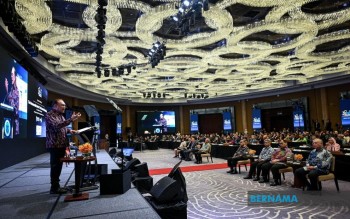
Prime Minister Datuk Seri Anwar Ibrahim has called for Malaysia to establish dedicated sovereign cloud infrastructure as a strategic necessity to shield critical security information and citizen data from potential foreign intrusion, while the country pursues deeper engagement with global digital investors across Southeast Asia's increasingly technology-dependent economies. Speaking at the 39th Asia-Pacific Roundtable in Kuala Lumpur on July 2, Anwar outlined a nuanced approach that balances national data protection with Malaysia's broader commitment to remaining open to international investment and technological collaboration in an interconnected world.
The Prime Minister's remarks directly addressed concerns arising from the United States Cloud Act, legislation that grants American authorities broad powers to access data held by US-registered companies operating internationally. Anwar highlighted the geopolitical asymmetry this creates, noting that while the United States exercises its sovereign right to access such information, Malaysia and other nations must establish corresponding protective mechanisms. Rather than characterise this as confrontational, he framed the sovereign cloud initiative as a pragmatic defensive strategy that acknowledges reality without abandoning the principles of openness that define democratic societies.
The concept of a sovereign cloud represents a carefully calibrated middle path in contemporary digital geopolitics. By creating a secure, nationally-controlled infrastructure for sensitive government and citizen data, Malaysia would establish a protective perimeter against extraterritorial data demands while maintaining broader connectivity to the global digital ecosystem. Anwar emphasised that such firewalls would specifically shield critical security information and personal data from individuals, recognising that certain categories of information require heightened protection given Malaysia's strategic position and the sensitivity of citizen privacy.
However, Anwar tempered expectations about what sovereign cloud architecture could achieve, acknowledging that complete digital isolation remains neither feasible nor desirable in an integrated global economy. The Prime Minister recognised that democratic values and the free flow of information necessarily constrain the extent of data protection any nation can implement. This honest assessment reflects understanding that while Malaysia can erect barriers against routine data harvesting, the interconnected nature of modern digital systems means absolute impermeability is impossible without sacrificing the openness upon which Malaysia's competitiveness depends.
The proliferation of digital platforms has created parallel challenges that extend beyond state-level data access concerns. Anwar identified growing threats from social media abuse, including harassment of a political, economic, personal, and sexual nature. These challenges disproportionately affect young Malaysians who navigate digital spaces with varying levels of sophistication and protection. The Prime Minister articulated that legitimate government safeguards become necessary to mitigate such harms, positioning regulation not as censorship but as essential infrastructure for protecting vulnerable populations from predatory behaviour enabled by platform anonymity and algorithmic amplification.
Malaysia's strategic positioning as an investment destination enhances the urgency of establishing sovereign digital infrastructure. The country currently attracts significant capital flows from the United States, China, and Germany—three technology powers with competing interests in Southeast Asia. A credible sovereign cloud system signals to all investors that Malaysia possesses sophisticated governance capacity while maintaining regulatory clarity. This positioning allows Malaysia to attract continued foreign direct investment without ceding control over sensitive national assets, creating competitive advantage rather than defensive disadvantage.
Anwar's emphasis on ASEAN centrality reflects recognition that Malaysia's capacity to exercise digital agency depends partly on regional coordination. Southeast Asia's collective digital economy exceeds many individual nations' capacities, yet fragmented national approaches create vulnerabilities. By framing Malaysia's sovereign cloud within a broader ASEAN context, Anwar suggested that regional coordination on data governance standards could amplify protection for all member states. This regional approach aligns with historical Malaysian foreign policy doctrine emphasising that smaller nations gain strength through institutionalised collective action rather than individual posturing.
The Prime Minister's characterisation of Malaysia as a small nation rather than a middle power reflects both humility and strategic calculation. By explicitly rejecting middle-power rhetoric, Anwar positioned Malaysia as fundamentally committed to ASEAN solidarity and collective strength rather than competitive individual advancement. This framing matters in Southeast Asian diplomacy, where ambitions of regional hegemony provoke counterbalancing by neighbours and external powers. Instead, Anwar presented Malaysia's strength as derivative from ASEAN's cohesion, suggesting that digital governance initiatives gain legitimacy through regional ownership rather than unilateral Malaysian action.
The sovereign cloud initiative must be understood within Malaysia's broader digital transformation strategy. The country seeks to build world-class technology infrastructure while remaining attractive to multinational corporations and investors. Sovereign cloud systems can serve this dual purpose: they protect sensitive state and citizen information while demonstrating to foreign investors that Malaysia maintains sophisticated technical and regulatory capabilities. This approach appeals particularly to investors from democracies that value rule of law and transparent governance, as it demonstrates commitment to institutional safeguards rather than arbitrary state control.
Implementing effective sovereign cloud infrastructure presents significant technical and organisational challenges that extend beyond simple policy declaration. Malaysia would need to develop domestic expertise in cloud architecture, cybersecurity, and data management while competing for talent with technology giants already embedded in the region. The financial investment required—both for infrastructure and ongoing operational capacity—represents substantial commitment. These challenges suggest that sovereign cloud development cannot occur in isolation; it requires coordination with regional partners, international security partnerships, and private sector participation.
The timing of Anwar's statements reflects accelerating strategic competition in Southeast Asia's digital economy. As geopolitical tensions between the United States and China intensify, third countries face mounting pressure to make binary choices about technological alignment. Malaysia's sovereign cloud approach offers alternative positioning: neither wholesale embrace of any single external power's digital ecosystem nor nationalist rejection of global integration. This flexibility preserves Malaysia's strategic autonomy while demonstrating sophisticated understanding that digital security cannot be achieved through isolation but requires managed interdependence backed by credible protective infrastructure.
Looking forward, the success of Malaysia's sovereign cloud initiative will depend on sustained political commitment, adequate resource allocation, and regional coordination. The initiative also requires ongoing dialogue with international partners about appropriate boundaries between national security protection and excessive data restrictions that might deter legitimate investment. As Southeast Asia continues rapid digital evolution, Malaysia's approach—balancing protection with openness, national interest with regional solidarity, and technological independence with global integration—may offer a model other nations in the region seek to emulate or adapt to their own circumstances.

