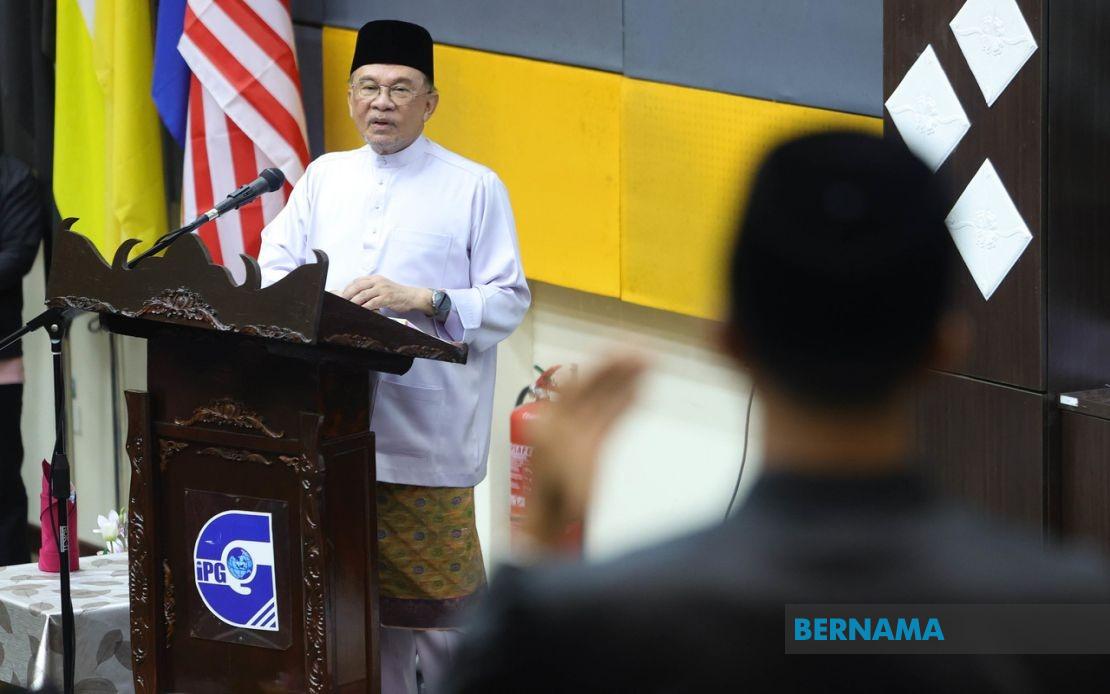
Prime Minister Datuk Seri Anwar Ibrahim has called for a fundamental reimagining of Malaysia's teaching workforce, insisting that educators must combine technical prowess in cutting-edge fields with deep moral anchoring. Speaking at an education forum in Nilai on July 17, Anwar emphasized that the nation cannot afford to produce teachers who are merely technologically literate without corresponding development in character and ethical reasoning. This dual imperative reflects a growing concern across Southeast Asia that rapid technological adoption risks outpacing the moral and philosophical frameworks necessary to guide its responsible use.
The Prime Minister's remarks underscore a critical recognition that Malaysia's competitive position in the global economy depends not simply on matching international standards in Science, Technology, Engineering and Mathematics (STEM) education, but on cultivating educators who can navigate the complex intersection of innovation and human responsibility. As artificial intelligence and other transformative technologies reshape industries and societies worldwide, the demand for teachers who understand both their technical capabilities and their ethical implications has become increasingly urgent. Malaysia's education establishment, Anwar suggested, must move beyond static curricula designed for an earlier era and instead embrace dynamic, responsive pedagogical approaches that prepare students for an unpredictable future.
Crucially, the Prime Minister articulated what he described as the need to "reach for the skies while keeping our roots on the ground"—a formulation that captures the delicate balance Malaysia must strike between technological advancement and cultural continuity. This framing carries particular weight in the Malaysian context, where education has long been expected to serve multiple, sometimes competing national objectives: economic competitiveness, social cohesion, and cultural preservation. By insisting that mastery of modern technology must remain inseparable from grounding in religion, culture, morality and human values, Anwar is positioning education as a bulwark against the potential alienation and fragmentation that unchecked technological change might otherwise produce.
The Prime Minister was unequivocal in identifying education as Malaysia's foundational priority for national advancement. In his view, securing the nation's future requires first establishing an exceptional education system, and only then cultivating the organizational and institutional capacity to adapt rapidly to global shifts. This sequencing matters: it suggests that technological capability without educational excellence would be hollow, and that the quality of teaching directly determines whether Malaysia can transform technological access into genuine competitive advantage. Education Minister Fadhlina Sidek and IPGKPT director Dr Kartini Abdul Mutalib were present at the event, signaling high-level institutional commitment to these themes.
Beyond the narrower question of teacher preparation, Anwar used the occasion to articulate a vision of education as fundamentally serving the cause of national unity and social cohesion. He warned bluntly that education systems which allow teachers or students to be influenced by interethnic or interreligious animosity ultimately undermine their own institutional legitimacy and effectiveness. In a country as ethnically and religiously diverse as Malaysia, where periodic communal tensions remind policymakers of fragility beneath surface stability, this emphasis carries genuine strategic weight. The Prime Minister's assertion that no nation, regardless of size or strength, can remain secure while sowing seeds of racial or religious hatred reflects hard-won historical understanding.
The broader implication of Anwar's remarks is that Malaysia's education system must actively promote what might be termed civic humanism—a commitment to shared human values that transcends particular ethnic or religious identifications. This stance represents something more than platitudinous appeals to unity; it suggests that educators themselves must be selected, trained, and continuously supported to embody and transmit these integrative values. Teachers who themselves harbor resentments toward other communities cannot credibly instruct students in tolerance and mutual respect, making the character and ethical formation of the educator corps itself a matter of urgent national importance.
The timing of these remarks also reflects regional and global anxieties about education's role during periods of rapid change. Across Southeast Asia, governments grapple with how to prepare students for a labor market transformed by automation and artificial intelligence while maintaining social stability and cultural identity. Malaysia's particular challenge is compounded by its economic transition toward higher-value manufacturing and knowledge work, requiring a workforce capable of sophisticated technical reasoning. Yet economic transformation unmoored from ethical and cultural grounding can generate profound social dislocation, as communities struggle to adapt to changing employment patterns and social hierarchies.
Anwar's emphasis on tolerance, mutual respect, and commitment to human values as prerequisites for building a truly progressive society amounts to a counterargument to those who view technology and tradition as inevitably opposed. Instead, he posits that genuine progress—understood as sustained advancement in both material prosperity and social well-being—requires synthesis of technological mastery with moral maturity. This formulation has implications not only for teacher training but for curriculum design, institutional governance, and the relationship between schools and their surrounding communities.
The practical implementation of these principles will test Malaysia's education bureaucracy and teacher training infrastructure. Creating pedagogical approaches that authentically integrate technical instruction with ethical formation, rather than treating these as separate or competing domains, demands significant curriculum redesign and professional development. Teachers must themselves possess sufficient understanding of emerging technologies to teach them competently, while simultaneously engaging with philosophical, ethical, and cultural dimensions of their application. This is a considerably more demanding proposition than traditional teacher preparation, whether in STEM or humanities domains.
Moreover, Anwar's vision implies that educator recruitment, assessment, and professional progression must be reformed to value ethical and moral development alongside technical credentials. A teacher brilliant in coding or data science but indifferent to questions of equity, justice, and human dignity would fall short of the standard the Prime Minister has articulated. Malaysian institutions training future teachers will need to develop more sophisticated methods of identifying and nurturing candidates who demonstrate both intellectual rigor and moral seriousness, a shift that could reshape teacher education substantially.

