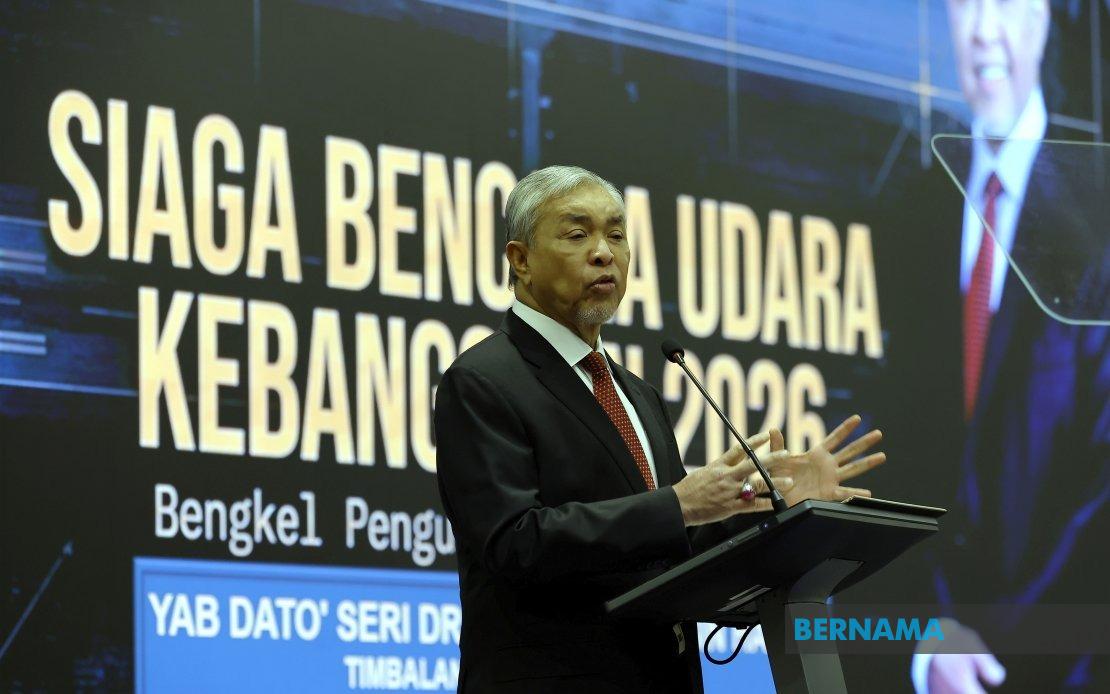
Malaysia's approach to aviation emergencies requires a fundamental shift towards a unified command system where all disaster-response agencies operate cohesively rather than as independent entities, Deputy Prime Minister Datuk Seri Dr Ahmad Zahid Hamidi has argued. Speaking at the launch of the National Air Disaster Preparedness 2026 workshop in Sepang on July 27, Ahmad Zahid outlined a vision for integrated operations that would enable rapid, coordinated responses to aircraft incidents and other aviation-related crises affecting the country.
The cornerstone of Ahmad Zahid's proposal centres on the principle of "one system, one command, and one action," a framework designed to transcend the traditional silos that often characterise emergency management across different government departments and agencies. By establishing a common operational picture accessible to all participating organisations—from civil aviation authorities to rescue services, law enforcement, and airport operators—Malaysia could eliminate the delays and confusion that frequently arise when agencies operate without shared situational awareness. This structural approach represents a departure from crisis management as it has historically functioned in the region, where competing institutional interests and unclear authority chains have sometimes compromised response effectiveness.
Ahmad Zahid emphasised that the true measure of a disaster management system lies not in the quantity of assets or personnel it can mobilise, but rather in how efficiently those resources function when operating under the extreme pressure of an actual emergency. A system that appears comprehensive on paper may prove inadequate when circumstances change rapidly and critical decisions must be made within minutes. This distinction underscores a sophisticated understanding of organisational behaviour under crisis conditions—a principle that extends far beyond Malaysia's aviation sector and holds lessons for how the country manages other large-scale emergencies.
The workshop itself represents a practical testing ground for existing protocols and inter-agency communication channels. With more than 100 representatives from government ministries, law enforcement, rescue services, airlines, airport operators, and industry bodies participating over two days, the event provides an opportunity to identify gaps in current procedures, evaluate communication effectiveness, and clarify operational roles and responsibilities. Deputy Transport Minister Datuk Hasbi Habibollah, National Disaster Management Agency director-general Datuk Meor Ismail Meor Akim, and other senior officials brought operational expertise to discussions about strengthening Malaysia's readiness for aviation emergencies.
Ahmad Zahid identified four strategic priorities that should guide the development of this integrated system. First, Malaysia must strengthen its chain of command and decision-making authority by reviewing existing procedures to eliminate ambiguity about who holds responsibility at different stages of an emergency. Second, the country needs enhanced information-sharing capabilities and improved inter-agency communication protocols that function reliably during high-stress situations. Third, scenario-based training must expand beyond airport perimeters to include remote areas and difficult-to-access locations where aircraft incidents might occur. Fourth, Malaysia should accelerate the digitalisation of disaster management processes, moving away from paper-based systems that slow information flow during crises.
These priorities reflect lessons learned from aviation emergencies in other jurisdictions and acknowledge that Malaysia's geography—with its mix of urban airports, remote regions, and maritime zones—demands sophisticated coordination mechanisms. Unlike smaller nations where central command structures suffice, Malaysia's vast territory requires clear protocols for delegating authority to regional commanders while maintaining strategic oversight from the national level.
Beyond the immediate operational considerations, Ahmad Zahid positioned aviation safety as a matter of strategic national importance rather than merely a technical concern for the transport sector. This framing carries significant weight given Malaysia's economic dependence on aviation. The country welcomed 42.2 million international tourists during the previous year, generating RM110.6 billion in revenue, while domestic tourism spending reached RM121.3 billion. A single major aviation incident could damage Malaysia's tourism reputation globally and deter both leisure and business travellers, with cascading effects across hospitality, retail, and related industries. Investment in disaster preparedness thus functions as an investment in protecting Malaysia's economic interests and maintaining the global confidence that sustains its tourism-dependent economy.
For Malaysian readers and regional observers, Ahmad Zahid's initiative signals that the government recognises vulnerabilities in current emergency-response systems and is committed to addressing them through systematic reform. Southeast Asia has experienced several aviation incidents over recent decades, and the region's rapid growth in air travel has intensified the need for robust disaster management capabilities. Malaysia's willingness to benchmark its systems and invest in integrated coordination could establish standards that other regional nations might eventually adopt.
The emphasis on unified command structures also reflects broader governance trends in Malaysia, where the federal government has increasingly sought to coordinate activities across multiple agencies through whole-of-government approaches. This workshop exemplifies that model applied to aviation safety, though success will ultimately depend on whether participating agencies receive adequate resources, training, and institutional incentives to maintain coordination during routine periods, ensuring they function seamlessly when actual emergencies occur.
The government's commitment to strengthening disaster preparedness through improved policies, coordination, and capacity building remains ongoing, according to Ahmad Zahid. The practical test will come not during exercises but during actual incidents, when the unified system's robustness will be measured against real-world challenges including communication breakdowns, resource shortages, and the fog of crisis conditions. Malaysia's aviation authorities and emergency services now have a clear mandate to build and continuously refine the integrated framework that Ahmad Zahid has outlined, recognising that the nation's economic interests, tourism reputation, and most importantly, the safety of passengers and residents depend on getting this right.

