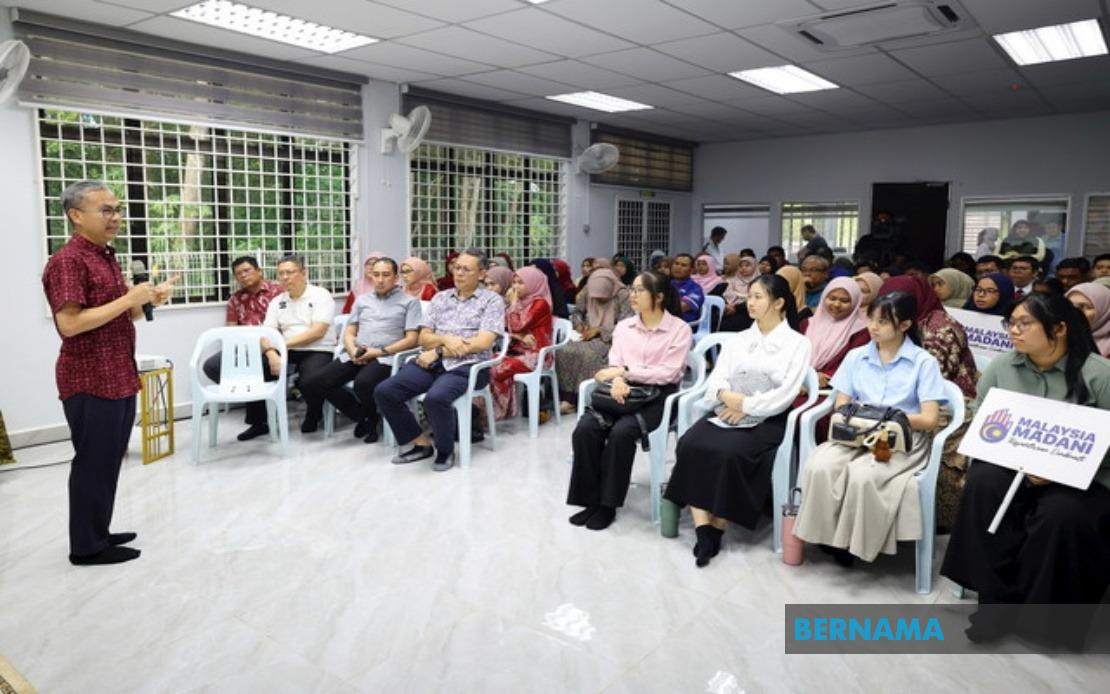
Communications Minister Datuk Seri Fahmi Fadzil has underscored the critical need to continuously cultivate patriotism and digital literacy among Malaysian youth, particularly those in secondary schools, as they prepare to navigate an increasingly complex digital landscape. Speaking after engaging with Form Six students in Jempol, Fahmi emphasised that building a generation equipped with both national consciousness and responsible online behaviour is essential for the country's advancement in the modern era.
The minister articulated a vision where young Malaysians grasp not merely the facts of their nation's history, but internalise a deeper understanding of their individual and collective responsibilities as citizens. This framing moves beyond rote memorisation of historical dates and figures, positioning civic awareness as an active choice that each young person must consciously embrace. Fahmi argued that understanding one's role within the Malaysian context serves as a foundation for meaningful participation in nation-building, whether through academic pursuits, professional endeavours, or community engagement.
During his interaction with approximately 60 Form Six students from three schools in the Jempol parliamentary constituency—Sekolah Menengah Kebangsaan Batu Kikir, SMK Seri Perpatih, and SMK Datuk Mansor—Fahmi discovered that the younger generation is acutely aware of contemporary challenges confronting society. Beyond traditional concerns, students raised questions about the proliferation of misinformation, the psychological toll of digital platforms, and the trajectory of technological advancement, particularly artificial intelligence. This demonstrated that Malaysia's youth are not passive observers of social and technological change, but active participants seeking guidance and clarity on how to engage constructively.
The session formed part of the Pentarama X Kelab Malaysiaku programme, an initiative that blends education with entertainment to reinforce national values and prepare students for Independence Day and Malaysia Day celebrations. By adopting this "edutainment" methodology, the Department of Information Malaysia seeks to move beyond traditional top-down messaging, instead creating interactive spaces where government officials and young people can exchange ideas bidirectionally. This approach recognises that contemporary youth engagement requires dialogue rather than lecturing, acknowledging that students possess legitimate concerns and perspectives worth hearing.
Fahmi framed the programme as more than mere festive promotion. He positioned it as a vital mechanism through which the ministry's leadership can remain attuned to the hopes, anxieties, and aspirations of Malaysians who will inherit and shape the nation's future. This listening dimension is particularly significant in a context where generational divides on issues ranging from climate change to social justice can create communication gaps between policymakers and young citizens. By creating structured forums for dialogue, the government signals respect for youth voices while gathering intelligence about what matters most to the next generation.
The expansion of Kelab Malaysiaku to 850 clubs nationwide indicates significant institutional investment in grassroots patriotic engagement at the school level. These clubs function as distributed nodes for promoting independence, unity, and national pride, embedding these values within the social fabric of educational institutions where they can take root organically. Rather than limiting such initiatives to national ceremonies, the expansion strategy suggests recognition that nation-building is an ongoing process requiring consistent reinforcement across multiple touchpoints throughout the school year.
Pentarama, the performance unit operationalising these messages through singing, dancing, and drama, addresses a demographic reality: many young people absorb and retain information more effectively through creative and performance-based media than through conventional lectures or textbooks. This recognition of different learning styles and engagement preferences reflects contemporary understanding of pedagogy, suggesting that the government is adapting its communication strategies to meet audiences where they are, linguistically and culturally.
For Malaysia, the emphasis on digital literacy carries particular weight given the nation's trajectory as a digitally connected society. The proliferation of social media, instant messaging platforms, and algorithmic content distribution has created unprecedented channels for both constructive civic participation and the rapid spread of divisive misinformation. Young Malaysians navigating multiethnic, multireligious, and increasingly polarised information ecosystems need not merely technical competence—the ability to operate devices and platforms—but ethical frameworks for distinguishing reliable from false information, and wisdom about their own role in either amplifying or questioning contested claims.
The minister's emphasis on ethical social media use addresses a gap often overlooked in discussions of digital literacy. Technical skills alone do not equip young people to recognise how algorithmic recommendation systems can create filter bubbles, how emotional triggers in posts can override critical thinking, or how their own contributions to online discourse might inadvertently inflame tensions. Integrating ethics into digital literacy education positions responsible online citizenship not as a constraint on freedom but as an extension of the broader civic virtues that patriotism encompasses.
The presence of officials from both the Department of Information Malaysia and the Malaysian Communications and Multimedia Commission—the latter responsible for regulating the communications sector—underscored the multi-agency coordination required to address these challenges holistically. Digital literacy and patriotism cannot be cultivated through isolated initiatives; they require alignment across educational policy, information governance, and regulatory frameworks. The coordination evident in this Jempol programme suggests institutional recognition of these interconnections, though broader integration across Malaysia's education system would be necessary to achieve nationwide impact.
For Malaysia's context specifically, the cultivation of patriotism among youth takes on additional dimensions given the country's constitutional commitment to unity amid diversity. A patriotism grounded in understanding national history and shared civic responsibilities, rather than narrow ethnic or religious nationalism, becomes a vehicle for reinforcing the social contract that underpins Malaysian multiculturalism. By encouraging young people to see themselves as stakeholders in a common national project, such programmes potentially counteract polarising narratives that emphasise group grievances over collective interests.
The students' questions about artificial intelligence and the future reflect anxieties about economic displacement and social change that will dominate their working lives. While Fahmi's session appears to have acknowledged rather than resolved these concerns, the willingness to engage with forward-looking questions suggests that patriotism in the contemporary context must address not merely historical memory but confident navigation of uncertain futures. Young Malaysians need to believe that their nation can adapt to technological disruption, harness innovation responsibly, and ensure that rapid change benefits rather than excludes significant segments of the population.
Moving forward, the measure of success for such initiatives will extend beyond the immediate enthusiasm they generate. Whether students who participated in the Jempol programme demonstrate measurably improved critical thinking about digital media, whether they report greater sense of connection to national institutions and civic processes, and whether such engagement translates into concrete civic participation will determine the long-term impact. Malaysia's communications ministry faces the challenge of converting episodic engagement into sustained, habit-forming commitments to patriotic and ethical citizenship that endure beyond the enthusiasm of a single dialogue session.

