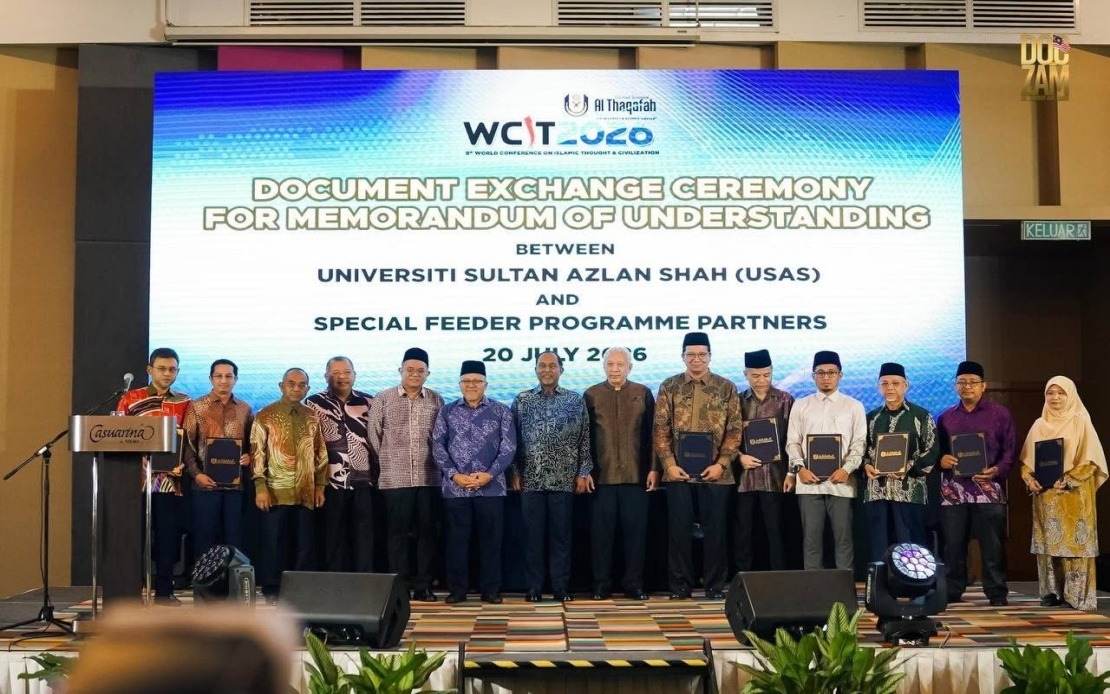
Malaysia is doubling down on its ambition to emerge as a global nexus for academic dialogue and intellectual advancement, particularly within Islamic thought and civilisation studies. Higher Education Minister Datuk Seri Dr Zambry Abdul Kadir articulated this vision in the context of the 8th World Conference on Islamic Thought and Civilisation (WCIT2026), positioning the nation as both a bridge for cross-cultural exchange and a leader in fostering progressive, values-driven knowledge systems. This strategic positioning reflects Kuala Lumpur's broader efforts to attract international scholars and position Malaysian institutions as serious players in global academia.
The WCIT2026 conference, which commenced with considerable momentum, has already demonstrated the appetite for such gatherings. An inaugural dinner hosted by Universiti Sultan Azlan Shah drew together more than 180 delegates, scholars, researchers, and intellectuals representing numerous countries, signalling strong international participation and validating Malaysia's capacity to convene global academic communities. The gathering underscored a shared commitment among participants to elevate intellectual discourse and strengthen Islamic thought's relevance to contemporary global challenges—a mandate that extends far beyond theological examination into practical solutions for modern societies.
Datuk Seri Zambry's address struck a notable chord by cautioning against what he characterised as mere nostalgia for past Islamic scientific and cultural achievements. Instead, he advocated for a future built on contemporary research, innovation, integrity-driven institutional leadership, and competitive educational systems capable of competing globally. This framing is significant for Malaysia, as it positions the nation not as a guardian of historical memory alone, but as an incubator for forward-thinking solutions grounded in Islamic values—a distinction that could appeal to diverse stakeholders seeking intellectual engagement rather than ideological reinforcement.
A crucial element of his message centred on the universality of knowledge itself. By emphasising that education must transcend the artificial boundaries imposed by politics, conflict, and technology, the minister articulated a perspective that resonates with Malaysia's multicultural context and its aspiration to be seen as neutral intellectual ground. This stance is particularly relevant in a region where geopolitical tensions and competing narratives often politicise educational discourse. Malaysia's willingness to frame knowledge as humanity's shared inheritance rather than the exclusive domain of any single nation or civilisation positions it favourably for attracting scholars and institutions seeking apolitical academic spaces.
Datuk Seri Zambry's invocation of historical destruction—Baghdad's libraries, Granada's cultural erasure, Sarajevo's academic institutions, and Palestine's ongoing suffering—served to contextualise why robust universities and vibrant intellectual communities matter beyond academic prestige. The destruction of these seats of learning represented not merely physical loss but the obliteration of civilisational futures and accumulated human wisdom. This framing elevates the work of WCIT2026 beyond conference proceedings; it positions academic excellence and institutional resilience as acts of civilisational preservation and progress.
For Malaysia specifically, hosting such international gatherings offers tangible benefits. The nation gains soft power and cultural influence by establishing itself as a destination for serious intellectual work, potentially attracting research funding, collaborative partnerships, and talented academics. Malaysian universities benefit from exposure to global scholarly networks, while the country enhances its reputation as a stable, welcoming environment for international academic exchange. This has particular resonance in Southeast Asia, where Malaysia competes with other regional hubs for educational investment and intellectual talent.
The three-day format of WCIT2026 suggests an intensive working conference rather than a ceremonial gathering, indicating serious intent to produce substantive outcomes. The minister's hope that the conference would yield resolutions and actionable ideas reflects Malaysia's commitment to translating intellectual dialogue into tangible contributions to Islamic world advancement and global welfare. This pragmatic orientation distinguishes the conference from purely theoretical exercises and positions its findings as potentially influential in policy circles and academic institutions across multiple countries.
The breadth of representation at the opening dinner—encompassing diverse countries, research traditions, and intellectual perspectives—hints at the conference's inclusive approach to Islamic thought. Rather than promoting a singular interpretation, WCIT2026 appears designed to facilitate multiple viewpoints, a strategy that strengthens intellectual rigour and appeal. For Malaysia, which espouses moderate Islamic approaches and champions interfaith dialogue, this positioning aligns with national values and foreign policy objectives.
Looking forward, Malaysia's commitment to serving as a knowledge bridge carries implications for the region's intellectual architecture. As geopolitical tensions rise and global knowledge production becomes increasingly fragmented along ideological lines, the availability of genuinely inclusive academic platforms becomes more valuable. Malaysia's success in hosting high-quality international conferences on Islamic thought could establish a model for Southeast Asian knowledge diplomacy, demonstrating how the region can contribute meaningfully to global intellectual discourse while honouring particular cultural and civilisational perspectives.
The higher education sector stands to gain considerably from this national initiative. Universities competing for international rankings and research collaborations benefit when their home country is recognised as a serious intellectual destination. Malaysian institutions hosting WCIT2026 activities gain visibility, potential partnership opportunities, and recruitment advantages in attracting international talent. The ripple effects extend to postgraduate research, funding opportunities, and the country's overall brand as a knowledge economy.
Ultimately, Malaysia's positioning through WCIT2026 reflects a sophisticated understanding that soft power in the modern world increasingly derives from intellectual leadership rather than military or economic dominance alone. By creating platforms for high-level scholarly exchange, particularly on topics central to Islamic and global civilisational concerns, Malaysia invests in its long-term regional and international standing. The success of this conference and similar future initiatives will substantially shape perceptions of Malaysia as a nation committed to knowledge advancement and cross-cultural dialogue.

