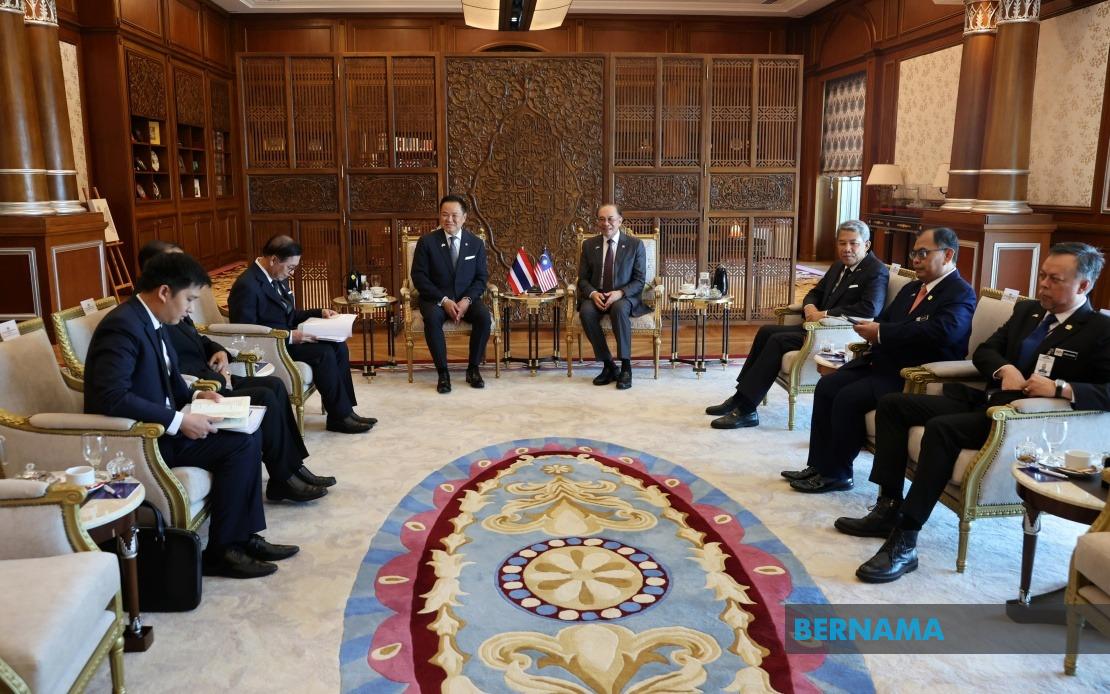
Malaysia has reiterated its commitment to resolving the ongoing Myanmar conflict through constructive engagement rather than isolation, with Prime Minister Datuk Seri Anwar Ibrahim highlighting the strategic importance of Thailand's involvement in facilitating regional dialogue. Speaking during bilateral talks with visiting Thai Prime Minister Anutin Charnvirakul at Putrajaya on Thursday, Anwar expressed alignment with Bangkok's approach to the protracted crisis, underscoring both nations' shared interest in achieving sustainable peace through diplomatic channels.
The Malaysian premier's remarks reflect ASEAN's broader diplomatic strategy since the 2021 military takeover in Yangon, which has sought to maintain the regional bloc's unity while promoting reconciliation. Anwar emphasised that Malaysia firmly believes the Myanmar people themselves must be granted the agency to determine their nation's political future, a principle central to ASEAN's non-interference doctrine while still allowing for constructive external engagement. This nuanced position attempts to balance respect for sovereign decision-making with the reality that Myanmar's instability increasingly affects neighbouring economies and regional security.
Anwar particularly stressed Thailand's unique position as Myanmar's immediate neighbour with historical and cultural ties that position Bangkok to exercise meaningful influence where other regional players face limitations. As a country sharing both a land border and deep commercial networks with Myanmar, Thailand possesses practical advantages in encouraging dialogue among conflicting parties. The Malaysian government views Thai engagement not as interference but as natural regional diplomacy from a trusted neighbour with vested interests in Myanmar's stabilisation.
The emphasis on Thailand's role reflects Malaysia's pragmatic assessment that sustainable solutions require buy-in from major regional stakeholders closest to the crisis. Unlike more distant ASEAN members, Thailand's geographical proximity and economic interdependence with Myanmar create stronger incentives for constructive involvement. Malaysia's public support for this approach signals broader ASEAN consensus that isolated Myanmar serves no one's interests, and that maintaining diplomatic channels—particularly through sympathetic neighbours—offers the best realistic path toward eventual reconciliation.
The Myanmar situation has consistently dominated ASEAN's political agenda for over three years, testing the bloc's commitment to its founding principles of non-interference while grappling with the humanitarian and security consequences of regional instability. Malaysia's advocacy for effective engagement acknowledges that purely rhetorical condemnation has yielded limited results, necessitating more sophisticated diplomatic strategies. The Five-Point Consensus, repeatedly referenced in ASEAN deliberations, remains the collective framework for regional efforts, though implementation has proven challenging amid Myanmar's deepening political fragmentation.
Beyond Myanmar, Anwar addressed the Thailand-Cambodia border tensions, another sensitive regional issue affecting ASEAN cohesion. The Malaysian premier expressed appreciation for Anutin's stated commitment to maintaining peace along that disputed frontier, signalling Malaysia's confidence in Thai leadership's inclination toward restraint. By publicly acknowledging Thailand's peaceful intentions, Anwar reinforced the importance of bilateral trust and mutual reassurance among ASEAN leaderships during a period of geopolitical complexity.
Anwar stressed that Malaysia places confidence in the wisdom and judgment of the leaders directly involved in border disputes to resolve their differences through peaceful mechanisms without external pressure. This deference reflects ASEAN's consensus-based diplomatic culture, where public lecturing of member states is considered counterproductive. Instead, Malaysia positions itself as a sympathetic observer willing to facilitate dialogue when requested, rather than as a critic imposing external solutions. This approach has become increasingly important as ASEAN seeks to prevent internal divisions that could be exploited by major powers.
Anutin's visit marked his first bilateral journey to Malaysia since his reinstatement as Thai Prime Minister in March 2026, underscoring the significance both nations place on high-level engagement. The two-day official visit included substantive discussions on regional security architecture, bilateral economic cooperation, and ASEAN institutional matters. By hosting the Thai premier, Malaysia demonstrated its investment in maintaining close relationships with key regional partners, essential for coordinating approaches to transnational challenges including Myanmar's crisis.
The bilateral agenda extended to practical cross-border cooperation, with Anwar and Anutin scheduled to jointly inaugurate a new road infrastructure project linking the Immigration, Customs, Quarantine and Security Complex in Bukit Kayu Hitam, Kedah, with Thailand's corresponding Customs, Immigration and Quarantine facility in Sadao. This infrastructure development symbolises Malaysia and Thailand's commitment to seamless regional integration and efficient people-to-people movement, complementing their diplomatic efforts on broader political issues. Improved border infrastructure facilitates not only legitimate commerce but also intelligence sharing and security cooperation.
For Malaysian observers and ASEAN watchers, Malaysia's consistent advocacy for dialogue-based solutions to Myanmar reflects both principled commitment to peaceful resolution and pragmatic recognition that the region's prosperity depends on stability. The approach avoids the false binary between legitimising military rule or imposing isolation, instead maintaining channels for eventual political transitions. By elevating Thailand's role as a bridge between ASEAN and Myanmar's military establishment, Malaysia acknowledges that sustainable peace requires engagement with all stakeholders, however morally complicated such diplomacy may appear.
The convergence of Malaysian and Thai positions on Myanmar holds implications for ASEAN's collective stance moving forward. As two of the bloc's most influential members in Southeast Asia's political geography, their alignment on pursuing effective engagement signals that major regional powers remain committed to solutions rooted in dialogue rather than confrontation. This consistency provides hope that despite Myanmar's internal divisions and international pressure, ASEAN members will maintain their commitment to the patient diplomacy that remains the bloc's primary tool for regional conflict management.

