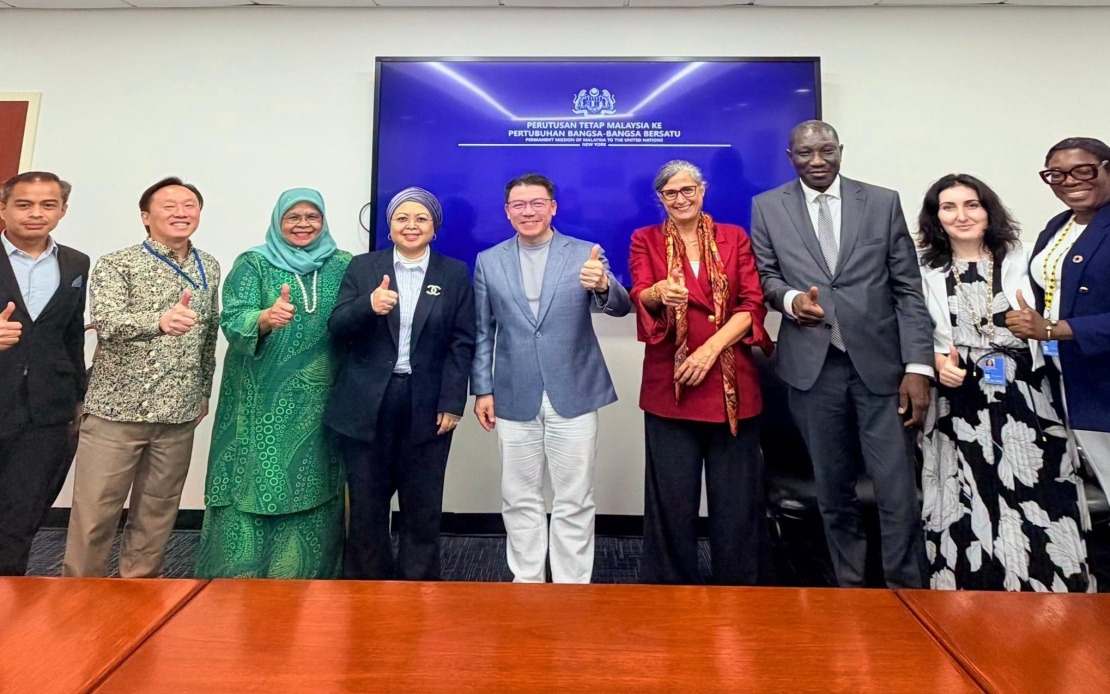
During a high-level gathering at the United Nations in New York this week, Malaysia has intensified its push for accelerated global progress on sustainable urbanisation, arguing that member states must move decisively beyond merely documenting progress and instead focus on delivering meaningful results for the billions of people already residing in cities worldwide. Housing and Local Government Minister Nga Kor Ming emphasised that the current midterm review of the New Urban Agenda represents a pivotal moment for nations to demonstrate real commitment through concrete action rather than rhetorical flourishes about future intentions.
The urgency underlying Malaysia's position stems from a stark reality: only four years remain until the 2030 deadline for achieving the Sustainable Development Goals and implementing the New Urban Agenda framework adopted by the international community. Nga framed the midterm review not as an opportunity to assess what went wrong, but as a critical juncture where nations must fundamentally shift approach and prioritise delivery over analysis. This framing reflects growing frustration in developing regions with the gap between pledged commitments and actual implementation on the ground, a challenge that resonates particularly across the Asia-Pacific region where rapid urbanisation outpaces infrastructure development.
As President of the UN-Habitat Assembly, Nga positioned Malaysia at the forefront of advocating for stronger regional and global mechanisms to address three interconnected crises confronting urban centres everywhere: the acute shortage of affordable housing, the persistent digital divide separating urban rich from poor communities, and the mounting vulnerability of cities to climate impacts. He stressed that solutions must be rooted in the principle of inclusivity, ensuring that marginalised communities and developing regions do not bear disproportionate costs of the urban transition and that progress benefits all segments of urban populations.
Malaysia's own achievements in green building construction provide concrete evidence for the minister's arguments. The country has already surpassed 500 million square feet of buildings certified under green index standards, demonstrating that large-scale climate-resilient infrastructure deployment is technically and economically feasible. Nga indicated that Malaysia intends to expand this achievement further before 2030, positioning the country as both a practitioner and advocate for sustainable urban development practices that other nations can learn from and adapt to their own contexts.
Central to Malaysia's regional strategy is the Asia-Pacific Urban Action Platform, which the country champions in partnership with neighbouring governments. This mechanism addresses a persistent challenge in implementing global urban agendas: translating international commitments into locally appropriate solutions that reflect regional circumstances and cultural contexts. The platform facilitates knowledge exchange among Asia-Pacific cities, strengthens financing mechanisms for green infrastructure projects, and most importantly, helps localise the Sustainable Development Goals so that global targets become meaningful priorities for municipal administrators and community leaders managing daily urban challenges.
The minister's statements reflect a broader conviction that sustainable urbanisation requires a multi-stakeholder approach transcending traditional divisions between national governments, local authorities, private sector actors, and grassroots communities. Meaningful urban transformation, according to Malaysia's position articulated in New York, depends fundamentally on strong political commitment from national leaders, locally-driven solutions that respect community agency and knowledge, and robust collaboration mechanisms linking governments with development partners and on-the-ground stakeholders who understand specific urban contexts intimately.
Malaysia's framing of sustainable cities through its MADANI Economy framework adds an indigenous conceptual dimension to global urbanisation discourse. Rather than simply importing western models of urban development, the MADANI approach emphasises people-centric development that prioritises economic inclusivity alongside environmental sustainability and social cohesion. This positioning allows Malaysia to offer distinctive perspectives shaped by Southeast Asian development experiences and to lead discussions about alternative pathways to urbanisation that do not necessarily replicate Western patterns of urban growth.
The two-day High-Level Meeting itself, themed around delivering sustainable urbanisation for all through scaled implementation of the New Urban Agenda toward 2036, assembled the full spectrum of urban actors: United Nations member states, senior government officials, mayors and local government leaders, and civil society organisations representing grassroots constituencies. This comprehensive gathering structure reflects recognition that cities cannot be governed or developed effectively through top-down national policies alone, and that sustainable urban futures require genuine partnership between multiple governance levels and non-state actors.
For Malaysian and Southeast Asian readers, Nga's intervention carries particular significance because rapid urbanisation across the region continues to generate acute housing shortages, infrastructure deficits, and environmental pressures. Cities across Malaysia, Indonesia, Thailand, Vietnam and the Philippines are expanding faster than municipal governance capacity and infrastructure investment can accommodate, creating widening disparities between formal city centres and sprawling informal settlements. The minister's insistence that the international community invest substantially in climate-resilient infrastructure and inclusive urban development directly addresses these regional realities.
The explicit recognition and appreciation extended to various global actors—from UN General Assembly President Annalena Baerbock to UN Secretary-General António Guterres and UN-Habitat Executive Director Anacláudia Rossbach—underscores that Malaysia views sustainable urbanisation as requiring coordinated international leadership rather than isolated national efforts. This diplomatic posturing also strengthens Malaysia's hand in ongoing negotiations around climate financing, green infrastructure funding, and technology transfer mechanisms that developing nations depend upon to implement ambitious urban sustainability programmes.
Malaysia's call for renewed determination to build inclusive, equitable and sustainable cities that leave no one and no place behind carries practical implications for how the country and its regional partners allocate resources and structure urban governance. The emphasis on leaving no community behind speaks directly to challenges of urban inequality, informal settlements, and the digital divide that characterise metropolitan areas across Southeast Asia. By foregrounding these concerns at the UN level, Malaysia attempts to ensure that international urban development frameworks and financing mechanisms prioritise precisely these marginalised populations.
Looking ahead to 2030, Malaysia's positioning as a vocal advocate for accelerated implementation rather than further deliberation suggests the country intends to lead by example, scaling its green building achievements, deepening regional knowledge-sharing through the Asia-Pacific Urban Action Platform, and potentially mobilising financing for sustainable urban projects across the region. The four-year countdown to 2030 will test whether international commitments translate into measurable improvements in urban living conditions for the billions of people already inhabiting the world's cities.

