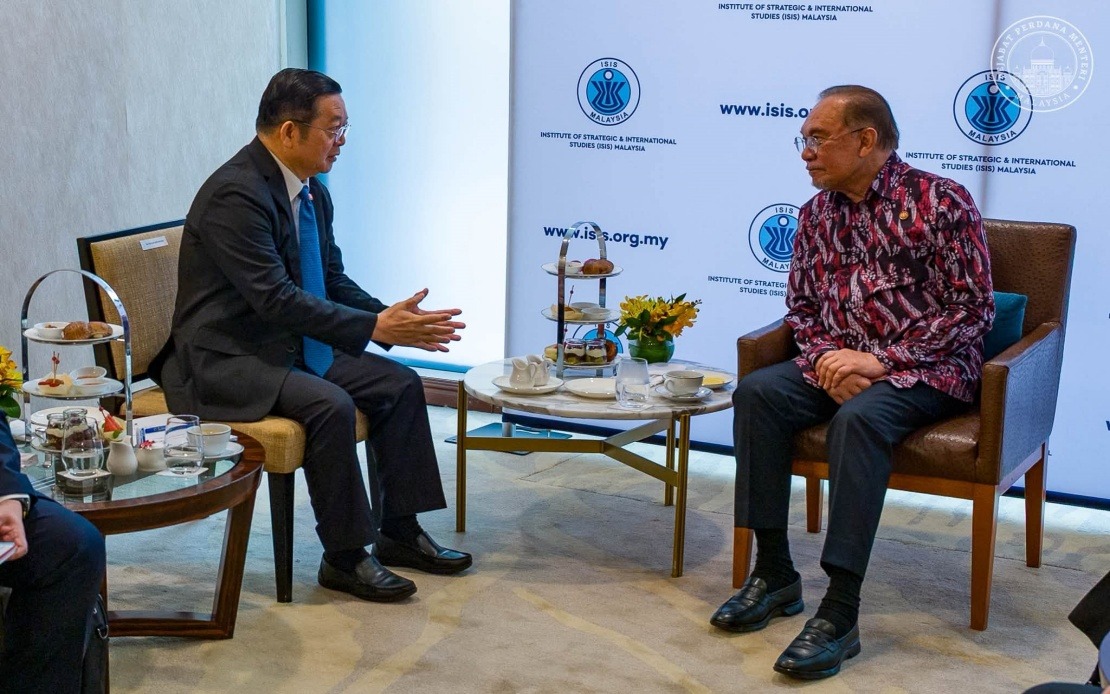
Prime Minister Datuk Seri Anwar Ibrahim has renewed Malaysia's commitment to playing a constructive role in strengthening ASEAN as a resilient and inclusive community capable of meeting the needs and aspirations of its 650 million people. The declaration came during a courtesy visit by ASEAN Secretary-General Dr Kao Kim Hourn to the Prime Minister's office in Kuala Lumpur, following Anwar's keynote address at the 39th Asia-Pacific Roundtable, a prestigious forum convening regional policy leaders, academics, and business figures to discuss critical geopolitical and economic issues shaping the Indo-Pacific.
The high-level engagement underscores Malaysia's positioning as a steady voice within the 10-member Southeast Asian bloc at a moment when the region faces compounding pressures from multiple directions. Anwar, who holds the additional portfolio of Finance Minister, seized the opportunity to exchange strategic perspectives on the array of challenges confronting ASEAN's collective interests and its ability to maintain relevance in an era of intensifying great power competition and shifting economic alignments. The substantive nature of their discussion signals that Kuala Lumpur views regional cohesion not as a luxury but as a strategic imperative for Malaysian interests and broader Southeast Asian prosperity.
Among the pivotal issues that dominated their conversation was the ongoing Myanmar crisis, a persistent test of ASEAN's unity and decision-making credibility. The military coup in 2021 and subsequent instability have fractured the bloc's consensus approach, with different members taking divergent stances on engagement and accountability. Myanmar's continued descent into conflict threatens to destabilise a neighbour with direct land borders shared by Thailand and regional ramifications for refugee flows, drug trafficking, and armed group activity. Malaysia's involvement in seeking constructive pathways forward reflects its broader concern that unchecked instability in Myanmar could undermine ASEAN's collective standing and complicate efforts to present a unified front on other pressing matters.
The South China Sea disputes also featured prominently in their talks, an issue that remains a persistent flashpoint with potential to ignite broader conflict. Competing territorial and maritime claims involving China, Vietnam, the Philippines, and other claimant states have created an environment of strategic mistrust and occasional military posturing. Malaysia's three-pronged interest—as a claimant state itself, a major shipping hub relying on freedom of navigation, and a voice advocating for rules-based frameworks—places Kuala Lumpur in a delicate position. Anwar's emphasis on this issue during discussions with the ASEAN Secretary-General indicates Malaysia's determination to pursue dialogue-based solutions and advance the Code of Conduct negotiations that seek to establish clearer guidelines for conduct in contested waters.
Artificial intelligence emerged as a contemporary concern reflecting ASEAN's forward-looking agenda. As AI technologies reshape economies, security systems, and governance structures globally, the bloc faces urgent questions about standards-setting, workforce adaptation, and safeguarding against misuse. Malaysia's consideration of these issues at the highest political level demonstrates awareness that technological advancement is not merely an economic matter but carries profound implications for social stability, employment, and the region's ability to compete in a digital economy. The discussion suggests Malaysia is advocating for an ASEAN-wide approach to AI governance rather than allowing individual member states to pursue fragmented policies.
The full accession of Timor-Leste into ASEAN represents another pivotal topic that shaped the conversation. After formally joining the bloc in 2002, the Southeast Asian nation has now completed post-accession procedures, marking an important milestone in regional integration. The implications extend beyond ceremonial recognition to include deeper economic ties, security cooperation, and institutional participation. For Malaysia, Timor-Leste's fuller integration presents both opportunities for enhanced maritime cooperation and considerations regarding management of an expanded membership with its own distinct development challenges and strategic alignments.
Implementation of the ASEAN Community Vision 2045, an ambitious blueprint for deeper regional integration across political-security, economic, and socio-cultural pillars, constituted another element of substantive discussion. This roadmap commits members to advancing free movement of goods, services, investment, and skilled workers, while strengthening institutional mechanisms and people-to-people connectivity. Malaysia, as a major economic engine within ASEAN and home to significant ASEAN diaspora communities, has substantial stakes in realising this vision's potential and addressing implementation bottlenecks that have hindered progress since the ASEAN Community's formal establishment in 2015.
The reverberations of the West Asia conflict, particularly the Israel-Palestine tensions and broader Middle Eastern instability, occupy an increasingly central place in ASEAN strategic calculations. Beyond humanitarian concerns, regional states worry about potential disruptions to global energy markets, impacts on diaspora communities, and the risk that great power competition could extend into the Middle East with consequences for Southeast Asia. Malaysia's Muslim-majority population and historical engagement with Palestinian causes ensure that developments in West Asia resonate domestically. Anwar's inclusion of this issue in discussions with ASEAN's top official suggests Malaysia views regional conflict management as intimately connected to ASEAN's capacity to maintain equidistance from competing power blocs.
Anwar's emphasis on ASEAN upholding principles of unity, centrality, and close cooperation reflects deeper concerns about the bloc's institutional coherence. Unity faces strain from divergent political systems, development levels, and strategic partnerships. Centrality—ASEAN's central role in shaping regional architecture—faces pressure as China and the United States pursue parallel engagement mechanisms outside traditional ASEAN frameworks. Close cooperation has been tested by member states' varying responses to sanctions, diplomatic initiatives, and security partnerships. Malaysia's reaffirmation of these principles signals its commitment to preserving ASEAN's agency and relevance rather than allowing it to become a venue where external powers impose their preferences.
The timing of this engagement carries particular significance given Malaysia's presidency of ASEAN Council in 2024, a rotating position that grants increased visibility and responsibility for advancing the bloc's agenda. Anwar's active engagement with the ASEAN Secretary-General, combined with his keynote address at the Asia-Pacific Roundtable, positions Malaysia as a thoughtful, engaged member state capable of articulating constructive positions on complex regional questions. For Malaysian readers and policymakers, the message is that Kuala Lumpur intends to leverage its ASEAN role to advance stability, prosperity, and the rules-based international order upon which Malaysia's own interests fundamentally depend, even as the region navigates unprecedented geopolitical turbulence and economic uncertainty.

