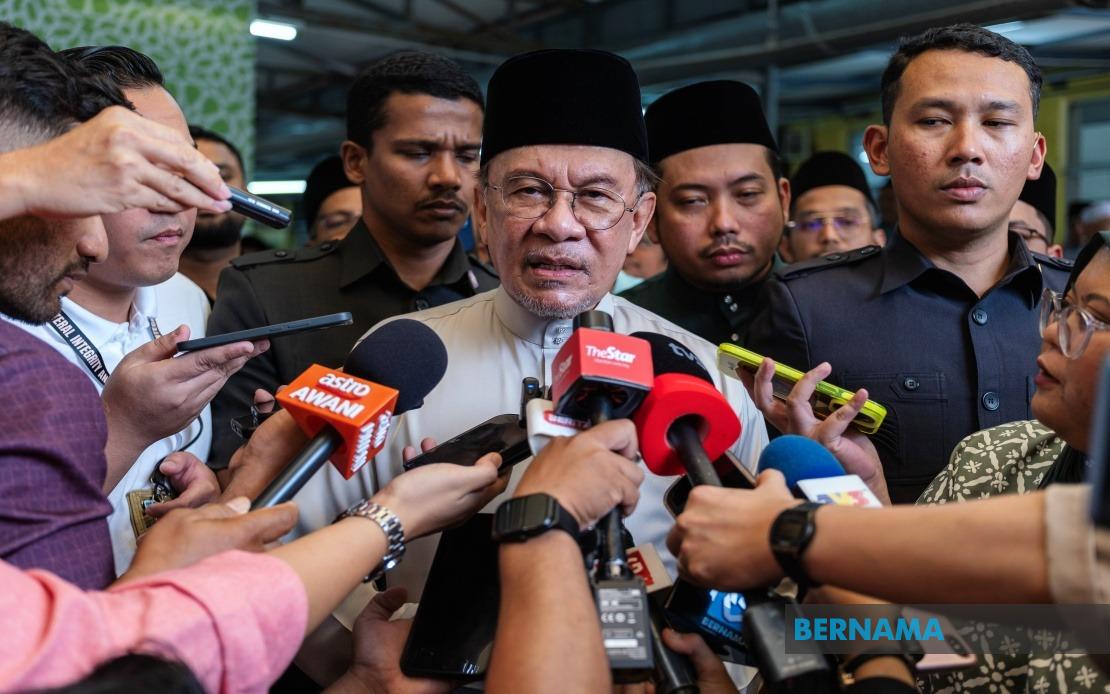
Prime Minister Datuk Seri Anwar Ibrahim has made clear that Malaysia will not budge from its established position on fugitive businessman Low Taek Jho, commonly known as Jho Low, notwithstanding international speculation that he may receive consideration for a pardon from United States President Donald Trump. The statement came as reports circulated suggesting that Jho Low could be among approximately 250 individuals potentially under review for clemency as the US marks its 250th Independence Day.
Anwar's remarks, delivered to journalists following Friday prayers at Masjid As-Sodiqin in Taman Kobena, underscored the government's determination to pursue accountability through legal channels regardless of external developments. The Prime Minister articulated that while Washington's decisions remain entirely within American jurisdiction and beyond Malaysia's sphere of influence, Kuala Lumpur's commitment to prosecuting Jho Low through its own judicial system remains non-negotiable.
The timing of these comments reflects growing international interest in the case of the fugitive financier, whose alleged role in the 1Malaysia Development Berhad scandal has made him one of Malaysia's most wanted figures abroad. Jho Low's absence from Malaysian courts despite facing multiple charges represents an ongoing embarrassment for the nation's law enforcement apparatus, and any indication that he might escape accountability through foreign intervention has long been viewed with concern by Malaysian authorities.
Anwar's explicit statement that Malaysia "will not be influenced, disturbed or affected by any US decision" sends a forceful message both domestically and internationally. The phrasing itself suggests awareness that such foreign interventions, if they occur, could be viewed as undermining Malaysia's judicial processes. By preemptively establishing this position, the government appears to be protecting its credibility and demonstrating to the Malaysian public that it will not accept external pressure when it comes to enforcing the rule of law.
The historical context makes this stance particularly significant. The 1MDB scandal, which allegedly involved billions of dollars siphoned from the sovereign wealth fund, captivated global attention and severely damaged Malaysia's international reputation. Jho Low's role in facilitating these transactions and his subsequent disappearance reinforced perceptions of impunity among the wealthy and connected. Any suggestion that he might evade justice through diplomatic means would reinforce such narratives and further undermine public confidence in Malaysia's commitment to accountability.
From a geopolitical perspective, Anwar's comments also reflect Malaysia's careful balancing act in its relationship with the United States. While Malaysia maintains strong bilateral ties with Washington and values American support on various regional and strategic issues, it is equally determined not to appear subordinate to American decision-making on matters of domestic law enforcement. This independent posture is particularly important given Malaysia's position as a developing nation keen to assert its sovereignty and maintain the trust of its own citizens.
The Jho Low case has also become emblematic of Malaysia's broader anti-corruption agenda. Since the change in government in 2022, the administration has invested considerable political capital in demonstrating its commitment to rooting out corruption and holding powerful figures accountable. Allowing external pressure to influence Malaysia's pursuit of Jho Low would send the opposite message and could embolden other fugitives or reduce the deterrent effect of the legal system.
Parallel to these discussions about Jho Low, Anwar noted that Malaysia has received a proposed contribution of RM1 million from the United States for the restoration of Tugu Negara, the National Monument, as part of celebrations marking Malaysia's independence day next year. While this appears to be a separate matter, it illustrates the complexity of Malaysia-US relations, which encompass cooperation across multiple domains even as the two nations maintain distinct positions on individual cases.
The Prime Minister indicated that the proposed American contribution would be discussed at an upcoming Cabinet meeting, suggesting that the matter requires governmental deliberation before acceptance or implementation. This measured approach reflects careful consideration of how such gestures are received and whether they might be interpreted as having strings attached or as an attempt to influence Malaysian government positions.
Looking forward, Malaysia's position on Jho Low appears unlikely to shift regardless of any American action. The government has invested too much political capital in pursuing accountability in the 1MDB scandal to abandon that commitment now. Furthermore, allowing a high-profile fugitive to escape through foreign intervention would create precedent that could undermine future law enforcement efforts and investigations.
For Malaysian observers and the international community, Anwar's statement reinforces that while Malaysia values its strategic partnerships with major powers like the United States, it will not compromise on its fundamental commitment to the rule of law or allow external pressure to dictate internal judicial processes. This determination will likely remain a defining feature of Malaysia's approach to the Jho Low case, regardless of developments elsewhere.

