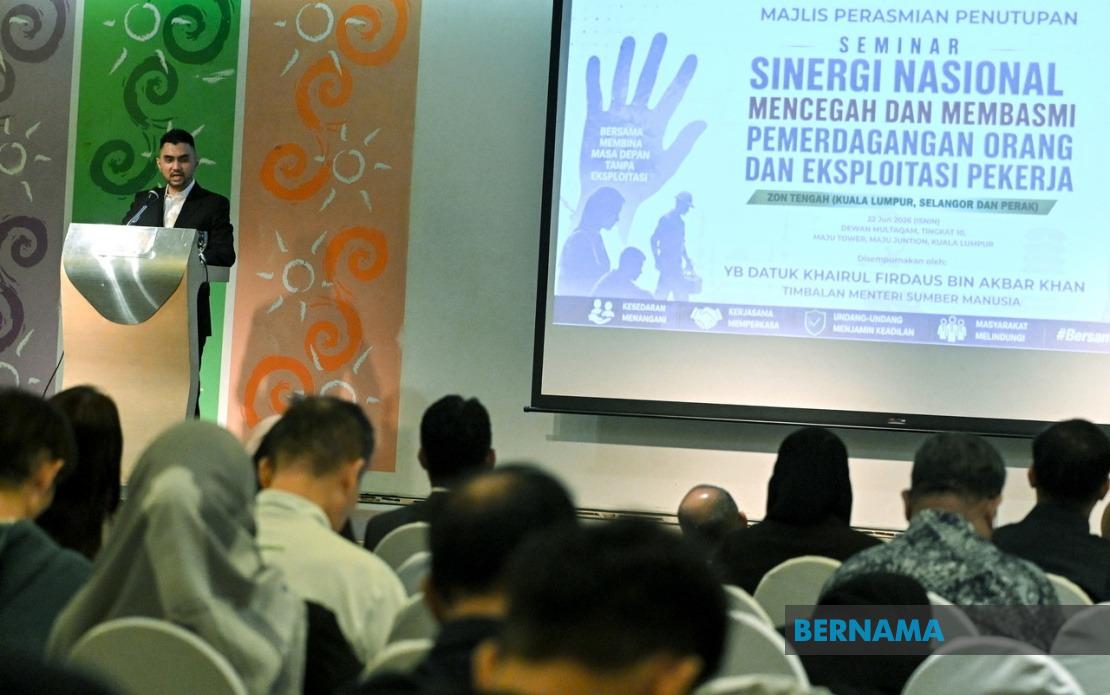
Malaysia's efforts to combat human trafficking and labour exploitation appear to be yielding measurable results, with official statistics showing a marked decline in the number of victims rescued over the past three years. Deputy Human Resources Minister Datuk Khairul Firdaus Akbar Khan attributed this downward trajectory to the strengthened enforcement and prevention measures rolled out across the country, offering cautious optimism about the nation's progress on this critical human rights issue.
Data compiled by the Peninsular Malaysia Manpower Department reveals a sharp contraction in rescue cases. The figures show 70 victims identified and assisted in 2023, a substantial reduction to 10 by the end of 2024, followed by a slight uptick to 17 throughout 2025. However, the current year's numbers remain minimal, with only four victims rescued during the five-month period ending May 2026. While these statistics suggest improved oversight and stronger controls, Khairul Firdaus cautioned that the apparent decline should not breed complacency among authorities or the public.
The minister's warning reflects an uncomfortable reality facing anti-trafficking operations across Southeast Asia: reported cases often represent merely the visible fraction of a much larger problem. Traffickers and exploiters typically operate in shadows, targeting vulnerable populations with limited access to reporting mechanisms or legal assistance. The gap between actual incidents and formally documented cases could be substantial, meaning Malaysia's declining numbers may reflect changing enforcement visibility rather than genuine reductions in victimization. This distinction carries profound implications for policy makers attempting to gauge the true scale of the crisis.
To address trafficking comprehensively, the Malaysian government has ramped up workplace enforcement activities. Between January and May 2026 alone, authorities conducted 386 nationwide operations specifically targeting labour-related violations and exploitation. These sweeps generated 311 formal investigation papers, indicating that enforcement personnel encountered numerous breaches warranting further scrutiny. The intensity of these operations demonstrates resource commitment, though questions persist about whether the capacity exists to detect sophisticated trafficking networks operating across borders or within informal sectors.
Malaysia's anti-trafficking agenda aligns with international frameworks established by the International Labour Organisation, to which the government has committed through ratified protocols. This alignment reflects broader recognition that modern slavery and forced labour transcend national boundaries, requiring coordinated multilateral responses. By anchoring domestic policy to ILO standards, Malaysia positions itself within a global movement to eliminate exploitative labour practices, though implementation gaps between aspiration and execution remain evident in many countries throughout the region.
A significant component of Malaysia's prevention strategy involves public awareness and institutional coordination. The National Synergy Seminar on Preventing and Eradicating Human Trafficking and Labour Exploitation represents this educational approach, bringing together stakeholders from government, civil society, business, and community organizations. The Central Zone iteration represented the latest in a rolling series of regional forums designed to build understanding and share best practices. Previous seminars reached participants in the North Zone at Sungai Petani, Kedah during May, and the South Zone at Kluang, Johor in early June.
These awareness campaigns have attracted substantial participation, with nearly 1,000 individuals attending across the regional seminars to exchange perspectives and devise collaborative strategies. Such gatherings create critical networking opportunities for frontline workers, investigators, social workers, and community leaders who encounter trafficking situations. The deliberate geographic dispersal of seminars ensures that enforcement and prevention knowledge reaches beyond federal urban centres to areas where trafficking vulnerabilities often concentrate among migrant workers and economically marginalized populations.
The trafficking and labour exploitation challenges facing Malaysia reflect broader Southeast Asian vulnerabilities. The region's rapid economic development, coupled with significant rural-urban migration and cross-border movement, creates conditions where criminal networks exploit desperate individuals seeking employment. Malaysian employers in agriculture, construction, domestic service, and manufacturing sectors have historically attracted workers from Bangladesh, Myanmar, Indonesia, and Cambodia, some of whom arrive under coercive arrangements or face wage theft and confinement after arrival. Addressing these systemic factors requires sustained commitment across multiple government agencies, employers, and neighboring countries.
The Peninsular Malaysia Manpower Department's role in coordinating these efforts places workplace standards enforcement at the frontline of anti-trafficking action. Unlike agencies focused on immigration or criminal investigation, manpower departments maintain regular contact with employers and workers through inspections and compliance monitoring. This positioned advantage means workplace inspectors can identify indicators of trafficking or severe exploitation during routine audits, provided they receive adequate training to recognize warning signs. The 386 operations conducted during the first five months of 2026 suggest active deployment of this capacity, though resource constraints likely limit coverage of the estimated millions of workers across peninsular Malaysia.
Looking forward, Malaysia's anti-trafficking framework will require continued evolution to address emerging vulnerabilities. Digital platforms increasingly facilitate trafficking recruitment through deceptive job advertisements targeting overseas workers. Supply chains in agriculture, manufacturing, and seafood industries maintain opacity that shields exploitative practices from external scrutiny. Migrant workers lack the legal protections and documentation status that would enable them to report abuses without risking deportation. These structural challenges demand solutions extending beyond enforcement operations to encompass legal reform, employer accountability mechanisms, and bilateral agreements with source countries to protect workers throughout their employment journey.
The declining rescue statistics, while superficially encouraging, therefore warrant interpretation within this complex operational context. Genuine progress against trafficking requires not only enforcement intensity but also prevention systems that address root causes of vulnerability, legal frameworks protecting marginal workers, and victim support services that enable survivors to rebuild lives without fear. Malaysia's continued seminar series and multi-agency coordination represent necessary but insufficient responses to a problem that ultimately reflects deeper economic inequalities and governance gaps across the region.