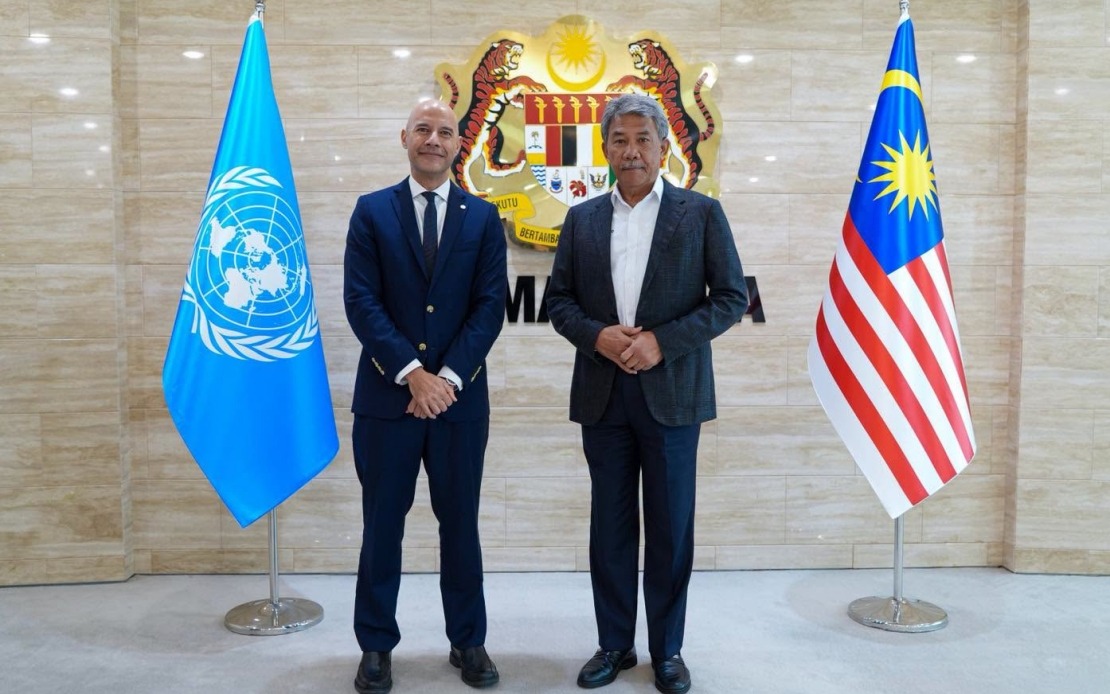
Malaysia's top diplomat has signalled renewed commitment to strengthening the country's partnership with the United Nations through a formal meeting with the organisation's newly appointed regional coordinator. Foreign Minister Datuk Seri Mohamad Hasan hosted Nikolas Myint, the freshly installed United Nations Resident Coordinator covering Malaysia, Singapore and Brunei, during a courtesy call at the Foreign Ministry headquarters, Wisma Putra, on Wednesday. The encounter underscored Malaysia's ongoing engagement with the multilateral system at a time when regional and global cooperation mechanisms face mounting pressure from geopolitical tensions and transnational challenges.
Myint's appointment by United Nations Secretary-General Ban Ki-moon on May 31, 2026, marks a significant shift in UN representation across the tri-nation bloc, consolidating oversight of three strategically important economies within Southeast Asia's broader geopolitical landscape. The timing of this formal reception by Malaysia's Foreign Minister reflects Kuala Lumpur's recognition of the UNRC's expanded mandate and the importance of establishing productive working relationships from the outset. As the coordinator assumes responsibility for coordinating UN agency operations across three distinct but interconnected economies, the inaugural engagement signals both protocol and substantive intent.
During their discussion, both parties seized the opportunity to explore the contours of future cooperation, with particular emphasis on how UN mechanisms and agencies might better support Malaysia's domestic priorities while contributing to broader regional stability and development objectives. The Foreign Ministry subsequently published the Foreign Minister's remarks on social media, highlighting that the meeting facilitated a comprehensive exchange of perspectives on bilateral cooperation frameworks between Kuala Lumpur and the United Nations system. This public acknowledgment serves multiple purposes: it demonstrates Malaysia's commitment to transparent governance, establishes a narrative of proactive multilateral engagement, and sets expectations for enhanced coordination in the months ahead.
The Foreign Minister's statement underscores Malaysia's principled stance on the role of multilateral institutions in addressing contemporary global predicaments. Specifically, Mohamad emphasised that Malaysia recognises the United Nations as an essential architecture for tackling interconnected challenges ranging from climate change and pandemic preparedness to security threats and sustainable development imperatives. This framing positions Malaysia not merely as a participant in the international system but as an active stakeholder invested in strengthening the legitimacy and effectiveness of global governance mechanisms.
The commitment to work closely with both Myint's office and the broader constellation of UN agencies operating within Malaysian territory reflects pragmatic diplomacy. Malaysia hosts numerous UN agencies spanning humanitarian assistance, development programmes, peacekeeping support, and technical cooperation initiatives. By formalising high-level engagement with the new UNRC, the Foreign Ministry ensures streamlined communication channels and positions Malaysia to influence agenda-setting within these agencies in alignment with national priorities. This approach has historically yielded tangible benefits, from enhanced technical cooperation to priority positioning in regional programmes.
For the UN system itself, Malaysia's receptiveness to the new coordinator carries significance beyond ceremonial courtesy. As a middle power with considerable soft power influence throughout Southeast Asia, Malaysia's institutional support lends credibility to UN operations in the region. The country's consistent participation in UN mechanisms—from peacekeeping operations to sustainable development initiatives—demonstrates the kind of sustained engagement that allows the organisation to maintain operational legitimacy in an increasingly multipolar world where great power competition threatens the universalist vision underlying the UN Charter.
The broader context of this meeting extends to Malaysia's positioning within the Non-Aligned Movement and its broader South-South cooperation frameworks. By emphasising partnership with the UN, the Foreign Minister reinforces Malaysia's commitment to rules-based multilateralism at a juncture when such commitment faces challenges from states prioritising bilateral arrangements or regional blocs. This stance carries particular salience for Southeast Asia, where smaller and middle-power states depend on robust multilateral institutions to balance larger neighbours and protect their interests in an increasingly contested regional environment.
The mention of Malaysia's development aspirations in the Foreign Minister's statement signals that enhanced UN cooperation will be calibrated to serve concrete national objectives rather than representing abstract internationalism. Infrastructure development, technological capacity-building, human capital advancement, and green transition initiatives all represent areas where UN agencies bring technical expertise and financial resources. By positioning the UNRC relationship as instrumental to these goals, Malaysia frames international cooperation as a practical tool for improving citizens' lives and advancing medium-term development benchmarks.
Looking forward, the establishment of this working relationship between the Foreign Ministry and the new UN Resident Coordinator could yield expanded programming across multiple sectors. The UN's presence in Malaysia encompasses agencies focused on refugee protection, development financing, humanitarian coordination, and technical standards-setting. Strengthened dialogue at the ministerial level typically cascades into enhanced collaboration at operational levels, potentially unlocking new partnerships or accelerating existing initiatives that might otherwise face bureaucratic delays or insufficient prioritisation.
The courtesy call also reflects Malaysia's diplomatic sophistication in managing relationships with international organisations. Rather than viewing the UN purely as an external actor imposing standards or advocating positions sometimes at odds with government preferences, Malaysia's approach treats the organisation as a collaborative partner whose legitimacy and effectiveness depend on engagement with member states. This pragmatic perspective—evident in the Foreign Minister's emphasis on mutual benefit and aligned aspirations—characterises how successful middle powers navigate the contemporary international system.

