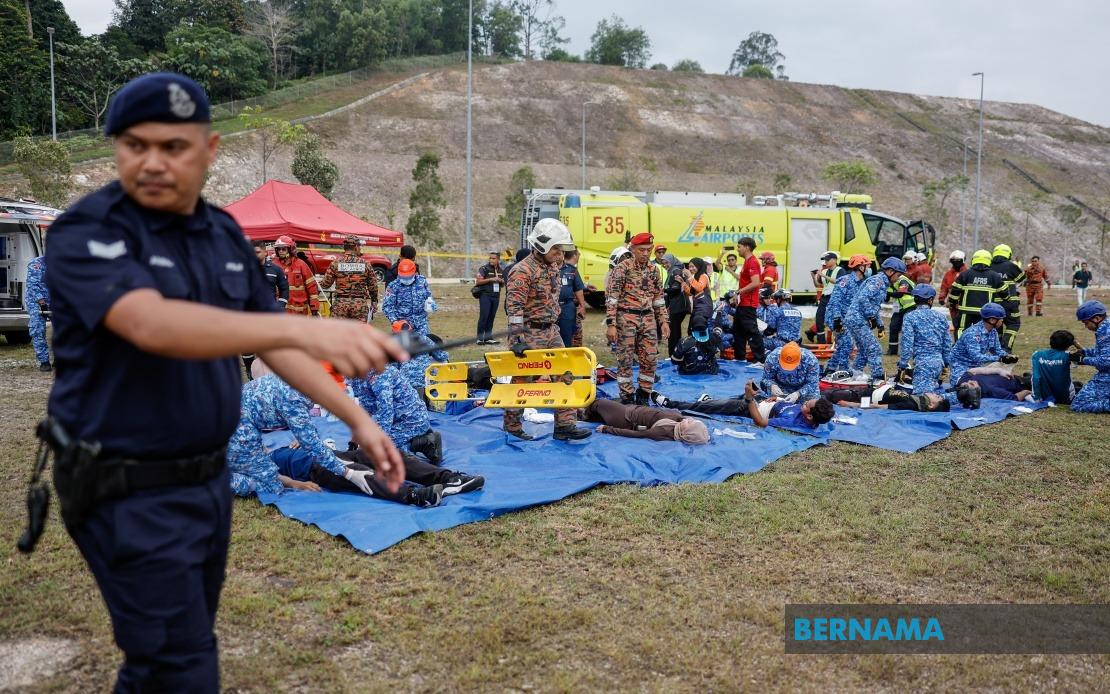
Malaysia has taken a significant step forward in aviation safety preparedness by conducting Ex Urban Falcon 2026, a comprehensive full-scale air disaster simulation that brought together over 20 enforcement and emergency response agencies to test their operational readiness and inter-agency coordination. The exercise, held at the Denai Alam Rest and Service Area along the Damansara-Shah Alam Elevated Expressway near Subang, marked an important milestone in the country's approach to managing potential aviation emergencies occurring outside traditional airport boundaries.
The simulation centred on a hypothetical ATR72 aircraft crash approximately six kilometres from Sultan Abdul Aziz Shah Airport in Subang, deliberately positioned beyond the airport perimeter to address a previously untested scenario in Malaysia's emergency response framework. According to Airport Fire and Rescue Services general manager Muhammad Hidayat Ismail, this exercise represented the first instance in which Malaysia had conducted a full-scale disaster simulation at such a distance from airport infrastructure, whereas historically such drills had been confined to areas near the airport boundary itself.
The operational scope of the exercise reflected the actual geographic responsibilities outlined in Malaysia's aviation emergency protocols. Under the National Aeronautical Search and Rescue Manual, the Airport Fire and Rescue Services maintains area coverage extending up to eight kilometres from an airport's midpoint, establishing the basis for testing response capabilities across a broader territorial range. This expansion in exercise parameters directly addresses a significant gap in Malaysia's preparedness framework, as off-airport accident scenarios present fundamentally different challenges compared to incidents occurring within controlled airport environments.
One of the foremost operational challenges identified during the exercise involved the speed of emergency response deployment. The simulated incident required responder teams to navigate narrow roads and negotiate multiple toll plazas to reach the crash site, adding crucial minutes to response times that could prove critical in real-world scenarios. This logistical reality distinguishes off-airport incidents from airport-based emergencies, where response teams operate in pre-planned environments with direct access routes and established coordination points.
The terrain characteristics of off-airport locations present another significant factor affecting casualty outcomes. Muhammad Hidayat highlighted that aircraft accidents occurring outside airport facilities typically result in substantially lower survival rates among victims compared to airport-adjacent incidents, primarily due to uneven ground conditions and reduced accessibility for rescue operations. The uncontrolled environment surrounding an off-airport crash site compounds the difficulties faced by emergency responders, who must adapt their procedures to variable geographic circumstances rather than the standardised infrastructure available at airport disaster response zones.
The magnitude of the exercise demonstrated Malaysia's commitment to comprehensive disaster management, with 450 participants drawn from critical public and private-sector agencies collaborating under a strategic partnership framework. This partnership structure involved Malaysia Airports Holdings Berhad, the National Disaster Management Agency, the Selangor state government, and PROLINTAS-DASH, reflecting the multi-jurisdictional nature of off-airport incident management. Such coordination becomes essential when incidents occur beyond airport administrative authority, requiring seamless integration of state-level emergency services, highway authorities, and municipal response capabilities.
A particularly important aspect of the simulation focused on Disaster Victim Identification operations, which would be led by the Royal Malaysia Police in actual emergency circumstances. The realistic casualty scenario presented during the exercise, wherein victims might substantially outnumber survivors, provided responders with practical experience managing mass casualty identification protocols in austere conditions. This aspect of the training addresses a critical capability gap, as DVI operations in uncontrolled environments demand specialised coordination and resource management distinct from airport-based protocols.
Muhammad Hidayat acknowledged that participating agencies demonstrated competency in executing their assigned responsibilities according to established procedures, with firefighting and rescue operations proceeding effectively throughout the exercise. However, he emphasised that the structured review process would prove essential for identifying refinement opportunities. The findings and operational challenges identified during Ex Urban Falcon 2026 were scheduled for detailed analysis during a follow-up workshop on 26 and 27 July, during which participating agencies would develop specific improvement measures and strengthen coordinated response frameworks.
From a technological perspective, Malaysia's aviation emergency response infrastructure incorporates advanced aircraft firefighting vehicles meeting specifications and standards established by the International Civil Aviation Organisation and Malaysia's Civil Aviation Authority of Malaysia. These assets, combined with the procedural frameworks tested during the exercise, position the country's emergency response capabilities favourably within regional standards. However, the off-airport dimension introduces variables that technological sophistication alone cannot address, necessitating the type of integrated operational testing that Ex Urban Falcon 2026 provided.
For Malaysian aviation stakeholders and the travelling public, the exercise reinforces the nation's commitment to maintaining comprehensive disaster preparedness across all potential incident scenarios. The willingness to identify and address previously untested response scenarios reflects a proactive rather than reactive approach to aviation safety management. By testing response protocols in geographic contexts beyond airport boundaries, Malaysia demonstrates recognition that aviation risks extend beyond controlled airport environments and require equally robust preparedness frameworks.
The inter-agency coordination demonstrated during the exercise holds particular significance for Southeast Asia's broader aviation community, where cross-border implications and shared airspace management require standardised emergency protocols. As regional aviation traffic continues expanding, the lessons derived from Ex Urban Falcon 2026 may inform best practices applicable across multiple jurisdictions within the Association of Southeast Asian Nations member states. The exercise ultimately underscores that comprehensive aviation safety requires moving beyond traditional airport-centric emergency planning to encompass the diverse geographic circumstances in which aviation incidents might occur.

