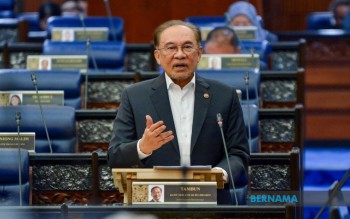
Prime Minister Datuk Seri Anwar Ibrahim has outlined how the emerging Malaysia-Thailand Border Economic Zone will fundamentally reshape trade flows across Southeast Asia, positioning Malaysia as a crucial transit point for goods moving deeper into the Indochinese peninsula. Speaking in Parliament during Minister's Question Time, Anwar explained that the joint initiative with Thailand will dismantle longstanding customs obstacles that have constrained Malaysian exports to Laos, Cambodia and Vietnam, particularly in the fisheries and agricultural sectors where Malaysia maintains competitive advantages.
The border zone represents a significant diplomatic achievement, as Thailand has formally agreed to streamline its customs procedures for Malaysian goods transiting through Thai territory toward these neighbouring markets. Previously, exporters faced stringent Thai regulatory requirements that effectively limited competitiveness and lengthened supply chains. The relaxation of these restrictions transforms the logistics landscape for Malaysian producers, allowing agricultural and seafood shipments to reach consumers across the Mekong region with greater speed and lower operational costs. This development emerges from discussions between Anwar and Thailand's Prime Minister Anutin Charnvirakul, reflecting deepening bilateral economic coordination at the highest political level.
The initiative extends beyond theoretical arrangements. The zone was formally launched at two strategic locations: Sadao on the Thai side and Bukit Kayu Hitam in Kedah, establishing physical infrastructure and institutional frameworks to facilitate this expanded trade. However, the ambitions reach further—Rantau Panjang in Kelantan has been identified as a third focal point, with coordination underway between the federal government and the state administration to accelerate development. This geographic spread reflects recognition that border communities themselves possess untapped economic potential beyond their historical role as mere transit points.
Anwar's government has explicitly structured the zone to benefit small and medium-sized enterprises rather than concentrating gains among large conglomerates. The policy framework prioritises skills development and employment generation within border communities, acknowledging that sustainable economic growth requires local populations to participate meaningfully in expanded trade activity. This approach addresses potential criticism that border zones often enrich external investors while marginalising the communities upon which they depend. Job creation through customs services, logistics, warehousing and value-added processing represents tangible benefit for residents in what have historically been economically peripheral areas.
The infrastructure dimension proves equally consequential. The federal government has committed to extending the East Coast Rail Link southward to Rantau Panjang, transforming the town from a minor border crossing into a major multimodal logistics hub. Rail connectivity fundamentally alters export economics, particularly for bulk commodities like agricultural products that incur significant transportation costs via road. During discussions with Thailand's Anutin, Malaysian officials proposed further extending this railway into Thailand along the same corridor, creating the possibility of an integrated rail network serving both countries. Such cross-border rail infrastructure would position the zone within broader regional connectivity frameworks being developed across Southeast Asia.
The timing of this initiative aligns with Malaysia's broader strategic pivot toward deepening Asean integration while pursuing higher-value manufacturing and agricultural export strategies. Rather than competing directly with China or Vietnam on low-cost manufacturing, Malaysia seeks to leverage its geographic position and established agricultural sector to serve growing consumption across the Mekong region. The Border Economic Zone operationalises this strategy by removing the artificial friction that customs procedures and regulatory divergence create. For Malaysian fisheries exporters particularly, proximity to markets in Vietnam and Cambodia represents opportunity to expand market share in protein-dense regions experiencing rapid urbanisation and rising middle-class consumption.
The mechanism for ensuring equitable distribution of benefits relies on structured governance arrangements between Malaysian and Thai authorities, though specific institutional details remain underdeveloped in public disclosures. The commitment to prioritising SMEs suggests preferential trade arrangements or dedicated support mechanisms for smaller operators who lack the sophisticated supply chain management that multinational corporations deploy. Such safeguards prove essential given the historical pattern of border zones creating enclaves of prosperity surrounded by relative deprivation. Border communities must transition from being passive hosts to active beneficiaries.
Thailand's willingness to ease customs requirements reflects its own interests in deepening regional integration and strengthening economic ties with Malaysia. From Bangkok's perspective, facilitating Malaysian exports through Thai territory enhances Thai logistics capabilities and generates customs revenue while reinforcing bilateral cooperation. The fact that Anutin championed this arrangement indicates political commitment at Thailand's highest levels, reducing risk that bureaucratic obstruction could undermine the initiative despite formal agreements.
For Malaysian exporters, particularly those in fisheries and agriculture, the zone promises tangible competitive advantages within months rather than years. Current supply chains to Cambodia and Vietnam typically involve circuitous routes through Singapore or direct maritime shipping—both expensive propositions. A streamlined land route through Thailand cuts transit times significantly, enabling Malaysian producers to serve markets previously accessible only at prohibitive cost. This transforms the competitive calculus for fisheries exporters especially, where product freshness determines value. Similarly, agricultural exports—whether palm-based products, rubber or processed foods—benefit from reliable, predictable transit arrangements.
The broader regional implications merit consideration. As the zone matures, it may catalyse similar arrangements between other Asean members, progressively lowering the informal costs of regional trade that customs procedures and regulatory divergence create. Malaysia's success in negotiating this arrangement with Thailand demonstrates that bilateral solutions can achieve meaningful trade liberalisation even within the formal Asean framework. The Border Economic Zone thus becomes a template for other border regions seeking to unleash economic potential constrained by national sovereignty and regulatory separation.
Implementation timelines and specific institutional arrangements require clarity as the zone transitions from political agreement to operational reality. The ECRL extension to Rantau Panjang will require substantial capital investment and coordination across multiple government agencies. Similarly, the proposed extension into Thailand demands formal agreements on railway governance, ownership and operational protocols. These technical details, while less visible than the high-level political announcements, ultimately determine whether the zone achieves its transformative potential or remains a partially realised aspiration.

