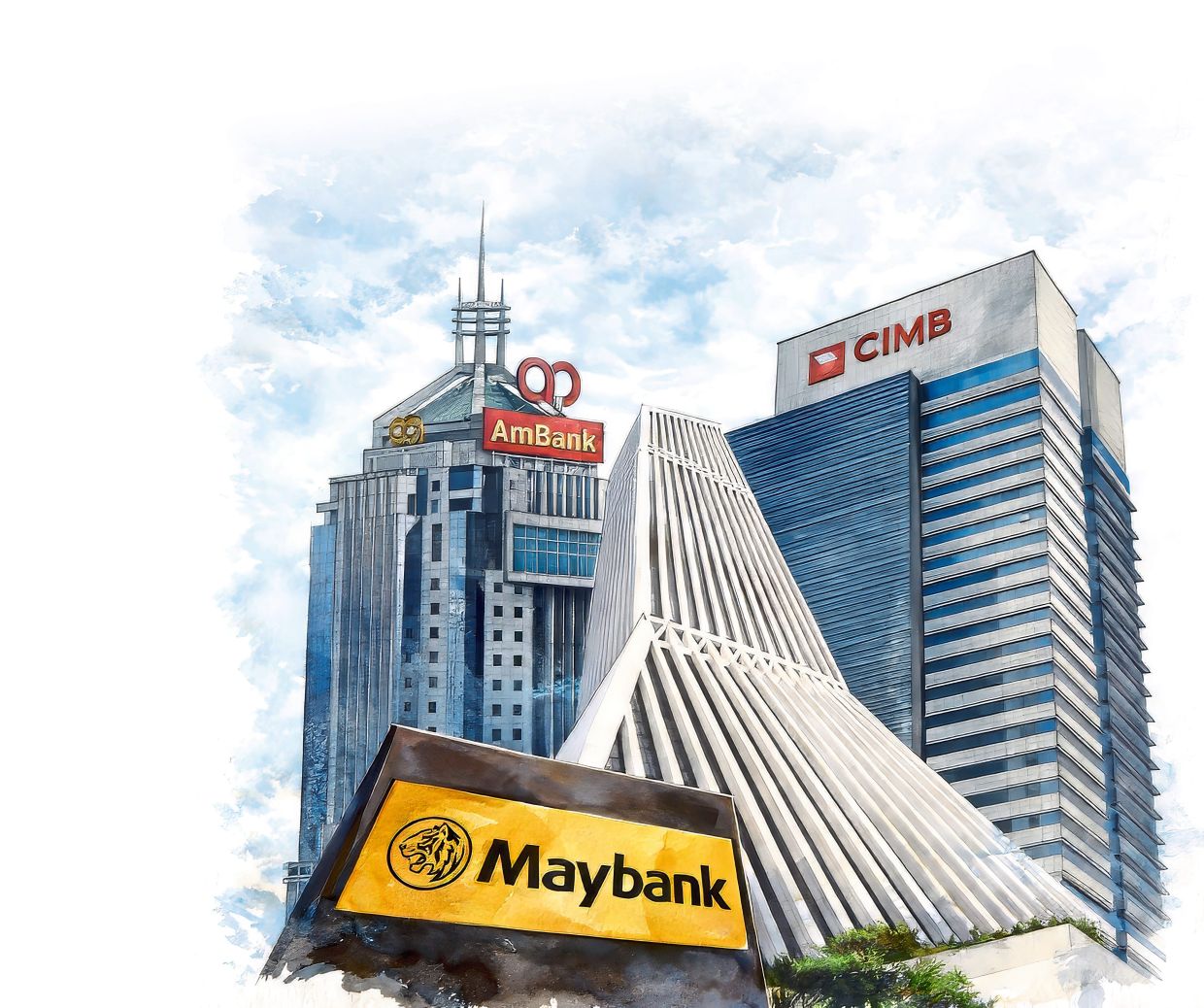
Malaysia's banking sector is approaching the second half of 2026 at a crossroads. Having benefited substantially from rising interest rates and steady economic expansion over the preceding years, lenders have enjoyed an extended period of stability that investors termed "defensiveness"—the protective quality that typically shields banking stocks during turbulent markets. Yet recent months have seen this advantage erode. Geopolitical tensions, particularly friction between the United States and Iran, have begun to undermine the sector's appeal, triggering noticeable selling pressure among institutional and retail investors alike.
The domestic banking industry's recent quarterly results painted a nuanced picture. While Malaysian lenders demonstrated overall resilience, the results also exposed cracks. International conflict and broader headwinds have begun weighing on profitability, prompting portfolio managers to reassess their positions. The investor response has been swift and decisive—market participants have liquidated their banking holdings in notable volumes, reflecting growing anxiety about the sector's trajectory. This sell-off mirrors concerns evident across the wider banking landscape, where similar caution has gripped other major financial institutions across the region.
Yet industry observers remain cautiously optimistic about what the back half of this year might deliver. Several prominent market participants argue that as geopolitical risks diminish following recent de-escalation moves between Washington and Tehran, a markedly different operating environment could materialise. The easing of Middle East tensions removes a significant source of economic uncertainty and opens the door for a more stable outlook on earnings and credit quality. This potential reprieve from geopolitical turbulence represents a crucial turning point for Malaysian banks seeking to rebuild investor confidence.
The calculus for Malaysian banking in 2H26 hinges significantly on the trajectory of US monetary policy. According to analysis from CIMB Research, a more aggressive posture from the Federal Reserve will fundamentally reshape the domestic banking outlook, introducing fresh tail risks centred on sustained elevated interest rates. This hawkish shift creates a complex environment where rates remain stuck at higher levels for an extended period, complicating the business models that Malaysian banks have become accustomed to. The combined effect of geopolitical relief and Fed policy tightening thus creates a paradoxical situation—positive on one front, challenging on another.
OCBC Bank (M) Bhd's leadership offers a more sanguine assessment of the near-term interest rate environment. Sammeer Sharma, managing director and head of consumer financial services, articulated the institution's house view that interest rates will likely stabilise rather than climb further. This holds true across major developed economies and within Malaysia specifically. Should this forecast prove accurate, margin compression risks would diminish considerably, allowing lenders to preserve profitability even as economic headwinds intensify. Sharma emphasised that Malaysia's relative immunity to recent global rate increases—having held monetary policy steady while peers abroad tightened aggressively—has cushioned the domestic sector from the worst effects.
Singapore presents a sharp contrast to Malaysia's experience. The city-state's monetary authorities have moved in lockstep with global market conditions, meaning Singaporean lenders face more pronounced margin pressures than their Malaysian counterparts. This divergence underscores the importance of domestic monetary policy frameworks in shaping banking sector fortunes. OCBC Malaysia has benefited substantially from operating in a benign rate environment, with the firm noting negligible direct exposure to Middle East turmoil. However, Sharma cautioned against complacency, warning that economic shocks often transmit through supply chains and cross-border linkages with a significant lag, potentially materialising in subsequent quarters as inflation pressures ripple through the economy.
Gauging 2H26's trajectory remains inherently uncertain, according to banking analysts interviewed on the matter. The domestic economy's resilience cannot be taken for granted, and lingering effects from the Iran conflict and associated energy shocks that emerged in early 2026 may not become fully visible until the third or fourth quarter. These effects will likely manifest as cost-push inflation, a particular burden for small and medium enterprises struggling with elevated operational expenses. Deteriorating business conditions among SMEs could subsequently translate into credit stress, as these firms find servicing debt obligations increasingly challenging amid compressed margins and reduced cash flows.
Asset quality represents the critical metric that will ultimately validate or undermine current optimism. Banking analysts have flagged that meaningful insights into credit trends will only emerge once June quarter results are disseminated and analysed. Should these earnings reports signal early warning signs of asset quality deterioration—such as rising delinquencies or impairment charges—it would suggest that the sector's resilience is more fragile than consensus currently assumes. The time lag between economic shocks and their reflection in loan portfolios means investors face several months of uncertainty before obtaining definitive answers.
CIMB Research's comprehensive analysis identifies the convergence of falling geopolitical risks and a persistently hawkish Fed as the defining dynamic reshaping 2H26 banking prospects. The de-escalation between the United States and Iran significantly lowers the probability of sustained, severe oil price shocks that would otherwise trigger widespread credit deterioration. This shift in risk perception is directing investor attention away from asset quality vulnerabilities and back toward conventional earnings drivers. The more hawkish Fed stance, conversely, introduces volatility in bond yields, foreign exchange markets, and global liquidity conditions, creating capital flow disruptions that disproportionately affect emerging market banks.
Crucially, the risks emanating from higher-for-longer rates are fundamentally market-oriented rather than credit-related. Bond volatility and foreign exchange swings pose challenges for treasury operations and derivative positioning, yet they do not directly threaten loan portfolios in the manner that economic downturns do. Market-driven risks typically command lower risk premiums from investors relative to credit risks, suggesting that despite these pressures, Malaysian banks should retain reasonable valuation support. The distinction between market and credit risk becomes essential when assessing the sector's true downside vulnerability.
Malaysian banks are entering 2H26 with substantial buffers that validate the view that the sector retains meaningful resilience. Current asset quality metrics remain sound, indicating that loan loss provisions and capital adequacy stand at comfortable levels relative to balance sheet size. This defensive positioning provides meaningful protection against the various tail risks that could emerge. Importantly, lenders retain optionality around capital deployment and dividend policy, allowing management flexibility should operating conditions deteriorate unexpectedly. This combination of solid fundamentals, conservative provisioning, and policy discretion suggests that even under stress scenarios, a systemic banking crisis remains a low-probability outcome.
The earnings trajectory offers another source of encouragement. Incremental improvements in net interest margins—the difference between borrowing and lending rates—should support profitability even as headline volumes grow modestly. Credit costs, the expenses associated with potential loan losses, appear likely to remain contained by historical standards. Together, these factors support the thesis that 2H26 earnings resilience can offset the market-related volatility that Fed policy tightness will invariably introduce. For Malaysian investors considering financial sector exposure, the calculus involves weighing short-term volatility risks against medium-term earnings stability and the sector's proven ability to navigate complex macroeconomic environments.

