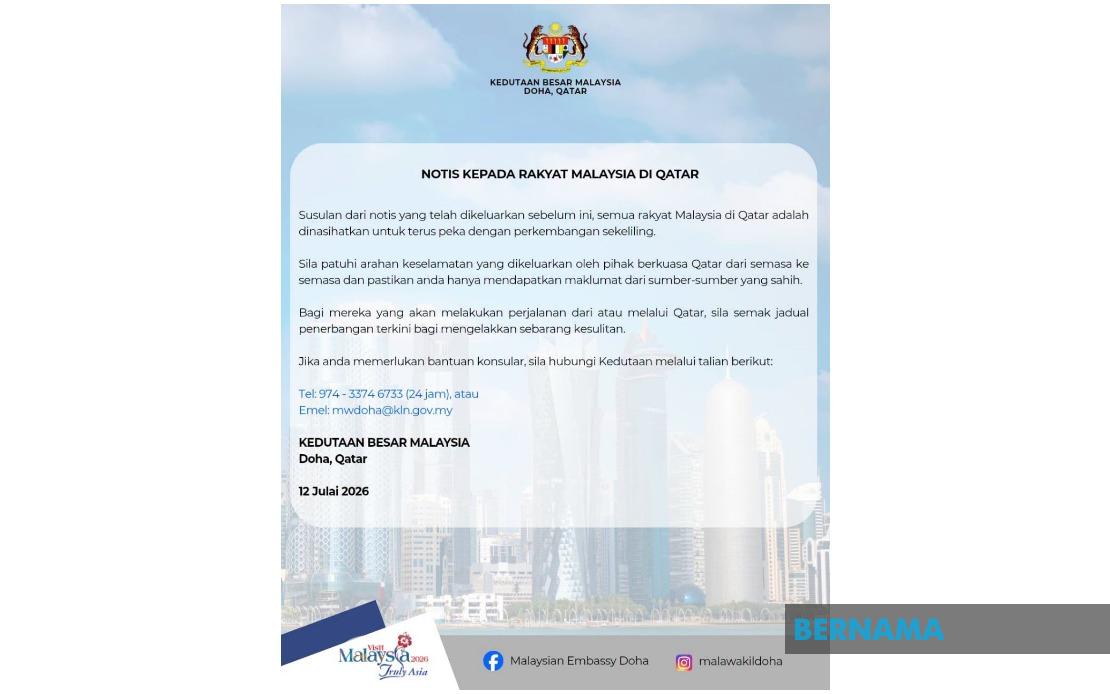
The Malaysian Embassy in Doha has issued an urgent advisory to Malaysian citizens in Qatar, directing them to adhere to security measures implemented by Qatari authorities in response to renewed military hostilities between the United States and Iran. The notice, posted on the embassy's official Facebook page, emphasizes the importance of remaining vigilant about one's surroundings and following guidance from local security bodies as tensions in the Persian Gulf region intensify.
Malaysians residing in or travelling through Qatar have been instructed to verify all information through credible channels and avoid relying on unconfirmed reports during this period of heightened regional instability. The embassy's call for heightened awareness reflects growing concerns about potential spillover effects from the conflict that could affect civilian populations and commercial operations in the Gulf state.
On Sunday, the United States military executed its third round of airstrikes against Iran within a single week, according to reporting by Anadolu Ajansi. These operations came in response to Iranian military action targeting a commercial vessel transiting one of the world's most strategically significant shipping corridors. The escalation marks a critical breakdown in an attempt at diplomatic resolution reached just weeks earlier.
Iran's Islamic Revolutionary Guard Corps Navy declared on Sunday that the Strait of Hormuz—the narrow passage separating Iran from Oman through which approximately one-third of global maritime petroleum trade flows—would be closed indefinitely. The announcement specified that the waterway would remain inaccessible to all vessel traffic until the United States ceases its involvement and interventions in the region, representing an unprecedented assertion of control over international waters.
The closure declaration carries profound implications for global energy markets and international commerce. The Strait of Hormuz serves as a vital conduit for oil and liquefied natural gas shipments destined for markets across Asia, Europe, and beyond. Any sustained blockade could trigger significant disruptions to global energy supplies, with particular consequences for countries like Malaysia and other Southeast Asian nations that depend on Gulf petroleum imports for their economic stability and power generation.
The current military escalation stands in sharp contrast to diplomatic efforts undertaken in June, when Tehran and Washington agreed to a Pakistan-brokered memorandum of understanding. That accord was designed to terminate the conflict that erupted in late February, creating a framework for achieving a durable peace settlement. The agreement explicitly outlined several critical provisions: an immediate cessation of all military operations across all theaters, the removal of the American naval embargo imposed on Iran, and the restoration of free passage through the Strait of Hormuz.
Despite the existence of this memorandum, the two nations have engaged in tit-for-tat military actions throughout this week, specifically over control and passage rights concerning merchant shipping lanes. This pattern reveals the fragility of the agreement and the deep mistrust persisting between the parties, suggesting that the underlying grievances remain unresolved despite the negotiated settlement.
For Malaysian nationals and businesses with interests in Qatar, the security advisory underscores the broader regional risks emanating from the Middle Eastern conflict. Qatar, a major hub for international commerce and home to a significant expatriate population, could face disruptions to its supply chains and economic activities should the Strait of Hormuz closure persist. Malaysian workers and investors operating in Qatari energy, finance, and trade sectors face potential operational complications if the blockade continues or expands.
The embassy has provided specific contact mechanisms for Malaysians requiring assistance, including a round-the-clock hotline operated at the Doha mission. The number +974-3374 6733 remains accessible to nationals seeking consular support, whether for emergency evacuations, visa matters, or general guidance during the crisis period. Email correspondence channels have also been established to accommodate those unable to reach the embassy by telephone.
Malaysians planning to transit through Qatar or engage in travel originating from the country have been advised to monitor airline schedules closely and anticipate potential service interruptions. The unstable security environment and possibility of shipping disruptions could indirectly affect aviation operations and airport functions, necessitating careful trip planning and flexibility regarding travel dates.
The broader Southeast Asian context amplifies the significance of this regional crisis. As a trading bloc heavily dependent on stable maritime routes and Middle Eastern energy supplies, ASEAN nations including Malaysia face collective economic vulnerability should the US-Iran tensions persist or escalate further. The blockade of the Strait of Hormuz represents a direct threat to regional prosperity and energy security that extends far beyond the Gulf itself.
Malaysia's diplomatic response, channelled through its embassy network, reflects the country's approach of encouraging its nationals to remain safe while maintaining calm and relying on official information channels. This measured stance balances the need to alert citizens to genuine risks without generating panic or encouraging hasty decisions that might exacerbate their situations.
Looking ahead, the sustainability of the Pakistan-brokered agreement will prove crucial not only for regional peace but for global economic stability. If diplomatic channels can be reopened and both parties recommit to the negotiated framework, the immediate threat to shipping and Malaysian interests may diminish. However, the pattern of attacks despite the memorandum's existence suggests that further negotiations and confidence-building measures will be necessary to achieve lasting resolution.

