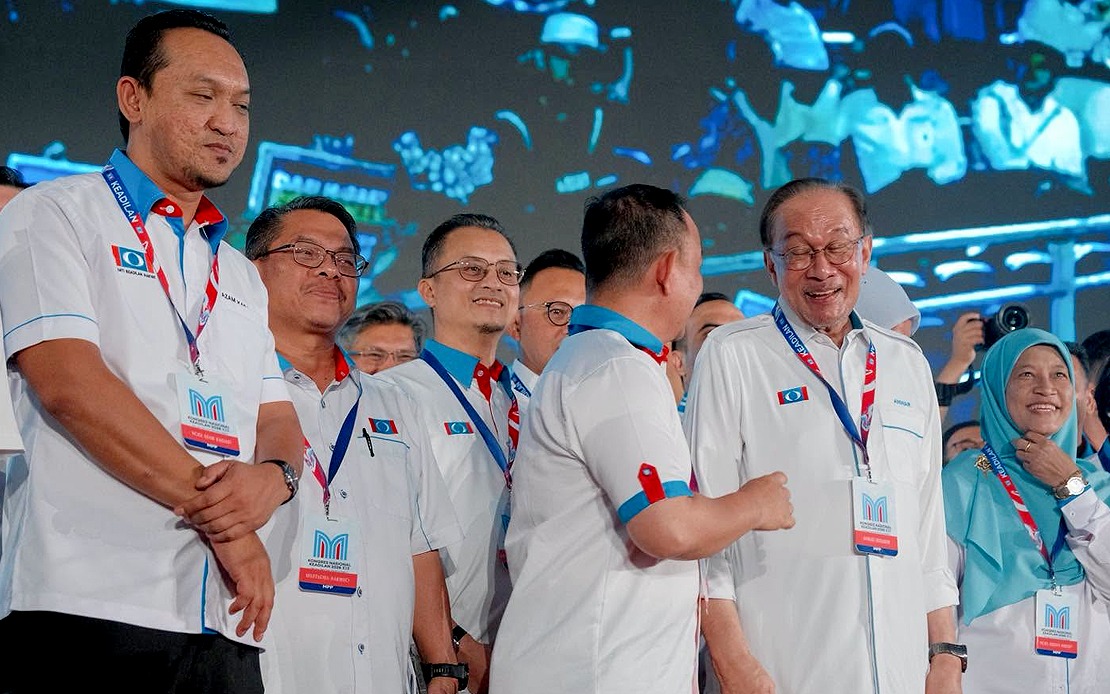
Political parties across Malaysia should retire the divisive playbook of identity politics and instead stake their electoral fortunes on substantive policy platforms and tangible performance records, according to Datuk Mustapha Sakmud, the Minister in the Prime Minister's Department (Sabah and Sarawak) and PKR's Sabah state leadership council chairman. Speaking on the sidelines of PKR's 2026 National Congress, Mustapha articulated a vision of Malaysian politics centred on measurable outcomes rather than the zero-sum competition over ethnic and religious sensibilities that has long defined the nation's political discourse.
The minister's intervention reflects a growing awareness among younger, more pragmatic factions within Malaysia's ruling coalition that the traditional model of political competition—where parties attempt to mobilise voters by stoking anxiety between communities—has become increasingly counterproductive and delegitimising. When political parties resort to using fear of one ethnic group against another or instrumentalise religious identity as a boundary marker between political camps, Mustapha contended, the inevitable result is fracture and suspicion rather than collective progress. This observation carries particular weight given the electoral volatility Malaysia has experienced over the past half-decade and the demonstrable fatigue many voters express when encountering yet another campaign centred on communal grievance.
For Sabah specifically, Mustapha made a compelling case that the state's remarkable demographic composition—characterised by genuine pluralism across ethnic, religious and cultural lines—represents a strategic asset rather than a liability to be managed through divisive politics. The question facing Sabah voters, he suggested, should not hinge on whether a candidate belongs to a particular community or follows a particular faith. Instead, voters ought to evaluate which political representatives and parties genuinely possess the competence, resources and track record necessary to address the concrete challenges affecting household finances, healthcare access, educational quality and infrastructure development. This reframing fundamentally reconceives what political maturity means in a plural democracy.
Mustapha expressed confidence that Sabah's electorate is becoming increasingly sophisticated in its voting calculus and resistant to the old machinery of identity-based mobilisation. He cautioned that certain political actors continue to peddle narrow identity politics, apparently viewing communal division as their most viable pathway to power. However, his assessment suggests that this approach has begun to exhaust its utility, particularly among younger voters and in urban centres where economic concerns predominate. The implication is that parties clinging to identity politics risk finding themselves increasingly out of step with voter expectations.
The minister advocated for adoption of what PKR terms a "Needs-Based Economy" framework, which would fundamentally restructure how government allocates resources and designs policy interventions. Under this approach, federal and state governments would distribute assistance and design programmes based on rigorous assessment of where needs are greatest, where development gaps are widest, and where income levels are lowest, rather than through formulae that privilege particular communities or employ uniform nationwide standards. Such a methodology would necessarily account for geographical realities—the specific infrastructure and service delivery challenges facing rural versus urban areas, for instance—while bracketing communal identity as a determinant of policy design.
In the Sabah context, this principle carries implications across several critical service domains. Fuel subsidies, a perennially contentious policy area in Borneo states where transportation and energy costs significantly impact living standards, ought to be allocated according to actual consumption patterns and economic necessity rather than through mechanisms that inadvertently favour particular groups. Education, healthcare, water provision, electricity access, internet connectivity and rural road infrastructure similarly require needs-based allocation frameworks that direct scarce government resources toward populations most dependent on public provision. Mustapha's emphasis on this point reflects recognition that Sabah residents, regardless of ethnic background, face common material constraints and common aspirations for improved service delivery.
Mustapha highlighted the substantial increase in Sabah's special federal grant—rising from RM600 million to RM1.5 billion under the current MADANI Government administration—as a concrete illustration of how policy shifts can address regional developmental imbalances and structural inequities. This expansion signals federal acknowledgement that Sabah's development trajectory has historically lagged peninsular states and that corrective measures require material investment. The minister pointed to the grant increase as vindication of the principle that articulating genuine needs, backed by evidence of regional disparities, can yield policy responsiveness even within constrained fiscal environments.
However, Mustapha reserved particular emphasis for what remains, in his assessment, an outstanding constitutional matter of fundamental importance: the federal government's obligation to allocate 40 per cent of net revenue derived from Sabah's resources back to the state. This claim, rooted in the Malaysia Agreement 1963 (MA63), represents a distinct dimension of the needs-based approach—one oriented not merely toward contemporaneous resource redistribution but toward honouring binding constitutional compacts that structure the federal system itself. The insistence that MA63 protections and revenue-sharing arrangements remain prioritised suggests that policy-based politics need not, and ought not, sideline questions of federalism, constitutional fidelity and indigenous rights of states within the Malaysian union.
The framing Mustapha advances potentially reshapes political competition in ways that could benefit parties able to articulate compelling policy platforms while disadvantaging those whose political organisations depend primarily on communal mobilisation machinery. Parties with sophisticated policy research capacity, track records of competent governance, and ability to speak credibly about addressing economic anxieties would gain ground under such a paradigm shift. Conversely, parties whose primary organisational strength lies in ethnic or religious networks, or whose leadership lacks evidence of administrative capability, might find themselves struggling to remain electorally competitive.
Moreover, the shift toward performance-based politics creates potential space for cross-communal political coalitions built on shared material interests rather than on communal accommodation or power-sharing formulae designed to satisfy elite representatives of different ethnic groups. Voters motivated primarily by concern for household finances, employment prospects, healthcare access and children's educational outcomes might prove more willing to support candidates and parties across traditional communal boundaries than voters mobilised through identity-based appeals. This could, in theory, foster both greater policy coherence and reduced zero-sum ethnic competition.
Yet significant obstacles remain to realising the vision Mustapha articulates. Established political machinery in many parties remains organised around communal networks and identities. Media ecosystems in some segments continue amplifying identity-based narratives. And in contexts where real or perceived communal grievances retain political salience, voters may continue preferring candidates and parties explicitly committed to defending group interests. The transition from identity politics to performance politics is neither automatic nor inevitable; it requires sustained political leadership, institutional reform, and gradual cultural change within Malaysian political organisations and among the electorate itself.

