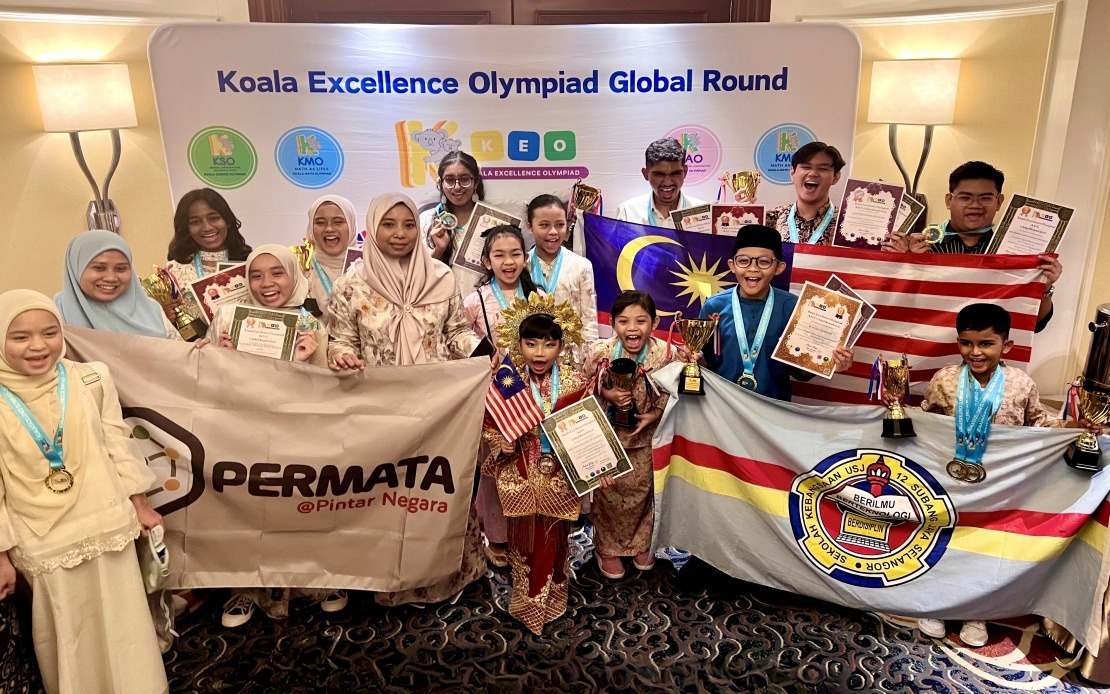
Malaysia's educational contingent has returned from the Koala Excellence Olympiad (KEO) 2026 in Macau with an impressive haul of medals and accolades that underscore the nation's growing competitive standing in international academic forums. The 17 students who represented Malaysia at the week-long competition concluded their participation with nine overall awards and 22 medals, comprising five gold, six silver and 11 bronze finishes across four distinct disciplines. The achievement reflects both the calibre of Malaysia's young talent pipeline and the structured preparation efforts of institutions coordinating their participation.
The Malaysian contingent, led by Aidah Misran, coordinator of the Malaysian Young Scientists Organisation (MYSO), drew its members from eight different schools spanning primary and secondary levels. Four participants came from Kolej PERMATA@Pintar Negara Universiti Kebangsaan Malaysia (UKM), six represented Sekolah Menengah Kebangsaan (SMK) Ungku Aziz, while two students attended Sekolah Sultan Alam Shah. The remaining seven students came from Sekolah Kebangsaan (SK) Convent (2) Bukit Nanas, SMK Convent Teluk Intan, SK USJ 12, SK Seri Hartamas and SK Convent Sentul 1. This geographic and institutional spread indicates that excellence in competitive academics extends beyond the typically high-performing elite schools, with notable contributions from neighbourhood and religious-affiliated institutions.
The KEO itself represents a significant departure from traditional examination-focused pedagogy. Developed by Australian educational specialists, the competition framework prioritises critical thinking, creative problem-solving and practical application of knowledge rather than the memorisation-heavy approaches that have long dominated educational assessment in the region. By bringing together students from multiple countries to compete in English, Mathematics, Science and Arts Olympiads, the platform creates an environment where Malaysian youth can benchmark themselves against international peers while developing skills increasingly valued in knowledge economies. For Malaysian educators and policymakers invested in improving educational outcomes, such competitions provide tangible evidence of how curriculum reforms emphasising holistic learning can yield measurable results on the world stage.
The standout performer at KEO 2026 was Mukridz Mardzuki, a Year Six pupil from SK Seri Hartamas, who captured the overall championship in the Science Olympiad primary school division. His victory carries particular significance given that primary school competitions often attract exceptional young talent from across the region, making a top finish a strong indicator of sustained academic trajectory. Beyond his championship, several other Malaysian students achieved runner-up finishes in their respective categories. Sarah Isabel Maryam Ahmad Suhael from SK Convent (2) Bukit Nanas claimed second place in primary school Science, while Alfie Rizq Danial Azlan from Sekolah Sultan Alam Shah secured the same distinction in the secondary category, suggesting a pipeline of competitive science talent across age groups.
English language proficiency, a perennial concern for Malaysian educators, received a boost from Ayra 'Adani Muhammad 'Aizat of Kolej PERMATA@Pintar Negara, who finished as runner-up in the English Olympiad. This placement underscores the advantage that students from specialised gifted and talented programmes enjoy, whilst also indicating that systematic English language instruction, when combined with enrichment opportunities, can produce competitive performers internationally. The result carries implications for policymakers considering how to elevate the nation's English language standards across the education system more broadly.
Third-place awards went to five Malaysian students across different disciplines, with one student notably securing multiple category recognitions. Marvyn Zef Mark Philip earned third-place finishes in both Science and English Olympiads, demonstrating the breadth of capability among Malaysia's top academic performers. P Prem secured third place in Science, Muhammad Khairul Mauidz Khairul Azman in Mathematics and AK Shashini in English. This distribution of achievement across multiple disciplines and multiple students reflects a broader ecosystem of academic excellence rather than performance concentrated in isolated individuals, a positive indicator for Malaysia's long-term competitive positioning in international education.
The participation of Malaysian students in the KEO 2026 occurs within a broader context of Southeast Asian nations increasingly emphasising international academic competitions as mechanisms for talent identification, curriculum validation and international positioning. Thailand, Vietnam and Singapore have similarly invested in competitions and olympiad programmes to develop gifted youth and enhance national standing in global knowledge hierarchies. Malaysia's respectable performance in this instance helps maintain the nation's profile as an education hub in the region, particularly important given competition from neighbouring countries offering similar or enhanced educational pathways to gifted students.
The Malaysian Young Scientists Organisation's coordinating role in facilitating participation points to the value of non-governmental bodies in supplementing government educational structures. By identifying talented students, organising preparation, and coordinating participation in international events, such organisations extend opportunity beyond what government institutions alone might reach, particularly given budgetary constraints and administrative procedures that can slow institutional responses to emerging opportunities. The coordination model exemplified by MYSO's efforts merits examination by other Malaysian organisations seeking to develop talent pools in specific disciplines.
Looking forward, the success at KEO 2026 raises questions about sustainability and scalability. Can Malaysia increase participation numbers in future iterations whilst maintaining quality? Are there mechanisms to translate competition success into longer-term academic and career pathways for these students? How can lessons from competition preparation inform mainstream curriculum development? These questions become increasingly pertinent as Malaysian institutions grapple with how to balance standardised examination performance with the development of twenty-first century competencies. The Koala Excellence Olympiad, by emphasising application and critical thinking, aligns closely with employer demands and evolving educational thinking, suggesting that Malaysia's investment in such platforms represents progressive policy positioning even as it delivers immediate medallist achievements.

