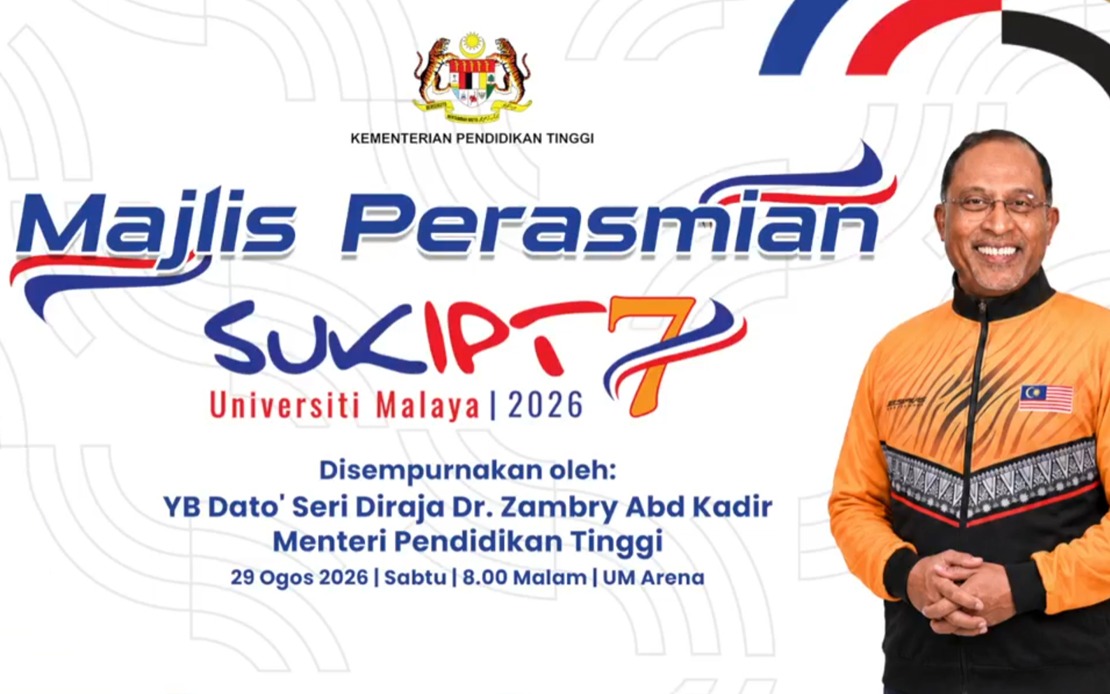
Malaysia's universities have evolved into serious training grounds for international sporting achievement, according to Higher Education Minister Datuk Seri Dr Zambry Abdul Kadir, who pointed to recent medal hauls at the Glasgow 2026 Commonwealth Games as evidence that tertiary institutions can rival traditional sports academies in developing elite competitors.
Speaking at the opening of the Higher Education Institution Games (SUKIPT) 2026 at Universiti Malaya Arena in Kuala Lumpur, Zambry articulated a vision of university sports as a pathway to national excellence rather than merely recreational activity. His remarks underscore a broader shift in Malaysian policy toward recognising that competitive athletic development need not be divorced from academic pursuits, and that the dual mission of educating and training athletes can be accomplished within the higher education ecosystem.
The minister's optimism rests on tangible recent achievements by IPT-affiliated athletes on the world stage. Muhammad Erry Hidayat from Universiti Putra Malaysia secured gold in men's 79-kilogramme weightlifting, whilst his UiTM counterpart Muhammad Aniq Kasdan claimed the men's 60kg category at the Commonwealth Games. More dramatically, Amir Daniel Abdul Majid of Universiti Sains Malaysia made history by becoming Malaysia's first Commonwealth Games gold medallist in judo, a breakthrough that expands the nation's medal portfolio into sports previously dominated by other Commonwealth nations. Amirul Daniel Abdul Rahim from Universiti Malaya also contributed a bronze medal in lawn bowls, rounding out a credible showing.
These international successes carry particular weight in Southeast Asia, where competition among universities for athletic prestige is intensifying. Other regional nations have invested heavily in collegiate sports infrastructure, and Malaysia's recent performances suggest the nation is holding its own in this emerging arena. The concentration of medals in strength and technical sports—weightlifting and judo—hints at strategic investment in specific disciplines where IPT programmes may have developed particular expertise or coaching capacity.
Domestically, IPT athletes have been equally prolific record-breakers. Omar Osman from Politeknik Sultan Ibrahim shattered the 400-metre national standard, whilst Muhammad Fadwah of UiTM and Danish Iftikhar Muhammad Rosli of Universiti Pendidikan Sultan Idris both cracked Malaysia Games (SUKMA) records—Fadwah and Rosli combining to set new benchmarks in the 200-metre and 4x100-metre relay events. The cascade of record-breaking across multiple institutions and sports suggests systemic improvement in coaching, facilities, and athlete selection within the tertiary sector rather than isolated success.
The seventh iteration of SUKIPT 2026, running from August 28 to September 6 at Universiti Malaya, represents an expansion of this competitive ecosystem. The tournament draws 64 contingents comprising 20 public universities, 42 private institutions, one polytechnic, and one community college—a sprawling cohort that reflects Malaysia's diversified higher education landscape. With 8,244 athletes and officials competing across 30 sports, the games function as both championship spectacle and talent identification mechanism, permitting administrators and coaches to monitor emerging athletes across a comprehensive array of disciplines.
Financial incentives built into SUKIPT 2026 reveal strategic intent to reward achievement and sustained excellence. The games are offering 227 gold medals alongside cash prizes: RM3,000 for individual Sportsman and Sportswoman of the Games, RM7,000 for Best Male and Female Team awards, and notably RM20,000 for athletes who break national records. These incentives, whilst modest by international standards, signal to competitors that record-breaking is valued and tangibly rewarded, potentially spurring athletes toward performances that transcend established norms.
The tournament's theme, 'Creating a Legacy of Champions', articulates an aspiration that reaches beyond the immediate competition window. The framing suggests organisers view SUKIPT not simply as an annual event but as a pipeline—a structured mechanism through which university athletes can be identified, developed, and prepared for representative honours at senior national and international level. This long-term perspective aligns with Zambry's contention that IPT sports, properly supported, can consistently deliver athletes capable of elevating Malaysia's standing in international sporting forums.
For Malaysian readers, these developments carry significance beyond sporting pageantry. The emergence of universities as competitive athletic institutions represents a broadening of the talent development base and a more efficient use of existing educational infrastructure. Rather than requiring standalone sports academies, Malaysia can leverage its 20 public universities and 42 private institutions as athletic development centres, embedding high-performance training within campuses where athletes can simultaneously pursue qualifications. This integrated model potentially yields social returns beyond medal counts—producing graduates with discipline, resilience, and international exposure.
However, sustaining this momentum will depend on consistent investment in coaching, sports science support, and training facilities across multiple institutions. The concentration of recent successes among specific universities—UPM, UiTM, USM, UM—may reflect uneven resource distribution within the tertiary sector. Zambry's vision of universities as breeding grounds for world-class talent risks remaining aspirational unless the infrastructure supporting less prominent institutions improves substantially, and unless pathways connecting SUKIPT success to international competition are formalised.
The Commonwealth Games results and SUKMA records represent a watershed moment for Malaysian university sports. They demonstrate that the nation's tertiary athletes, when properly supported and afforded competitive platforms, can compete credibly on the world stage. Whether this can be transformed into sustained, systematic excellence across multiple universities and disciplines will depend largely on whether current policy emphasis translates into durable funding commitments and strategic planning beyond the ceremonial opening of annual games.

