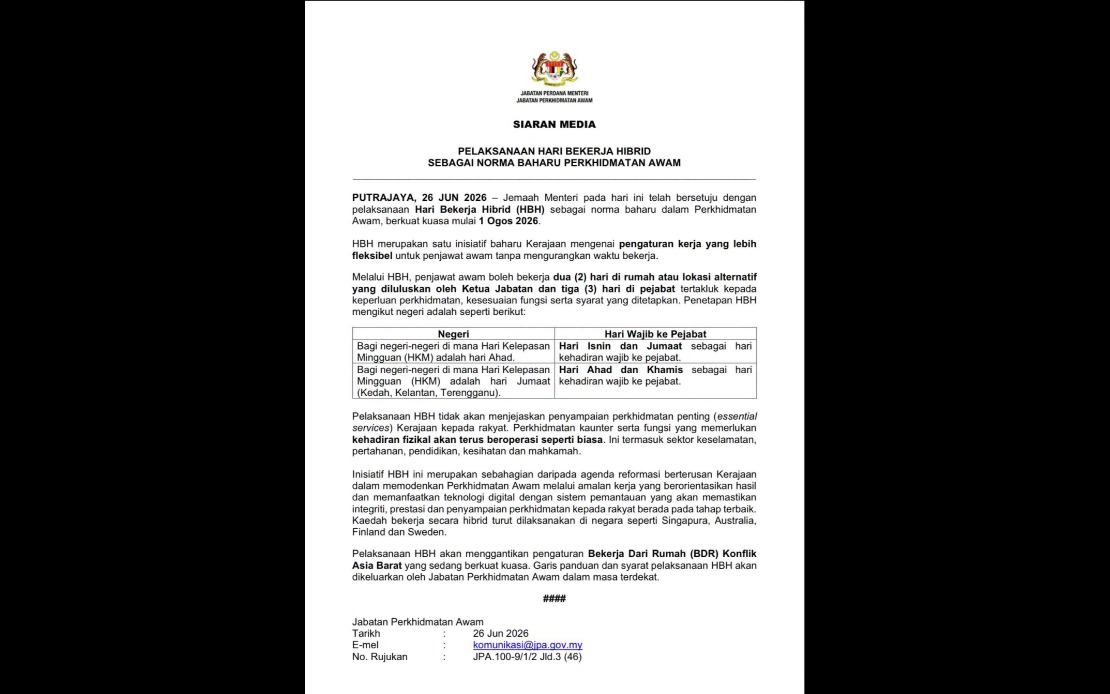
Malaysia's Cabinet has given the green light for a significant restructuring of how the nation's 1.6 million civil servants will operate, with the Public Service Department announcing on June 26 that a new hybrid work framework will take effect on August 1. The decision marks a formal transition from the temporary work-from-home arrangements that emerged during the pandemic, replacing them with a structured model designed to balance flexibility with operational efficiency across government agencies.
Under the new Hybrid Work Day framework, civil servants will split their working week between remote and office-based locations. The arrangement permits employees to work two days from home or from an alternative workplace that has been approved by their departmental head, while committing to three days of physical office presence each week. This division applies across the board, though the specific days designated for mandatory office attendance will vary depending on the state's official weekly rest day and operational requirements.
The implementation recognises regional differences in Malaysia's administrative calendar. For states that observe Sunday as the weekly rest day, civil servants must be present at their offices on Mondays and Fridays. In contrast, those working in Kedah, Kelantan, and Terengganu—where Friday functions as the official weekly holiday—will have Sunday and Thursday designated as compulsory office attendance days. This tailored approach acknowledges the diversity of Malaysia's federal structure while maintaining consistency within each state's civil service operations.
The Public Service Department has emphasised that this initiative does not represent a reduction in working hours or commitment from civil servants. Rather, it constitutes a modernisation effort that introduces greater flexibility into work arrangements without compromising the quality or duration of service delivery. The framework is positioned as part of the government's broader agenda to reform and upgrade the public sector through performance-based management practices and expanded deployment of digital technologies.
Critical to the government's assurance regarding service continuity is an explicit carve-out for essential services. Counter services and functions that necessitate direct public interaction will continue to operate according to existing schedules, with no disruption anticipated. This preservation applies particularly to frontline operations in security and defence, education, health services, and the judicial system—sectors where physical presence remains non-negotiable for operational integrity. The department has pledged that the hybrid arrangement will not impair citizens' ability to access these vital services.
The policy signals Malaysia's alignment with international best practices in flexible work management. The Public Service Department noted in its statement that comparable arrangements have been successfully implemented in developed economies including Singapore, Australia, Finland, and Sweden. By drawing on these precedents, Malaysian authorities appear confident that the hybrid model can deliver benefits observed elsewhere—improved employee satisfaction and retention, reduced operational costs, and enhanced work-life balance—without sacrificing the standards expected of a functioning civil service.
To prevent potential pitfalls associated with remote work arrangements, the Public Service Department has committed to introducing a comprehensive monitoring mechanism. This oversight framework is designed to track and maintain optimal levels of integrity, individual performance, and service delivery standards across the civil service. The department's emphasis on monitoring suggests an awareness of concerns that might arise regarding accountability when employees work away from traditional office environments, particularly in a region where management practices traditionally emphasise direct supervision.
For Malaysian readers and businesses that interact regularly with government agencies, the hybrid work model carries practical implications. While the arrangement aims to enhance efficiency through reduced commuting time and improved employee morale, the specified office days suggest that citizens seeking in-person government services should plan their interactions accordingly. The predictable nature of mandatory office attendance days—fixed by state—should enable better scheduling of activities requiring direct engagement with civil servants.
The timing of the August 1 implementation provides government departments approximately five weeks to prepare operational adjustments, revise work schedules, and communicate expectations to affected personnel. The Public Service Department has indicated that more detailed implementation guidelines and specific operational conditions will be released in due course, suggesting that the June 26 announcement represents a policy framework rather than a fully developed operational blueprint. Departments may face varying degrees of complexity in execution depending on their specific functions and staffing structures.
This policy development also reflects broader questions about the future of work in Malaysia's formal economy. As the private sector continues navigating post-pandemic employment norms, the government's formalisation of hybrid arrangements in the civil service may influence corporate practice nationwide. Malaysian employers across sectors will likely monitor the policy's outcomes, particularly regarding productivity metrics and employee retention rates, as evidence for their own workplace arrangements.
The hybrid work initiative must be understood within Malaysia's context of rapid digitalisation and the government's stated commitment to improving public sector efficiency. By legitimising remote work as an established arrangement rather than an emergency measure, policymakers acknowledge that technology and trust-based management can sustain government operations. The success of this transition will partly depend on the quality of digital infrastructure and training provided to enable smooth remote collaboration across government hierarchies and departments.

