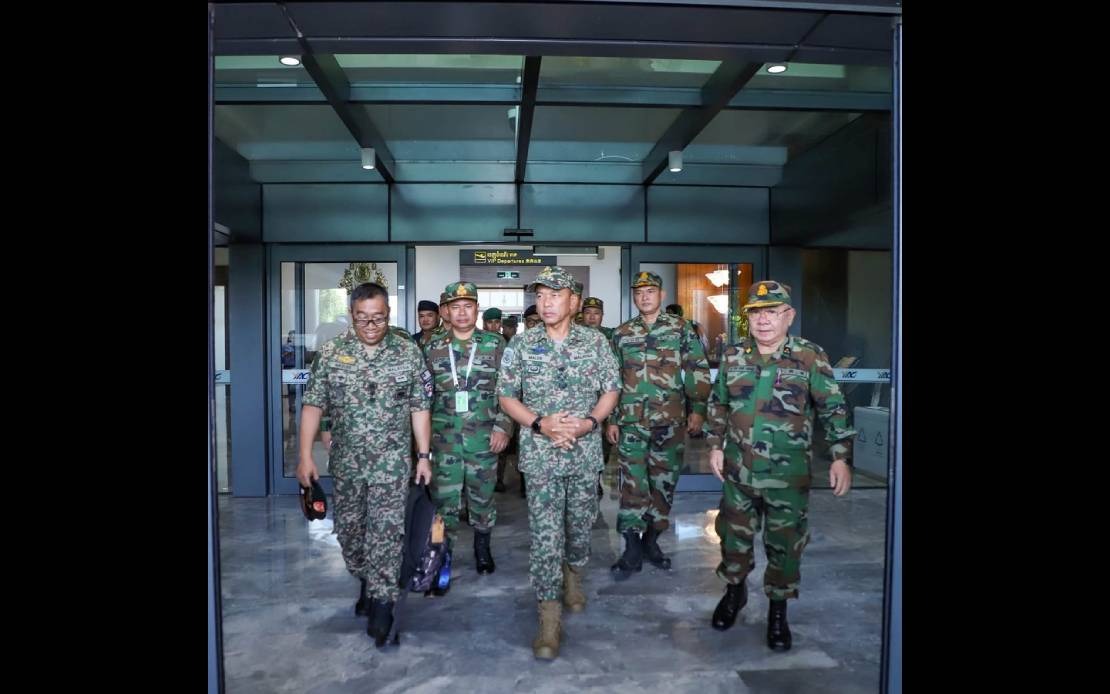
Malaysia's military leadership is deepening its direct involvement in monitoring one of Southeast Asia's most volatile border zones. Chief of Defence Force Gen Tan Sri Malek Razak Sulaiman travelled to Cambodia's Banteay Meanchey province this week to conduct a first-hand assessment of conditions along the contentious Cambodia-Thailand frontier, signalling Kuala Lumpur's commitment to stability in a region where territorial disputes have repeatedly triggered armed confrontation.
The visit, which runs from July 8 to 11, was undertaken at the formal invitation of Cambodia's military commander, General Vong Pisen. The timing underscores Malaysia's growing engagement in managing regional tensions through direct diplomatic and military-to-military channels, a practice increasingly important as ASEAN nations grapple with border disputes that periodically erupt into violence.
Upon arrival in the border area, Malek Razak received a comprehensive briefing from the ASEAN Observer Team, the multinational monitoring force stationed there to oversee compliance with the Cambodia-Thailand ceasefire agreement. The AOT's briefing would have covered the current security posture, movement patterns of military personnel, and compliance with established protocols—essential intelligence for Malaysia as it navigates its role within ASEAN's collective security architecture.
The Cambodia-Thailand border has been a persistent flashpoint within the region. Tensions escalated dramatically on July 24, 2025, when military confrontations erupted stemming from competing territorial claims. The resulting clashes prompted ASEAN to establish the Observer Team the following year as a confidence-building measure. This mechanism allows member states to maintain real-time awareness of the situation and collectively encourage de-escalation without direct intervention in bilateral disputes.
Currently, the AOT operates under Philippine leadership, reflecting Manila's responsibility as ASEAN's chair. This rotating structure ensures multiple perspectives on border compliance and allows smaller nations to contribute meaningfully to regional security governance. Malaysia's participation through its defence chief's visit demonstrates that Kuala Lumpur takes the monitoring effort seriously, rather than treating it as a procedural formality.
For Malaysian policymakers and military strategists, understanding developments along distant ASEAN borders carries practical significance. Uncontrolled violence or state collapse at any ASEAN frontier could generate refugee flows, disrupt trade routes, or create power vacuums exploited by non-state actors. The Cambodia-Thailand border region, already challenging due to terrain and historical grievances, could become a conduit for trafficking, insurgent movement, or great-power proxy competition if stability deteriorates further.
Malek Razak's assessment tour also reflects the broader Malaysian approach to ASEAN centrality. Rather than assuming responsibility for enforcing outcomes, Malaysia emphasizes presence and awareness. By personally visiting the border and engaging with the observer team, the defence chief demonstrates that Malaysia remains invested in collaborative mechanisms, even when they operate far from Malaysian territory. This soft-power approach, though less visible than military posturing, builds trust and credibility within the bloc.
The Philippines' leadership of both ASEAN and the AOT places Manila in an influential position. However, the involvement of Malaysia's defence establishment ensures that major regional players maintain independent knowledge of the situation. This distributed awareness helps prevent any single nation's assessment from dominating regional narratives about the border's stability or imminent risks.
Regional security observers will likely interpret Malek Razak's visit as Malaysia's reaffirmation of ASEAN's institutional role in managing crises. At a time when external powers jostle for influence in Southeast Asia, such demonstrations of intra-ASEAN cooperation carry symbolic weight. The visit signals that despite broader geopolitical rivalries, ASEAN member states continue taking their collective security responsibilities seriously through mechanisms like the AOT.
For Cambodia, Malaysia's willingness to engage directly with its military leadership and assess conditions on the ground represents validation of Cambodia's efforts to maintain stability along its western frontier. It also provides Phnom Penh with reassurance that larger neighbours monitor compliance fairly and that the AOT's oversight operates with genuine commitment from major regional powers.
The larger challenge facing ASEAN remains the fundamental dispute between Cambodia and Thailand—a disagreement rooted in contested border demarcation that extends back decades. Observer teams and military-to-military visits can prevent flare-ups from escalating uncontrollably, but they cannot resolve the underlying territorial question. Malaysia's approach acknowledges this reality by focusing on conflict management through presence and dialogue rather than pursuing a quick diplomatic solution to an intractable problem.
As maritime disputes occupy much regional attention, land-border tensions like those between Cambodia and Thailand merit sustained focus. Malek Razak's visit exemplifies how Malaysia balances its broader strategic interests with its obligation to support ASEAN-wide stability mechanisms. The visit also demonstrates Malaysia's sophisticated understanding that regional security is collective; instability anywhere within ASEAN eventually affects everyone within the bloc.

