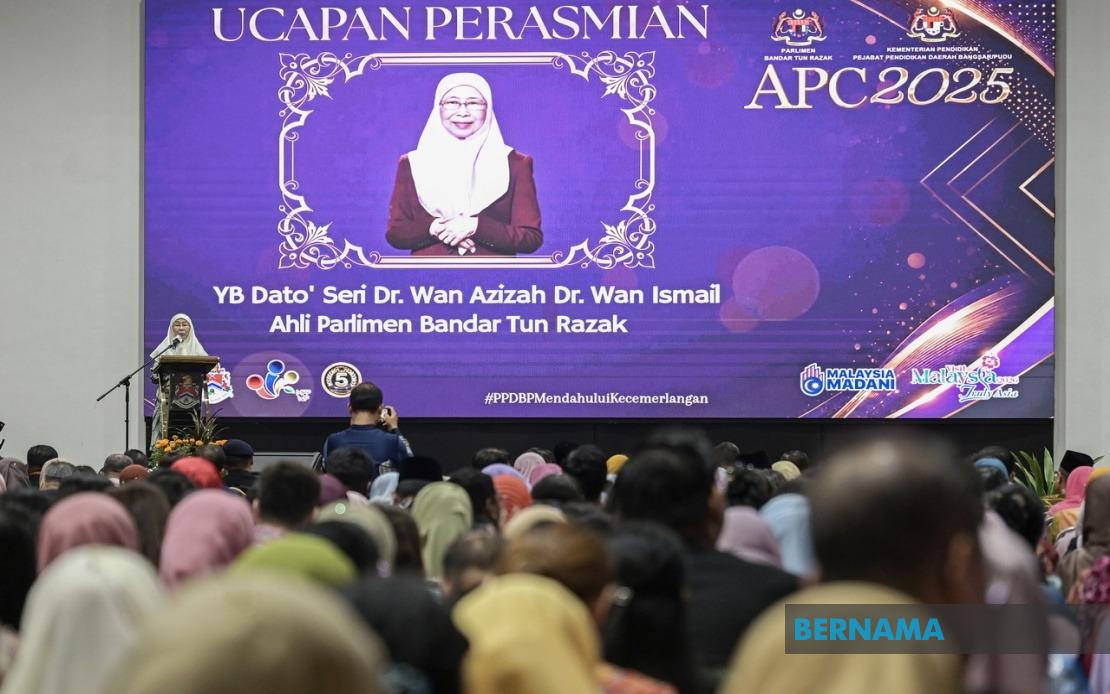
The real measure of a country's progress extends far beyond economic indicators and infrastructure projects. At an awards ceremony honouring educators in Kuala Lumpur, Prime Minister's wife Datuk Seri Dr Wan Azizah Wan Ismail articulated a vision of national development centred on human character and moral foundations. Her remarks underscore a philosophical shift gaining traction in Malaysian policy circles: that lasting prosperity requires investing in the ethical and intellectual development of citizens alongside traditional measures of advancement.
Dr Wan Azizah, who represents Bandar Tun Razak in Parliament, delivered these observations while officiating the 2025 Excellent Service Award ceremony organised by the Bangsar/Pudu District Education Office at the Kuala Lumpur City Hall Training Institute. The occasion recognised the contributions of nearly 750 educators and school administrators from 143 schools across the district, an event attended by approximately 1,000 guests reflecting the significance placed on educational excellence at the highest levels of government.
The Prime Minister's wife highlighted a particular challenge facing Malaysia's urban centres: many schoolchildren spend substantial portions of their formative years in educational institutions while parents juggle demanding work schedules. This reality places teachers at the frontlines of character formation, a responsibility that extends well beyond curriculum delivery. She articulated the view that education's fundamental purpose transcends knowledge transfer, embracing instead the cultivation of individuals distinguished by integrity, courteous behaviour, and genuine concern for others.
In an era when artificial intelligence increasingly handles information processing and retrieval, Dr Wan Azizah identified values-based education and critical thinking as non-negotiable priorities. The proliferation of digital information has created an environment where distinguishing credible knowledge from misinformation presents an unprecedented challenge for young people. Traditional pedagogical approaches focused solely on content mastery prove inadequate when students must navigate algorithmic feeds, deepfakes, and competing narratives. Teachers therefore require recognition and support for cultivating in students the moral compass and analytical skills necessary to interrogate information sources and resist manipulation.
The awards ceremony itself embodied this philosophy in practice. The recognition extended to 746 individual educators and administrators represented a deliberate statement about priorities. Rather than celebrating financial metrics or enrolment statistics, the Bangsar/Pudu district chose to spotlight personal dedication and exemplary performance. Dr Wan Azizah expressed confidence that such recognition would motivate recipients to sustain their commitment while inspiring peers to strengthen collective efforts toward educational excellence. The visibility of these awards, endorsed by the Prime Minister's office through his wife's attendance, sends an unmistakable message about governmental support for quality teaching.
For Malaysian readers observing educational policy from the outside, these remarks carry particular relevance given ongoing debates about curriculum reform and student outcomes. The emphasis on character development reflects international trends, with countries from Singapore to South Korea integrating ethical and social-emotional learning into their educational frameworks. However, Malaysia's approach distinctly prioritises the role of educators as character architects rather than relegating such development to peripheral programmes. This orientation acknowledges a fundamental reality: teachers influence not merely what students know but who they become.
The geographical focus on Bangsar and Pudu—districts encompassing both established middle-class neighbourhoods and areas with significant working-class populations—demonstrates awareness that values-based education must reach across socioeconomic divides. Urban concentration of parental work commitments affects families regardless of income level, creating universal stakes in whether schools can effectively nurture young people's moral development. The presence of Kuala Lumpur Federal Territory Education Department director Megat Affandi Ismail alongside the Prime Minister's Political Secretary Datuk Azman Abidin reflected coordination across administrative levels, suggesting institutional commitment rather than merely ceremonial acknowledgment.
Dr Wan Azizah's framing also implicitly addresses concerns about technological disruption and social fragmentation that preoccupy policymakers across Southeast Asia. As automation reshapes employment landscapes and digital connectivity erodes traditional community structures, the distinctive human capacities for ethical judgment, empathy, and collaborative problem-solving become increasingly valuable. An education system that cultivates these qualities prepares citizens for an uncertain future better than one focused narrowly on technical skills or memorised knowledge.
The scale of the awards ceremony—honouring three-quarters of a thousand educators across a single district—underscores the substantial human investment required to sustain educational quality. These teachers and administrators represent the invisible infrastructure of national development, individuals whose daily interactions with students create ripple effects extending across generations. By elevating their recognition, Malaysian leadership signals understanding that no economic policy or infrastructure project succeeds without human capital rooted in integrity and capability.
Moving forward, the challenge involves translating such rhetorical commitment into tangible support mechanisms. Teachers require professional development opportunities to strengthen their capacity for character education, curricular resources that integrate ethical learning alongside academic content, and working conditions permitting the kind of individual attention that character formation demands. The awards themselves provide recognition, yet sustained systemic improvement requires sustained investment.
Dr Wan Azizah's message resonates particularly for Malaysian parents navigating educational choices amid rapid social change. Her articulation of education's broader purpose—nurturing not merely knowledgeable but ethical, compassionate individuals—offers reassurance that institutions remain focused on holistic human development rather than treating students as economic inputs. In a region grappling with social cohesion challenges, inequality, and technological disruption, such emphasis on shared values and moral character addresses anxieties that GDP growth alone cannot resolve. The recognition accorded to Bangsar/Pudu educators represents an investment in the kind of citizens Malaysia needs to navigate coming decades with wisdom and integrity.

