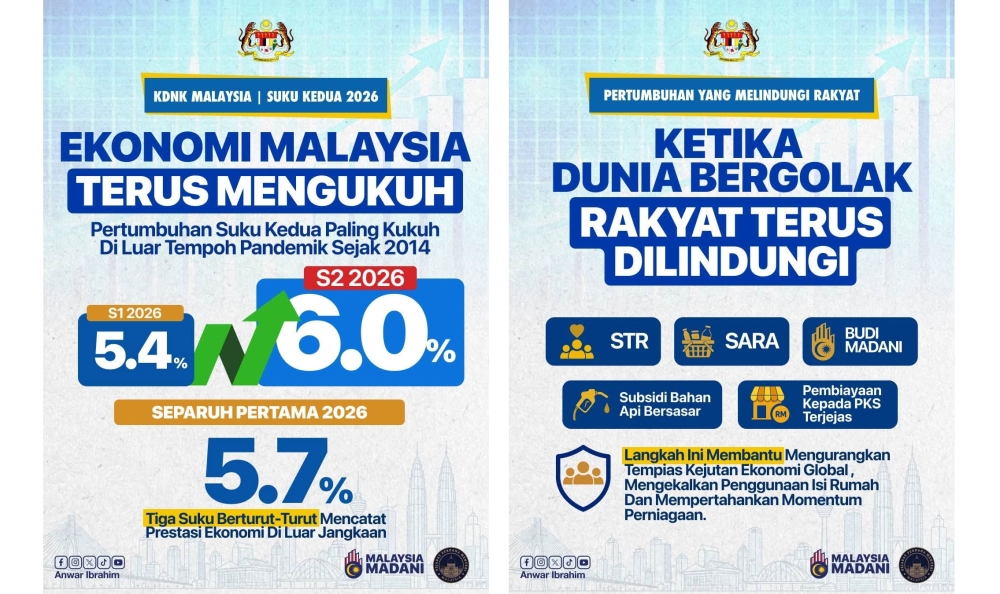
Prime Minister Datuk Seri Anwar Ibrahim has pointed to Malaysia's outperformance in economic growth during the second quarter as evidence that the government's policy interventions are successfully cushioning households from the ripple effects of international price pressures. Speaking in Kuala Lumpur on Wednesday, the Prime Minister framed the stronger-than-anticipated expansion as a vindication of the administration's approach to managing the economy amid global uncertainties.
The government's strategy has centred on implementing targeted support mechanisms designed to insulate ordinary Malaysians from the worst impacts of surging commodity prices and supply chain disruptions that have plagued the global economy in recent years. These measures reflect a deliberate attempt to maintain purchasing power among lower and middle-income households while maintaining macroeconomic stability—a balancing act that policymakers across Southeast Asia have struggled to achieve without triggering broader inflation concerns.
Anwar's remarks underscore the political significance of economic performance for the ruling coalition. With inflation proving a persistent challenge for governments worldwide and voter dissatisfaction mounting over cost-of-living pressures, demonstrating that official interventions are yielding tangible results becomes crucial for maintaining public confidence. The Prime Minister's emphasis on shielding households positions the government as actively engaged in addressing everyday financial concerns that dominate Malaysian household conversations.
Malaysia's economic trajectory carries particular weight in regional comparisons. As the second-largest economy in Southeast Asia, the nation's growth trajectory influences investor sentiment across the bloc and sets benchmarks against which neighbouring countries measure their own performance. A robust expansion suggests that despite global headwinds, the Malaysian economy retains the structural capacity to generate momentum—though this must be weighed against ongoing vulnerabilities in specific sectors and demographic shifts affecting long-term growth potential.
The protective measures referenced by Anwar likely encompass various initiatives undertaken since the government took office, ranging from subsidies on essential goods to targeted cash transfers for vulnerable populations. Such programmes carry budgetary implications that require careful monitoring to ensure fiscal sustainability, particularly given Malaysia's existing debt levels and the need to maintain investor confidence in government finances. The challenge for policymakers involves calibrating support levels that provide meaningful relief without creating dependency or distorting market signals that guide economic allocation.
Inflation management remains particularly pressing given Malaysia's openness to trade and reliance on imported commodities. Unlike larger, more self-sufficient economies, Malaysia cannot easily insulate itself from external price movements. Government interventions therefore focus on managing transmission mechanisms—preventing imported inflation from cascading through the domestic economy through wage pressures and second-round effects. The relatively controlled inflation environment that has prevailed despite global turbulence suggests these measures have had some success, though economists debate whether such controls create artificial stability that masks underlying vulnerabilities.
The Prime Minister's framing also reflects awareness of political economy dynamics in Malaysia's competitive electoral environment. Economic messaging carries weight with voters, and opposition parties have consistently highlighted cost-of-living concerns as central to their political platforms. By emphasizing government action and demonstrating concrete results through growth statistics, the ruling coalition seeks to establish narrative dominance on economic management—a domain traditionally associated with technocratic credibility rather than partisan politics.
Looking ahead, sustaining this growth trajectory while managing inflation pressures will require sustained policy coherence and structural economic reforms. Malaysia's manufacturing sector, traditionally a growth engine, faces competitive pressures from neighbouring countries with lower labour costs. Meanwhile, the digital economy and high-value services sectors offer expansion opportunities but require significant human capital investment. The government's ability to navigate this transition while maintaining household purchasing power will substantially influence whether the current growth momentum proves durable or represents a temporary cyclical upswing.
Regional implications of Malaysia's economic performance deserve consideration. A growing Malaysian economy supports demand for goods and services from neighbouring countries and provides a market for regional supply chains. Conversely, if economic management falters, capital flight and reduced regional investment could trigger broader slowdown effects. This interdependence means Malaysian policymakers operate within constraints shaped by regional economic dynamics while simultaneously influencing those same dynamics through their own decisions.
The government's claims regarding household protection warrant scrutiny from independent analysts and research institutions capable of evaluating whether official interventions have genuinely improved welfare outcomes for vulnerable populations or merely managed visible inflation metrics while disguising underlying cost pressures. Real wages, employment security, and access to essential services ultimately matter more to households than headline growth figures. Comprehensive assessment requires examining distributional effects of growth and protection measures across income groups to determine whether prosperity has been broadly shared or concentrated among specific segments.
Moving forward, the sustainability of current economic performance hinges on maintaining investment flows, managing labour market challenges, and deepening productivity gains across sectors. International trade dynamics, currency movements, and regional geopolitical developments will influence Malaysia's growth prospects significantly. The government's challenge involves maintaining the policy framework that has yielded recent positive results while adapting to inevitable future shifts in external conditions and domestic structural needs.

