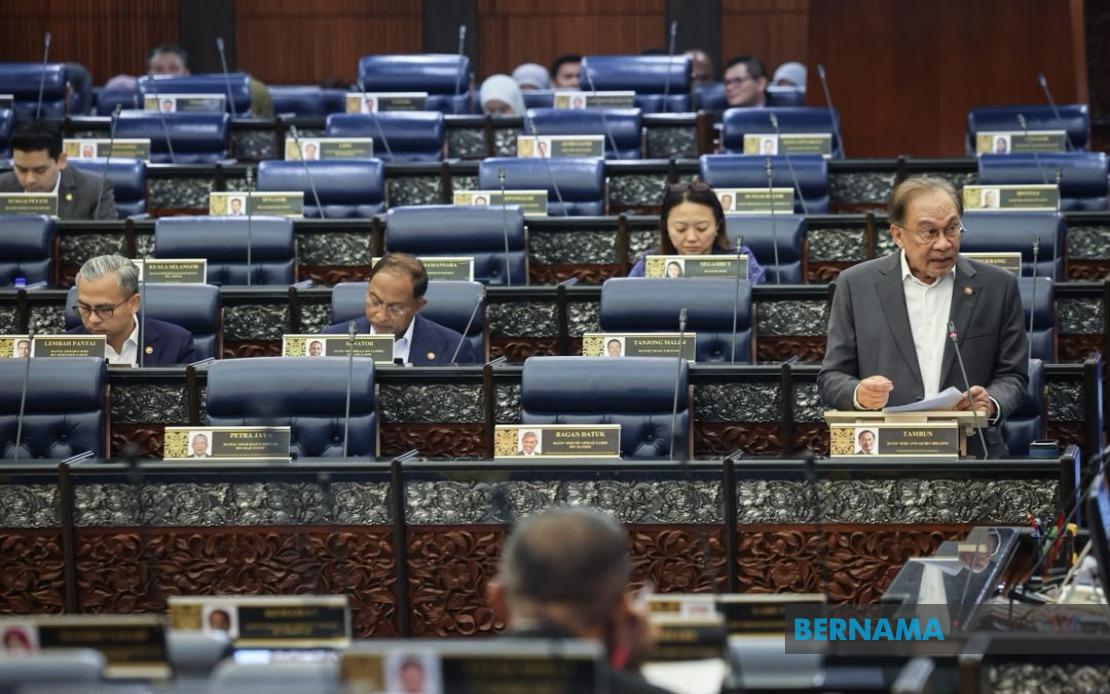
Prime Minister Datuk Seri Anwar Ibrahim moved to counter recent criticism of Malaysia's fuel pricing by drawing a direct comparison with major global oil producers, asserting that Malaysian consumers continue to benefit from some of the region's most competitive rates. Speaking in Parliament on July 14, he highlighted that the government's BUDI MADANI subsidy programme has successfully maintained the price of RON95 petrol at RM1.99 per litre, a figure he positioned as substantially lower than what motorists pay in neighbouring and competing oil-exporting nations.
The Prime Minister's comments were prompted by a parliamentary question from Datuk Rosol Wahid, the PN-Hulu Terengganu representative, who raised concerns about the differential in fuel costs between the previous administration under Datuk Seri Najib Razak and the current government. Wahid's intervention appeared designed to remind legislators of Anwar's earlier pledges, made during his tenure in opposition politics, to drive fuel prices down to RM1.50 per litre—a commitment that has not been realised under his current administration. The question thus touched upon a politically sensitive subject: whether the government has adequately delivered on one of its key electoral promises to ordinary Malaysians struggling with cost-of-living pressures.
In his response, Anwar reframed the discussion by shifting focus to regional and global comparisons rather than engaging directly with the RM1.50 pledge. He demonstrated that Saudi Arabia, the world's largest crude oil exporter and a country with vastly greater petroleum reserves and production capacity than Malaysia, now charges motorists above RM2.40 per litre for fuel—meaning Malaysian drivers benefit from a price advantage of more than 40 sen per litre. This disparity is particularly striking given Saudi Arabia's position as a net energy exporter with minimal extraction costs relative to international benchmarks, making its pricing structure a telling benchmark for evaluating Malaysia's own approach.
The Prime Minister further extended his comparative analysis to Qatar and the United Arab Emirates, both major regional oil producers with substantial petrochemical infrastructure and export revenues. He noted that both nations have set retail fuel prices higher than Malaysia's current rate, with the UAE having implemented a price increase merely two months prior to his parliamentary statement. This observation carries particular weight in the Malaysian context, as the UAE's decision to raise prices despite its status as a major oil producer suggests that even wealthy hydrocarbon-rich economies have begun passing higher energy costs to consumers—a policy choice that implicitly validates Malaysia's maintenance of subsidised rates as an extraordinary measure of government support.
Anwar's invocation of historical context provided additional ammunition for his position. He recalled that during earlier calls for fuel price reductions, Saudi Arabia's petrol cost around 50 sen per litre—a figure that has since dramatically escalated to over RM2.40. This historical trajectory underscores the global inflationary pressures affecting fuel markets and suggests that Malaysia's stability in pricing, achieved through continued government subsidy, represents genuine policy achievement rather than a competitive disadvantage. The Prime Minister effectively argued that maintaining flat prices in an environment of rising global crude costs requires substantial fiscal commitment and demonstrates governmental prioritisation of affordability for ordinary citizens.
The BUDI MADANI initiative itself deserves scrutiny as a policy framework. Introduced to replace previous subsidy mechanisms, the programme represents a government decision to absorb the differential between international crude prices and domestic retail rates, thereby shielding Malaysian consumers from full market exposure. This approach contrasts sharply with the market liberalisation strategies adopted by several developed nations and some regional peers. By maintaining a price ceiling rather than allowing dynamic, market-determined pricing, the government opts for predictability and affordability at the expense of fiscal resources that might otherwise fund infrastructure, education, or healthcare expansion.
The broader political context surrounding fuel pricing in Malaysia reflects deep public sensitivity to petrol costs as a bellwether of living standards and governmental effectiveness. During the Najib era, fuel subsidy reforms and periodic price adjustments generated considerable public backlash and became flashpoints for political mobilisation against the ruling coalition. Anwar's opposition rhetoric during that period capitalised on public frustration, and his subsequent elevation to the Prime Minister's office created expectations that he would prioritise fuel affordability. The fact that prices remain above his stated RM1.50 target yet below comparable regional rates suggests a government attempting to balance electoral promises with fiscal sustainability—a precarious equilibrium that continues to invite parliamentary scrutiny.
For Malaysian motorists and the broader business community, the implications of fuel pricing extend beyond simple pump costs. Heavy vehicles, commercial fleets, and public transportation operators all factor fuel expenses into operational budgets, meaning subsidised petrol rates create ripple effects throughout the economy. Lower fuel costs reduce logistics expenses, potentially moderating prices for goods and services consumed by ordinary households. Conversely, from a macroeconomic perspective, fuel subsidies represent a substantial drain on government revenue—funds that might otherwise address structural inefficiencies, invest in renewable energy transitions, or reduce budget deficits. This tension between immediate consumer relief and long-term fiscal sustainability frames ongoing debates about Malaysia's energy policy direction.
Anwar's parliamentary defence of fuel pricing also reflects broader geopolitical considerations affecting Malaysia's energy sector. Unlike Saudi Arabia or Qatar, Malaysia is not a major crude exporter; rather, it functions increasingly as a net energy importer as domestic production declines relative to consumption. This structural reality means Malaysian policymakers cannot rely upon petroleum revenues to subsidise domestic prices indefinitely. The comparison with Saudi Arabia, while politically effective, somewhat obscures the fact that Saudi prices reflect a fundamentally different resource base and fiscal structure. As Malaysia transitions toward renewable energy sources and confronts the reality of depleting hydrocarbon reserves, fuel pricing policies will necessarily evolve, potentially requiring difficult adjustments to consumer expectations built upon years of subsidised rates.
The parliamentary exchange also illustrated how fuel pricing intersects with broader narratives about governmental competence and economic management. For opposition figures, Malaysia's inability to achieve RM1.50 petrol represents broken promises and economic mismanagement. For government supporters, the maintenance of prices below RM2.00 amid global inflation demonstrates pragmatic stewardship and commitment to social welfare. Both interpretations contain validity, depending upon one's weighting of competing priorities: immediate affordability versus long-term fiscal health and economic transformation. Moving forward, Malaysian policymakers will likely face mounting pressure to articulate a coherent long-term energy strategy that transparently addresses the unsustainability of indefinite subsidies while acknowledging legitimate public concerns about affordability and living standards.

