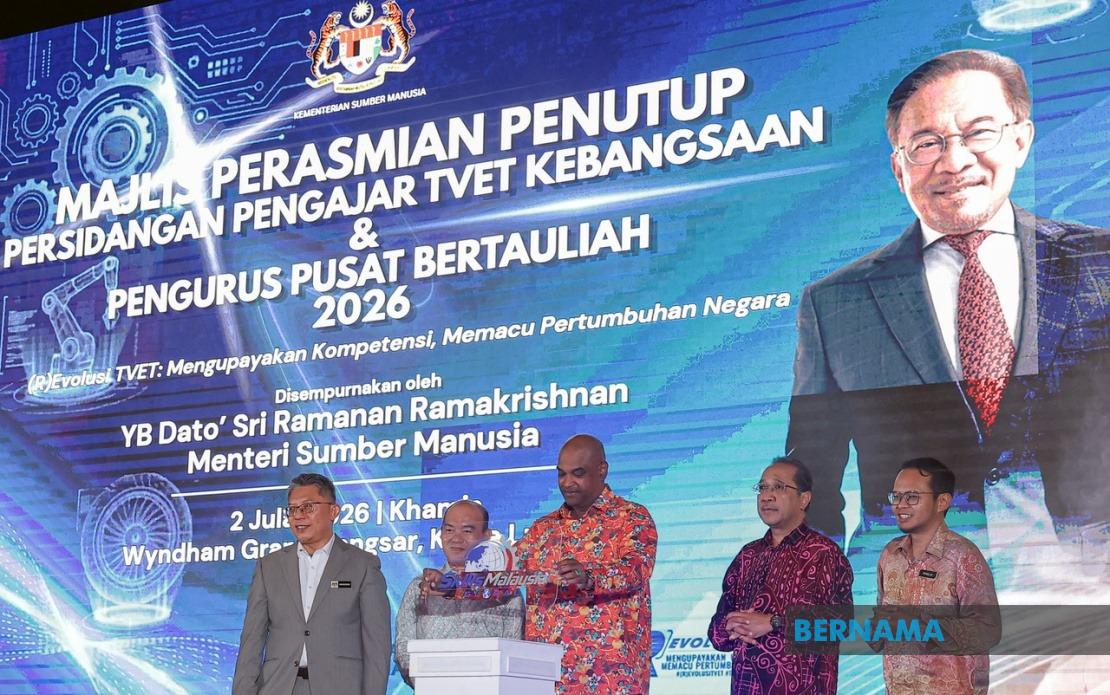
The Ministry of Human Resources (KESUMA) is making a significant push to restructure how it finances vocational skills development, seeking to convert the Skills Development Fund Corporation's (PTPK) current loan-based model into an outright grant system. Minister Datuk Seri R. Ramanan announced the initiative is being prepared for Cabinet consideration, signalling a potential shift in how Malaysia funds technical and vocational education and training across the nation.
The proposal targets approximately RM100 million currently extended as loans through PTPK, a mechanism that has created considerable financial strain for programme participants. Ramanan articulated the core concern driving this initiative: many individuals pursuing Technical and Vocational Education and Training (TVET) courses must leave their employment to complete their studies. This creates a double financial burden whereby trainees simultaneously lose their regular income stream while remaining obligated to service loan repayments tied to their education costs. The combination of foregone wages and debt obligations has emerged as a significant barrier to participation in Malaysia's vocational development ecosystem.
This policy recalibration reflects broader strategic thinking within KESUMA about the role TVET plays in Malaysia's economic transformation agenda. Speaking at the National TVET Instructors and 2026 Accredited Centre Managers Conference in Kuala Lumpur, Ramanan framed vocational education not as a secondary pathway but as a cornerstone of the Malaysia MADANI human capital development framework. The rebranding signals governmental recognition that TVET institutions and programmes require elevated status and resourcing equivalent to traditional academic tracks to be effective.
The ministry's emphasis on TVET's economic importance stems from acute labour market realities. Ramanan stressed that technical and vocational education serves as a critical mechanism for eliminating skills mismatches that have constrained Malaysia's economic competitiveness. When workers possess qualifications that align precisely with industry demand, the resulting efficiency gains ripple through the entire productive apparatus. This alignment effect becomes particularly consequential as Malaysia pursues positioning itself as a Regional Innovation Hub, a designation that requires not merely high-level researchers but also technically proficient workers capable of implementing advanced manufacturing, digital infrastructure, and precision engineering at scale.
The financial aspirations accompanying this strategic vision are substantial. KESUMA has established a target of achieving Gross National Income per capita around RM77,200 annually—a significant elevation from current levels that underscores the ambitious economic restructuring envisioned. This income target cannot be achieved through traditional sectors alone; it requires a workforce possessing capabilities in emerging technology fields, advanced services, and knowledge-intensive manufacturing. TVET graduates constitute a critical cohort within this workforce expansion, yet their participation remains constrained by the very financing structures the ministry now proposes to reform.
Simultaneously, KESUMA is advancing internationalisation of Malaysia's vocational ecosystem. The newly launched Internationalisation Action Plan for the Department of Skills Development, spanning 2026 to 2030, establishes six strategic pillars designed to elevate Malaysian credentials to international standing. A pivotal component involves mapping Malaysia's National Occupational Skills Standards (NOSS) against global benchmarks, positioning the Malaysian Skills Certificate (SKM) for recognition by foreign professional bodies. This globalisation strategy transforms TVET from domestic workforce development into a potential export service, as Malaysian-certified technicians become marketable internationally.
The internationalisation framework incorporates contemporary governance expectations through explicit integration of Sustainable Development Goals (SDG), Environmental Social and Governance (ESG), and Diversity Equity and Inclusion (DEI) principles. This signals Malaysia's awareness that international quality standards now encompass sustainability and social responsibility dimensions beyond purely technical competence. The establishment of CIAST as a world-class instructor training institution underpins these ambitions, as training quality directly determines whether Malaysian vocational graduates meet international expectations.
For Malaysian workers, the proposed shift from loans to grants carries immediate practical implications. Individuals from lower-income backgrounds—precisely those populations most dependent on vocational pathways for economic mobility—would face substantially reduced financial barriers to participation. Removal of loan obligations allows trainees to focus entirely on skill acquisition rather than dividing cognitive and emotional resources between studies and debt anxiety. This enhanced accessibility particularly benefits rural and semi-urban populations where family incomes often cannot absorb educational loan burdens alongside living expenses.
Regionally, Malaysia's vocational development orientation positions it distinctly within Southeast Asia's human capital competition. Countries including Vietnam, Thailand, and Indonesia have similarly prioritised technical education expansion, yet Malaysia's potential advantage lies in combining accessible financing with internationally recognised certification. If KESUMA successfully converts PTPK loans to grants while simultaneously elevating SKM credentials internationally, Malaysian TVET graduates could command premium positioning in regional labour markets, particularly within Singapore and high-growth East Asian economies.
The Cabinet consideration process will ultimately determine whether this ambitious restructuring materialises. Beyond immediate financing implications, approval would signal sustained governmental commitment to vocational education as strategic priority rather than residual provision for academically unsuccessful students. Such repositioning requires sustained budgetary commitment extending beyond single budget cycles, necessitating broad political consensus among Cabinet members that TVET funding represents investment in national competitiveness rather than subsidy to disadvantaged groups.
Implementation challenges remain non-trivial. Converting existing loans to grants requires either budgetary reallocation from other programmes or new appropriations, both politically contentious decisions. KESUMA must demonstrate persuasively that grant-based financing generates returns—whether measured through labour market outcomes, enterprise productivity gains, or export service expansion—justifying the fiscal impact. Success measurement frameworks, programme quality monitoring, and graduate tracking systems would require simultaneous enhancement to substantiate effectiveness claims.

