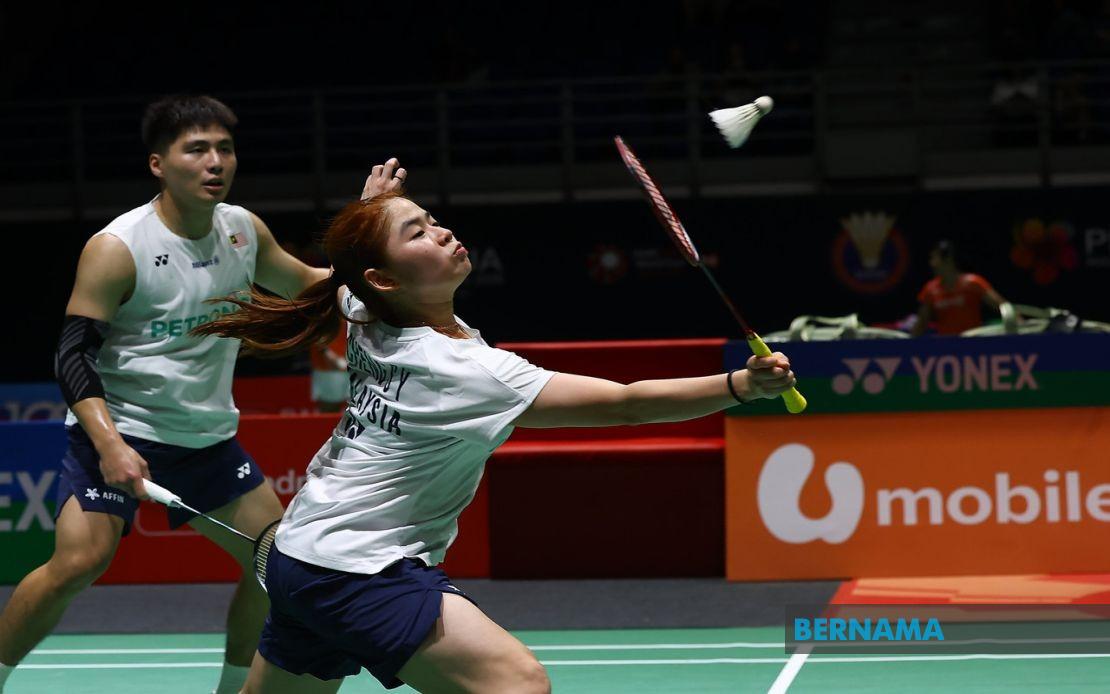
Malaysia's badminton contingent at the 2026 Japan Open has concluded its tournament run following a pair of semi-final defeats in Tokyo on July 18. The elimination of the mixed doubles combination of Jimmy Wong and Cheng Su Yin, alongside the men's doubles team of Goh Sze Fei and Nur Izzuddin Rumsani, brings an end to what had been a promising showing for the Southeast Asian nation at one of the sport's premier international competitions.
The mixed doubles pairing of Jimmy Wong and Cheng Su Yin faced off against Hong Kong's Tang Chun Man and Tse Ying Suet in what proved to be a tightly contested encounter extending beyond an hour of play. The Malaysian pair, who had earned an unseeded berth into the semi-finals through an impressive series of upsets against higher-ranked opposition, ultimately succumbed 17-21, 21-18, 21-15 over the course of 69 minutes. The loss terminated a notable tournament narrative wherein Wong and Cheng Su Yin had emerged as potential giant-killers, demonstrating the capacity to trouble established top-ten pairings throughout their campaign.
Despite the disappointment of falling just short of the finals, the Malaysian mixed doubles team's performance at the Japan Open provided substantive evidence that they belong among the world's elite combinations. Their ability to navigate past seeded opposition and sustain competitive momentum against experienced adversaries like Tang and Tse suggests a promising trajectory for this pairing in the international circuit. The pair's run to the penultimate round validates the technical development and strategic sophistication they have cultivated within Malaysia's badminton ecosystem.
The men's doubles assignment for Malaysia encountered an even more formidable obstacle, as Goh Sze Fei and Nur Izzuddin Rumsani drew the world's top-ranked pairing, South Korea's Kim Won Ho and Seo Seung Jae. The 58-minute semi-final proved a challenging examination of the Malaysian duo's capabilities, particularly given the exceptional pedigree of their opponents. Beginning from a position of considerable disadvantage, Goh and Nur Izzuddin initially struggled to impose their game plan, dropping the opening set decisively with a 12-21 scoreline that appeared to presage a straightforward victory for the favoured Koreans.
However, the Malaysian pairing demonstrated resilience and tactical adjustment, storming back to claim the middle set 21-11 and forcing the encounter to a decider. This turnaround illustrated the depth of competitive character within this combination and their capacity to respond meaningfully to adversity within a match context. The psychological momentum generated by the second-set victory appeared insufficient to sustain their challenge, as Kim Won Ho and Seo Seung Jae reasserted their dominance in the final set, prevailing 21-13 to progress to the championship match.
The historical record between these two pairs provides relevant context to understanding the significance of the semi-final meeting. Goh and Nur Izzuddin have encountered the South Korean duo on five previous occasions, managing victories in only two of those contests. This pattern of results underscores the profound challenge posed by facing the world's premier men's doubles partnership, even for combinations of considerable technical merit and international experience. The Malaysian pairing has simply been unable to consistently unlock the tactical solutions required to breach Kim and Seo's defensive solidity and offensive efficiency.
From a broader Malaysian sporting perspective, the campaign represents a creditable effort within the intensely competitive global badminton landscape. The nation's representation reached the semi-finals across multiple disciplines, demonstrating sustained investment and development within the sport's domestic pathway. Though the objective of securing medals remained unfulfilled, the appearance of Malaysian athletes in championship-round competitions at tournaments of Japan Open's magnitude validates the structural framework supporting elite badminton performance domestically.
The Japan Open occupies a significant position within international badminton's annual calendar, attracting the world's finest practitioners across all five disciplines. For Southeast Asian nations, performing competitively at such venues carries particular importance, both in terms of individual athlete development and in establishing regional credibility within the sport's global hierarchy. Malaysia's presence in semi-finals indicates the nation remains positioned among badminton's more serious competitors, despite facing intensifying competition from China, Indonesia, South Korea, and other established powerhouses.
Looking forward, Malaysian badminton administrators and coaching staff will likely conduct comprehensive evaluations of the semi-final performances to identify areas requiring tactical refinement and technical enhancement. The encounters against Hong Kong and South Korean opposition provide valuable diagnostic information regarding the gaps separating Malaysia's current capability from championship-winning standards. Translating such analytical insights into concrete performance improvements will constitute the essential challenge as these pairings approach subsequent international competitions and endeavour to progress from runner-up finishes to tournament victors.

