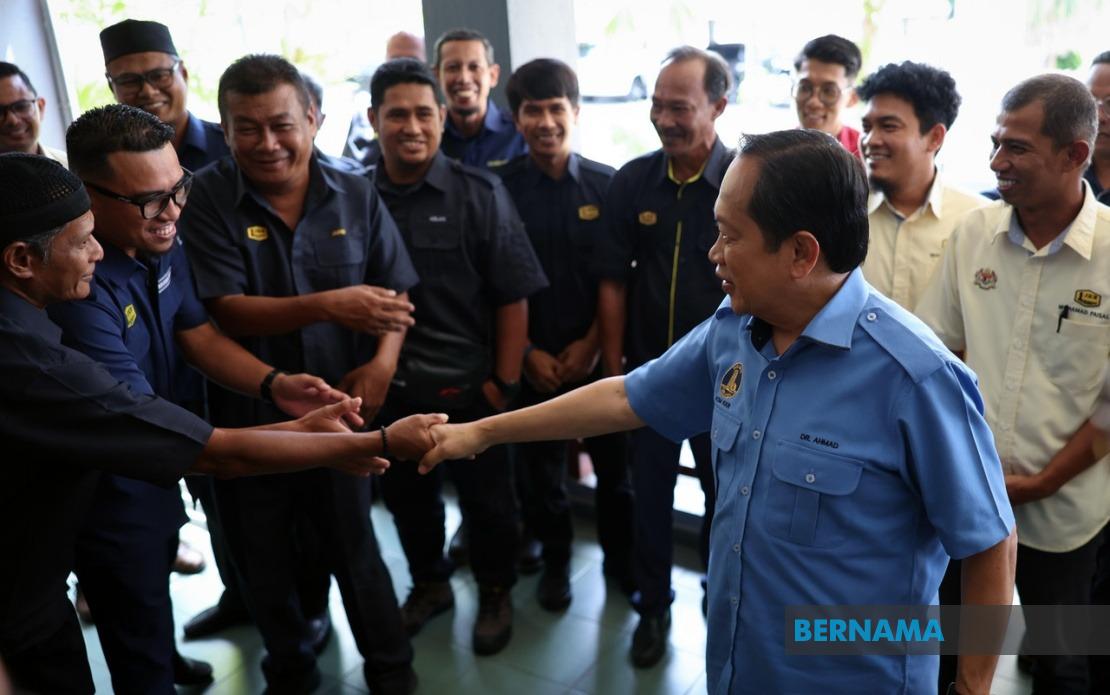
Deputy Works Minister Datuk Seri Ahmad Maslan has confirmed that the nationwide Programme Cakna MADANI initiative to construct additional classrooms using the Modular Precast System (MPS) will reach completion by the end of this year. Speaking during a working visit to inspect federal development projects at the Public Works Department office in Alor Gajah, Ahmad indicated that the accelerated construction methodology is delivering results across multiple school sites, with all facilities expected to be operational when Year One students arrive for the 2027 academic session.
The adoption of the modular construction approach represents a significant departure from conventional building methods in Malaysia's education infrastructure development. Ahmad credited himself with proposing the Modular Precast System to Prime Minister Datuk Seri Anwar Ibrahim in the previous year, positioning the initiative as a strategic response to long-standing delays in school infrastructure projects. The underlying principle behind the technology centres on reducing construction timelines without sacrificing structural integrity or durability—a challenge that has historically plagued Malaysia's public works sector.
The efficiency gains demonstrated by the MPS model draw inspiration from international best practices, particularly China's advanced modular construction techniques. Ahmad highlighted the remarkable speed achievable through this methodology, noting that Chinese builders have successfully erected 10-storey residential structures in approximately 28 hours and 45 minutes using comparable systems. This technological reference point underscores Malaysia's commitment to adopting proven international standards while adapting them to local educational infrastructure needs. The cost-effectiveness of the approach—delivering lower expenses alongside faster execution and maintained quality standards—addresses long-standing concerns about value-for-money in government construction contracts.
Within the Alor Gajah district specifically, the Public Works Department is implementing substantial educational infrastructure improvements totalling RM12.05 million across 14 schools. These projects focus on constructing the additional classrooms necessary to accommodate new Year One cohorts in 2027, reflecting demographic pressures on existing school facilities in this region. Concurrently, separate initiatives valued at RM1.83 million involve constructing covered multipurpose facilities at two schools, expanding recreational and assembly spaces essential for holistic student development beyond traditional classroom instruction.
The scope of federal building projects in Alor Gajah extends considerably beyond classroom construction. The Public Works Department is simultaneously managing five major infrastructure developments worth RM22.6 million, demonstrating the coordinated approach to educational and institutional facility upgrades across the district. These encompass the reconstruction of two dilapidated primary schools—Sekolah Kebangsaan Kampung Tengah and Sekolah Kebangsaan Kuala Linggi—addressing long-standing safety and structural concerns that have likely impacted teaching and learning environments. Additional work includes constructing a replacement canteen facility at Sekolah Ramuan Cina Besar, recognising the importance of adequate food service infrastructure in supporting student nutrition and school operations.
Beyond education-focused infrastructure, the investment portfolio reflects broader federal development priorities. The construction of the Lesung Batu Mosque addresses community religious facilities, while significant upgrades to training infrastructure at the Alor Gajah National Youth Skills Institute (IKTBN) specifically targeting the Hospitality Department represent alignment with national workforce development objectives. These parallel projects indicate a holistic approach to community infrastructure development, integrating educational facilities with religious, vocational, and recreational amenities within a single coordinated programme.
Maintenance and facility preservation remain critical components of the Alor Gajah infrastructure strategy. An additional RM5.1 million allocation has been designated for maintaining existing federal buildings across multiple ministry portfolios, including facilities under the Ministry of Education, Ministry of Natural Resources and Environmental Sustainability, and Ministry of Health. This preventive maintenance approach reflects a maturing understanding that facility longevity depends on consistent upkeep rather than cyclical major repairs. The distributed responsibility across multiple government agencies suggests integrated coordination mechanisms to avoid duplication and ensure efficient resource utilisation.
The programme's implications extend beyond Alor Gajah to signal nationwide standardisation of the modular construction approach. Ahmad's remarks confirm that the MPS methodology is being deployed across multiple school sites nationally, indicating centralised policy implementation at the federal level. This consistency approach promises uniformity in facility quality and timeline adherence across regions, addressing historical variations in project delivery performance that have characterised Malaysian public works. The standardisation of construction methodology also facilitates knowledge transfer, training, and operational efficiencies across the public works sector.
Longer-term applications of the modular system extend possibilities for Malaysia's infrastructure development beyond temporary or ancillary structures. Ahmad noted that while current applications focus on additional buildings, the technology is fundamentally scalable to permanent construction projects. This observation suggests potential evolution toward more extensive use of modular systems in future educational and institutional infrastructure programmes. The durability assurances provided—with the technology capable of supporting decades of continuous use—position modular construction as a viable alternative to traditional building methodologies for Malaysia's infrastructure needs.
The workforce implications of accelerated modular construction merit consideration within Malaysia's construction and engineering sectors. The transition from conventional site-based building practices to factory-produced modular assembly may reshape employment patterns, skill requirements, and labour productivity within the construction industry. Training and adaptation programmes for workers transitioning to modular assembly techniques will likely become necessary to maximise the technology's benefits while supporting affected workers. The adoption of advanced construction methodologies represents both opportunity and challenge for Malaysia's construction workforce.
The Programme Cakna MADANI's emphasis on timely facility delivery directly addresses documented deficiencies in Malaysia's education infrastructure capacity. As population growth and demographic shifts concentrate student populations in specific regions, maintaining adequate classroom facilities remains an ongoing challenge. The modular system's efficiency enables more responsive facility expansion aligned with enrolment patterns, reducing periods when students operate in overcrowded or substandard learning environments. This responsiveness represents a significant departure from traditional planning cycles that often lag behind actual infrastructure needs.

