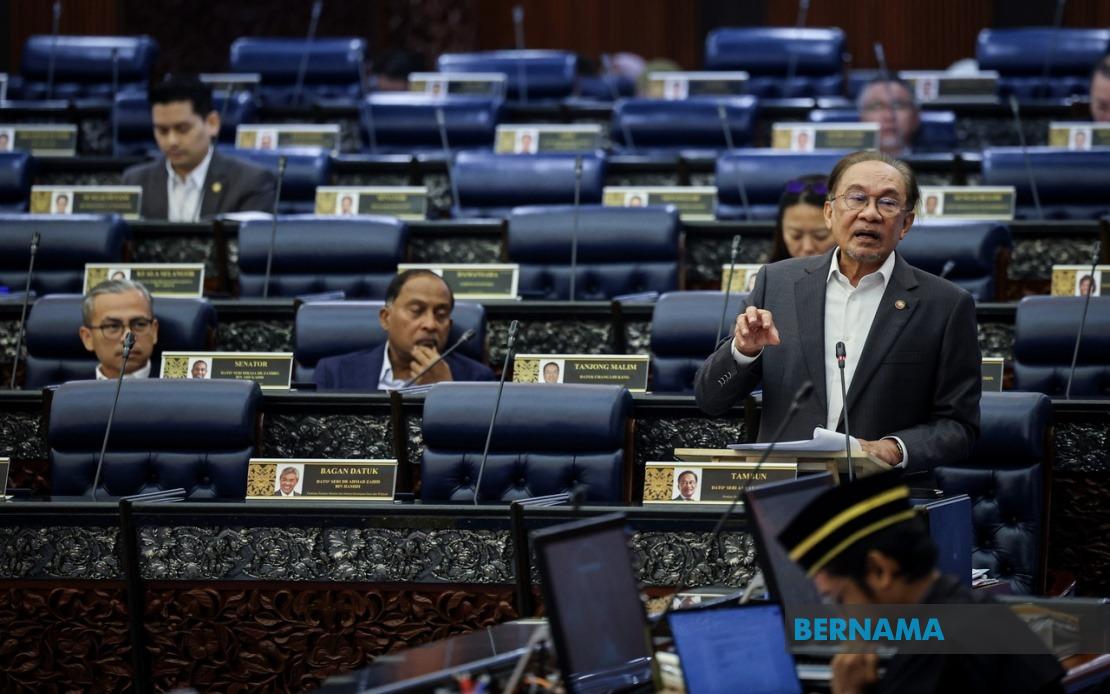
Malaysia's drop in the latest World Press Freedom Index reflects enforcement actions against media organisations over sensitive content rather than attempts to suppress political dissent, Prime Minister Datuk Seri Anwar Ibrahim explained in Parliament on July 7. The country's ranking slipped from 88th last year to 95th in this year's assessment, a decline that has attracted international scrutiny of Malaysia's commitment to media freedom. Anwar characterised the decline as a consequence of how international observers interpret specific regulatory decisions, particularly those involving what the government deems essential national safeguards rather than editorial restrictions.
The Prime Minister identified two high-profile cases that significantly influenced Malaysia's lower standing in the index compiled by Reporters Without Borders (RSF). Sin Chew Daily faced enforcement action following publication of an inaccurate illustration of the Jalur Gemilang, while Sinar Harian encountered regulatory response related to the publication of the Inspector-General of Police's biography. These actions, though justified domestically on grounds of protecting national symbols and institutional integrity, were perceived by the international media community as serious incursions on editorial independence. Anwar acknowledged this perception gap, noting that while other nations may not regard flag imagery with comparable sensitivity, Malaysia's approach reflects deep constitutional commitments and national values that the government considers non-negotiable.
Central to Anwar's defence of the government's regulatory stance is the distinction between enforcing boundaries on what he termed the three Rs—religion, race, and the royal institution—and suppressing legitimate political opposition. The Prime Minister emphasised that the government does not prosecute outlets for factual inaccuracies in general reporting or for publishing political criticism of leaders and policy. Instead, when such issues arise, the government has shifted toward public clarification and parliamentary explanation rather than regulatory action. This policy orientation reflects a deliberate effort to calibrate the balance between protecting constitutionally protected interests and preserving space for robust democratic debate, though the strategy has proven difficult to communicate internationally and may not substantially alter international assessment methodologies that view enforcement action as inherently restrictive.
Anwar pointed to recent legislative reform as evidence of the government's commitment to narrowing the scope of criminal liability in media expression. Amendments to Section 233 of the Communications and Multimedia Act 1998 have removed satirical remarks directed at the Prime Minister and other leaders from the category of criminal offences. This reform acknowledges that political satire and robust commentary on government figures constitute essential elements of democratic discourse and should not trigger state prosecution. The amendment signals a shift in governmental thinking, recognising that distinguishing between legitimate satire and genuine defamation requires nuance that criminal provisions often fail to provide. However, the scope of these reforms may not extend fully to content touching on the sensitive domains of religion, race, and royal prerogative, where the government maintains stricter boundaries aligned with constitutional provisions and rulings from the Conference of Rulers.
A critical contextual element in Malaysia's press freedom assessment involves the role of social media platforms and their content moderation decisions. Anwar noted that RSF's evaluation considers not only direct government action but also the broader information ecosystem, including the removal of content by technology companies based on user complaints rather than state directives. This distinction carries significant implications for how Malaysia's regulatory environment is perceived internationally, as platforms' unilateral content decisions may appear similar to government censorship to external observers, even when they operate independently of official instruction. The Prime Minister cited his own experience, noting that social media platforms have removed posts he authored regarding Hamas despite the government's disagreement with such removals, illustrating how technology company policies rather than Malaysian state action can constrain information flow and contribute to perceptions of restrictive media environments.
The Malaysian Communications and Multimedia Commission (MCMC) operates within further constraints that may not be fully understood in international press freedom assessments. Requests by MCMC to social media platforms for content removal are not automatically granted, as final decisions rest with platform operators themselves. This division of authority means that Malaysia's regulatory capacity extends only to formal requests, with no guarantee of compliance. When platforms decline MCMC requests or remove content beyond what the commission has requested, the platform rather than the government bears responsibility, yet the overall effect on information availability may be attributed to Malaysia's regulatory environment by foreign observers unfamiliar with these operational distinctions. This structural reality complicates both the government's ability to manage information flows and the accuracy of international assessments that may not account for the distinction between regulatory intent and actual implementation capacity.
The Reporters Without Borders methodology evaluates press freedom across multiple dimensions beyond direct government action, including the political environment, legal framework, economic conditions, socio-cultural context, and security situation. Malaysia's ranking decline may thus reflect broader assessments of political stability, economic factors affecting media sustainability, or perceived security risks rather than solely enforcement decisions against specific outlets. Understanding this multifactorial assessment framework is important for Malaysian policymakers and observers, as addressing the ranking requires attention to institutional governance, economic media viability, and social cohesion, not merely reforming enforcement procedures. The interplay of these factors means that even if the government were to refrain entirely from regulatory action against news organisations, improvements in the overall assessment might proceed only gradually as other contextual elements evolve.
Anwar's framing of the government's position rests on a principled argument about constitutional obligations and national consensus. The Conference of Rulers, Malaysia's highest consultative body on constitutional matters, has articulated positions on protecting the royal institution and preventing content that inflames religious or racial tensions. The government, in this account, enforces boundaries established through institutional consensus rather than imposing arbitrary restrictions on expression. This constitutional grounding distinguishes Malaysia's regulatory approach from more overtly authoritarian systems, though it does not necessarily satisfy international press freedom indices that prioritise near-absolute editorial latitude. The tension between respecting constitutional structures that reflect Malaysia's multicultural compact and meeting international standards of unrestricted expression remains unresolved in this framework.
The practical implications of Malaysia's ranking decline extend beyond institutional pride or international standing. Lower rankings in press freedom indices can influence investor perceptions, affect international cooperation on media standards, and provide ammunition for critics of the government's democratic credentials. For Malaysian media organisations, the international assessment may impact access to international partnerships, advertising networks that screen for press freedom compliance, and the mobility of journalists seeking international opportunities. Conversely, the government's position that enforcement is defensive rather than expansive reflects a genuine policy debate within democratic governance about where protective boundaries should lie. The challenge for Malaysia moving forward involves demonstrating through sustained action that the government distinguishes rigorously between protecting constitutional institutions and suppressing legitimate political expression, while accepting that international assessments may continue to penalise any enforcement action regardless of its constitutional rationale.

