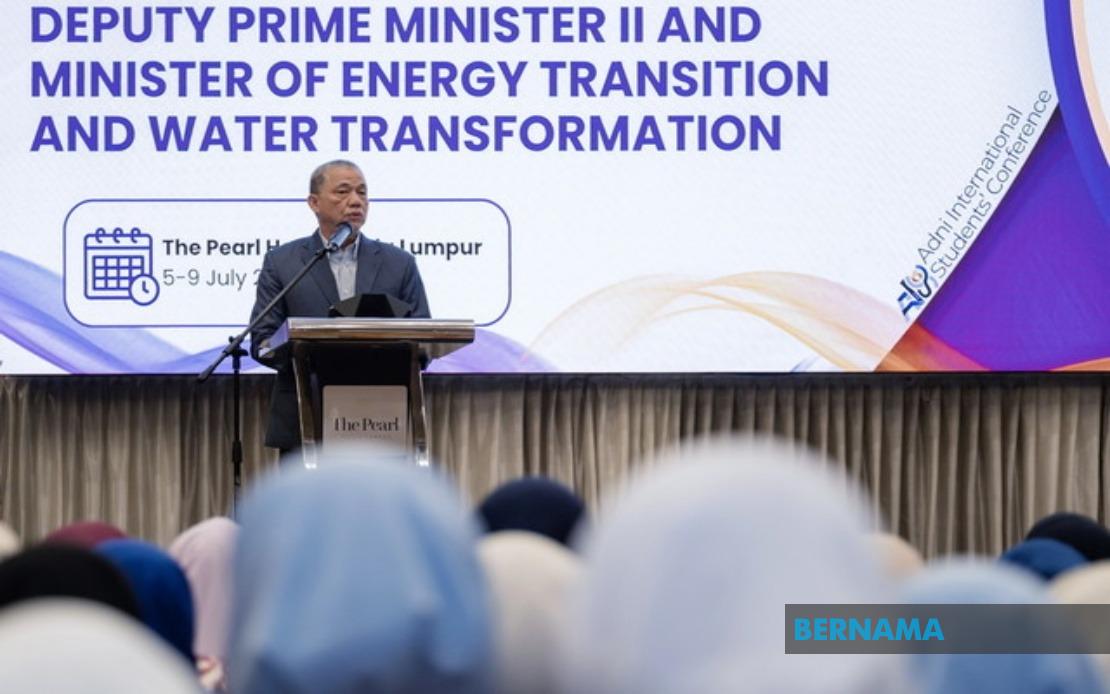
The nation's trajectory will be determined less by its economic resources or technical prowess than by the calibre of its workforce and citizens, according to Deputy Prime Minister Datuk Seri Fadillah Yusof, who articulated this vision while inaugurating the ADNI International Students' Conference (AISC) 2026 in Kuala Lumpur on July 6. His remarks underscore a strategic reorientation within Malaysia's leadership—one that acknowledges the limits of material and technological investment alone and pivots toward recognising people as the ultimate competitive asset in an increasingly complex global landscape.
Fadillah elaborated that contemporary societies require individuals equipped with analytical rigour, articulate communication skills, and the flexibility to navigate perpetual transformation. This articulation reflects a growing recognition across Southeast Asia that the rapid pace of change—spanning artificial intelligence deployment, climate disruption, and evolving labour markets—demands workforces capable of independent reasoning rather than rote execution. The Deputy Prime Minister's emphasis signals that Malaysia is moving beyond conventional infrastructure and innovation metrics to measure national readiness through the intellectual and adaptive capacities of its people.
The challenges confronting the region transcend borders and demand coordinated responses that no single actor can manage independently. Climate instability, pandemic preparedness, technological disruption, and widening socioeconomic divides represent interconnected problems requiring input from governmental agencies, universities, commercial enterprises, grassroots organisations, and the emerging generation. Fadillah framed this reality as necessitating genuine partnership rather than siloed institutional responses, positioning the MADANI Government's commitment to human capital advancement as the foundational pillar upon which integrated solutions can be constructed.
This philosophical stance echoes principles established by former Prime Minister Tun Hussein Onn, Malaysia's third premier, who emphasised that enduring national strength emanates from the cohesion and moral fibre binding communities together rather than from monuments or machinery. By resurrecting this intellectual lineage, contemporary policymakers signal continuity with foundational nation-building wisdom while applying it to twenty-first-century circumstances. The invocation establishes human-centred development not as a contemporary fad but as a core Malaysian principle requiring renewed emphasis.
Fadillah articulated a holistic vision of genuine progress extending beyond economic metrics to encompass educational enrichment, physical and psychological wellness, ethical grounding, imaginative capacity, environmental stewardship, and social bonds. This expansive framework contrasts with narrower development paradigms that prioritise gross domestic product growth or sectoral productivity gains. For Malaysian policymakers and development practitioners, this reframing carries significant implications—it suggests redirecting resource allocation toward curriculum reform, mental health infrastructure, values education, and community-building initiatives alongside traditional economic interventions.
The conference theme, 'Thriving Together: Diversity, Education and Wellness in a Digital World,' deliberately mirrors the United Nations Sustainable Development Goals, positioning the gathering as a microcosm of global aspiration translated into institutional practice. By bringing approximately 150 participants—originating from Thailand, the Philippines, Indonesia, and Malaysia—into sustained dialogue, the conference operationalises the interconnectedness Fadillah described. For Southeast Asian observers, the deliberate cultivation of cross-border student engagement represents an understated but consequential investment in regional stability through cultivation of interpersonal relationships and mutual understanding before geopolitical frictions crystallise.
The Deputy Prime Minister advanced a crucial distinction regarding technological advancement: artificial intelligence and computational systems, no matter their sophistication, cannot replicate wisdom—that deeper integration of knowledge with ethical judgment. Similarly, digital platforms, despite their capacity to facilitate connection, cannot substitute for compassion—the empathetic recognition of shared human vulnerability and interdependence. This argument carries particular force in Southeast Asia, where rapid digitalisation threatens to outpace society's ethical frameworks, potentially creating populations adept at information exchange but impoverished in moral consciousness and interpersonal solidarity.
Education emerges from Fadillah's intervention as the critical mechanism through which societies transform abstract commitments to human development into concrete capability. Quality instruction encompasses not merely knowledge transmission but cultivation of intellectual independence, ethical reasoning, intercultural competence, and adaptive capacity. For Malaysia and its regional partners, this understanding necessitates comprehensive educational reform—from pedagogical approaches that encourage questioning over memorisation, to curriculum revision incorporating global citizenship, to teacher professional development ensuring educators themselves model the critical thinking and emotional intelligence they are charged with fostering.
The gathering brought together young people positioned to shape regional trajectories across the coming decades, creating an opportunity for formation of intellectual and personal networks that may facilitate cooperation across borders long after formal conference proceedings conclude. In an era of rising nationalist sentiment and geopolitical tension throughout Southeast Asia, such investments in transcultural understanding among emerging leaders—however modest in scale—constitute quiet but indispensable infrastructure for regional peace and collaborative problem-solving. The deliberate inclusion of delegates from neighbouring nations signals recognition that Malaysia's human capital development cannot be pursued in isolation from the broader Southeast Asian context.
Fadillah's emphasis on shared values, mutual respect, and institutional trust as the connective tissue binding diverse societies represents a counterweight to technological determinism and economic reductionism that have dominated development discourse. These intangible yet foundational elements—trust, respect, ethical commitment—constitute the preconditions enabling complex societies to function effectively and justly. For Malaysian policymakers navigating a multicultural federation increasingly strained by polarisation, this restatement of the priority accorded to social cohesion and character formation carries urgent relevance, suggesting that technical and economic initiatives, while necessary, prove insufficient without accompanying investments in values education and community-building.
The MADANI Government's positioning of human capital development as central to national progress reflects broader global trends whereby countries competing for prosperity and influence recognise that advantage accrues to societies producing thoughtful, adaptable, ethically grounded citizens capable of collaboration. Malaysia's particular circumstances—including its positioning as a regional hub, its multicultural composition, and its aspiration toward high-income status—amplify the pertinence of Fadillah's message. The pathway forward requires sustained commitment to educational quality, wellness infrastructure, ethical leadership, and the deliberate cultivation of cross-cultural understanding within and beyond national boundaries.

