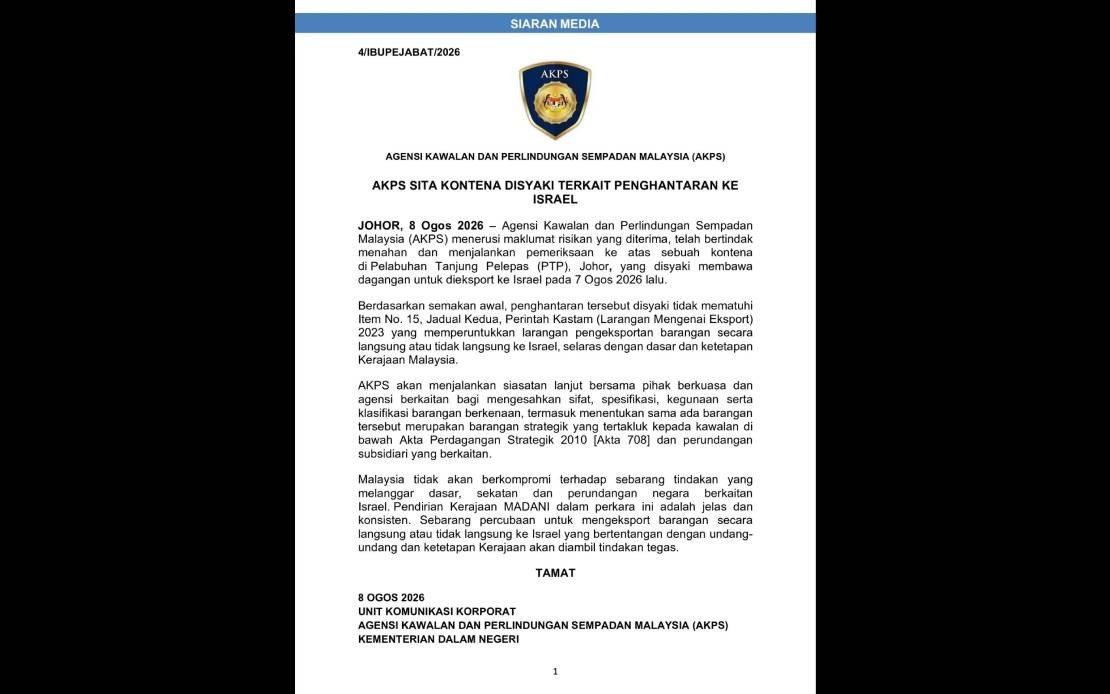
Malaysia's customs authorities have successfully intercepted a shipment believed destined for Israel at the Port of Tanjung Pelepas in Johor, drawing immediate praise from Prime Minister Datuk Seri Anwar Ibrahim as evidence of the country's unwavering commitment to its Palestine-centred foreign policy. The Malaysian Border Control and Protection Agency (AKPS) conducted the seizure and inspection operation, discovering a container suspected of containing strategic goods intended for export to the Israeli state in violation of national export control regulations.
Anwar's public commendation of AKPS through a Facebook statement underscores how seriously Malaysia's government treats enforcement of its Israel trade restrictions. The Prime Minister framed the interception as a crucial mechanism preventing Malaysia from becoming a conduit for commerce that could indirectly benefit Israeli operations against Palestinian populations. This messaging reflects a broader narrative within Malaysia's political leadership that views trade regulation as an extension of diplomatic principle rather than merely administrative procedure.
The detained shipment allegedly breached Item No. 15 of the Second Schedule of the Customs (Prohibition of Exports) Order 2023, which explicitly forbids direct or indirect export of goods to Israel in accordance with Malaysian government policy directives. This regulatory framework represents one of the world's most stringent formal trade restrictions targeting Israel, demonstrating Malaysia's legislative willingness to embed Palestine solidarity into binding commercial law rather than confining it to rhetorical gestures.
Anwar's statement specifically referenced Malaysia's membership in The Hague Group, a coalition of nations pursuing coordinated approaches to trade and diplomatic matters. By invoking this multilateral framework, the Prime Minister positioned the seizure within a broader international context, suggesting that Malaysia's embargo reflects not isolated national preference but alignment with coordinated global initiatives. This framing carries particular weight given Malaysia's role as a regional economic hub with significant shipping and port infrastructure.
The Prime Minister further noted that Malaysia's port closure to Israeli vessels and cargo has remained in force since December 2023, indicating sustained rather than sporadic enforcement of the embargo policy. This temporal marker reveals that the current seizure represents implementation of a standing directive now nearly nine months into effect, demonstrating institutional continuity across multiple enforcement cycles. For port operators and international shipping companies, such persistence signals that Malaysia's restrictions are permanent structural features of doing business rather than temporary political gestures.
Anwar's rhetorical emphasis on humanity, justice, and international law reflects Malaysia's positioning of its Israel embargo within a human rights rather than purely political framework. By anchoring the seizure to universal principles of dignity and Palestinian rights protection, the government appeals to both domestic constituencies sympathetic to Palestine and international audiences concerned with humanitarian standards. This rhetorical strategy distinguishes Malaysia's approach from characterizations of the embargo as mere political posturing or economic nationalism.
For Malaysian exporters and logistics operators, the seizure carries immediate practical implications regarding due diligence in supply chain management. Goods transiting through Malaysian ports destined for Israel require careful documentation and verification, as customs authorities now demonstrate active enforcement capacity beyond paperwork review. Companies must implement screening procedures to identify Israeli consignees or end-users, adding compliance costs but signalling clear regulatory expectations to market participants.
The incident also reflects Malaysia's navigation of complex pressures within the global economy. While maintaining strong Palestine advocacy, Malaysia simultaneously functions as a major international trading hub and technology manufacturing centre with significant foreign investment from diverse sources. The seizure demonstrates that these roles, while potentially tension-ridden, need not be fundamentally incompatible if enforcement remains targeted at specific jurisdictions rather than applied as broader trade discrimination affecting other nations.
Regionally, Malaysia's continued enforcement of Israel restrictions positions it distinctly within Southeast Asia's spectrum of diplomatic approaches. While neighbouring countries maintain varied relationships with Israel, ranging from cold pragmatism to quiet commercial engagement, Malaysia's explicit embargo and vocal political commitment provide a counterbalancing perspective within ASEAN's internal diversity. This positioning carries implications for regional coordination on Middle Eastern questions and Palestinian representation in Southeast Asian forums.
The seizure also illustrates how Malaysia's enforcement infrastructure has matured in practical capacity since the initial embargo's declaration. AKPS's ability to identify, detain, and properly inspect containers suspected of containing Israel-bound goods demonstrates institutional development that extends beyond legislative passage toward actual customs implementation. This operational competence requires training, inter-agency coordination, and intelligence gathering regarding shipping patterns and company networks involved in Israeli trade.
Looking forward, the incident establishes precedent that Malaysian authorities view enforcement as an ongoing responsibility rather than one-off demonstration. International shipping companies and export-oriented manufacturers will likely adjust their operational assumptions regarding Malaysian port utilization, potentially redirecting certain cargo flows to alternative hubs in Singapore or elsewhere. These market adjustments, while economically measurable, represent the practical transmission mechanism through which political principle becomes economic constraint.
Anwar's personal intervention in publicly praising the seizure carries additional significance beyond routine government statements, signalling the highest political level's direct engagement with embargo enforcement. Such visibility reinforces organizational incentives for customs officials to maintain vigilance and communicates to domestic audiences that Palestine solidarity remains a genuine priority rather than rhetorical flourish. For international observers and diplomatic counterparts, the Prime Minister's intervention also clarifies that Malaysia's Israel restrictions enjoy top-level political commitment likely to persist across electoral cycles and administrative transitions.

