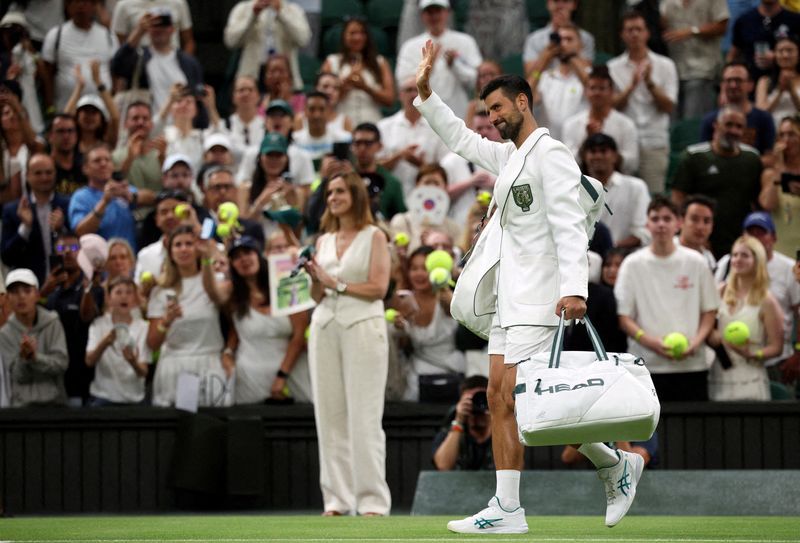
Wimbledon's all-white dress code has long restricted the kaleidoscopic fashion statements seen at other Grand Slam tournaments, yet this year the tournament has witnessed a striking shift as male players seize the pre-match walkway as a platform for sartorial expression. Novak Djokovic has commanded attention in a personalised Lacoste blazer paired with tailored shorts, whilst sixth-seeded Taylor Fritz has turned heads in a crisp white Hugo Boss jacket, formal trousers, and silk scarf ensemble. Their bold choices reflect a broader movement among the sport's male contingent to match the high-fashion theatricality that players like Naomi Osaka have championed across the 2024 Grand Slam circuit.
The cultural shift extends beyond mere aesthetics, signalling a fundamental recalibration of how elite athletes leverage tournament visibility for brand storytelling and personal identity. Joelle Michaeloff, chief creative officer at Wilson sports brand, characterises the current moment as unprecedented territory for men's tennis fashion. She notes that sponsors and athletes alike are capitalising on Wimbledon's global television reach and cultural cachet, transforming the walk-on from a functional transition into a carefully orchestrated marketing moment. Her observation underscores how the relationship between athlete, sponsor, and audience has fundamentally transformed, with brands investing substantially in design and promotion to amplify these fleeting but memorable appearances.
Naomi Osaka has undoubtedly catalysed this trend through her consistent, bold fashion choices across the major tournaments this year. Her jellyfish-inspired outfit at the Australian Open, layered yellow and gold Nike ensemble at the French Open, and recurring kimono-inspired creation at Wimbledon have established her as tennis's contemporary fashion icon. The 14th seed's strategy demonstrates how walk-on fashion can transcend sport and enter broader cultural discourse, generating organic social media engagement and press coverage that extends far beyond the sporting pages. Eleanor Thomas, collections lead at the All England Lawn Tennis Club, positions Osaka's Wimbledon contributions alongside the tournament's most iconic sartorial moments, cementing her influence on the sport's visual language.
Yet the male players' participation in this fashion evolution carries its own pressures and strategic considerations. Fritz, acutely aware that a striking outfit paired with early-round elimination could invite ridicule, has managed to navigate the third round without dropping a set, thereby preserving the credibility of his designer choices. His remarks underscore a calculated tension in men's tennis between embracing style innovation and maintaining competitive focus. The requirement to remove his custom trousers—designed with side seams for quick removal—before play commences exemplifies the practical constraints that govern fashion experimentation within Wimbledon's rigid regulatory framework. This balancing act reflects broader gender dynamics in professional tennis, where female players have established greater latitude for fashion risk-taking without comparable scrutiny of their playing performance.
Designer involvement and sponsor collaboration have evolved substantially beyond simple endorsement arrangements. Karen Khachanov, the Russian player who has reached the third round, exemplifies this deeper engagement by actively participating in design discussions regarding fabrics, colours, necklines, and fit. Such involvement transforms the athlete from passive model into creative collaborator, blurring traditional boundaries between sport and fashion industries. This democratisation of design input among male players represents a meaningful departure from historical precedent, where contractual obligations typically dictated appearance without substantive player input. The emerging dynamic allows athletes to express authentic style preferences rather than merely comply with sponsor directives, thereby elevating the walk-on from manufactured moment to genuine artistic statement.
However, Wimbledon's stringent all-white requirement continues to constrain creative expression compared to other Grand Slams. Italy's Matteo Berrettini's experience of having a proposed outfit rejected for insufficient whiteness illustrates the tournament's unyielding regulatory stance. This limitation paradoxically heightens the creative challenge, requiring designers to innovate within narrow parameters and pushing stylists toward sophisticated approaches involving fabric texture, cut, and accessorisation rather than chromatic variety. The constraint has historically bred iconic moments, from Ted Tinling's revolutionary white bodysuit in 1985 to Roger Federer's 2007 jacket, suggesting that restriction can catalyse rather than inhibit fashion innovation.
The historical context of tennis fashion extends well beyond contemporary celebrity culture, reaching back to the sport's earlier eras when sartorial choices conveyed political and social meaning. Arthur Ashe's revolutionary approach to dress during the 1960s and 1970s established a precedent for using fashion as a vehicle for personal identity and social statement. Michaeloff positions the current moment within this longer continuum, arguing that contemporary athletes are drawing inspiration from these pioneering figures whilst benefiting from expanded media platforms and globalised social networks. The reach and momentum of fashion moments has demonstrably amplified, with digital reproduction enabling images to circulate globally within hours, fundamentally altering the calculus of fashion investment for athletes and sponsors alike.
Sponsor strategy has evolved in tandem with player engagement, transforming walk-on moments into coordinated multimedia campaigns. Nike and Osaka's team deployed strategic social media promotion surrounding her kimono-inspired arrival, whilst Hugo Boss invested in publicising Fritz's suit ensemble. Kostyuk collaborated with Wilson on her second iteration of The Marta Dress specifically for Wimbledon, demonstrating how iterations and refinements can sustain media interest across tournaments. This orchestrated approach reflects sophisticated understanding of modern sports marketing, wherein the walk-on serves as content catalyst generating organic and paid media exposure that extends far beyond the tournament's traditional broadcast windows.
The gendered dimensions of this fashion evolution merit careful examination. Fritz himself acknowledged that female players have historically led the charge in deploying walk-on fashion as a production element, suggesting that male participation represents catching-up rather than innovation. Yet his willingness to engage with this traditionally feminine-coded space marks a subtle but meaningful shift in how elite male athletes approach self-presentation and brand identity. The presence of Djokovic—a 24-time Grand Slam champion whose cultural influence extends across global sporting hierarchies—legitimises fashion-forward choices for male competitors, potentially encouraging broader participation and normalising sartorial expression as consistent with athletic excellence rather than competing with it.
Wimbledon's museum curators and institutional historians are already documenting this transformative moment in the tournament's fashion narrative. Thomas's recognition of Osaka's contributions as iconic moments worthy of preservation alongside Federer's legendary 2007 jacket signals that contemporary fashion statements are being integrated into the tournament's official historical record in real time. This institutional validation matters considerably for athletes and sponsors, as it transforms ephemeral walk-on moments into permanent cultural artefacts, enhancing their marketing value and cementing their significance within sports history. The convergence of player agency, sponsor investment, and institutional recognition suggests that Wimbledon's fashion evolution reflects deeper shifts in how professional tennis constructs meaning and value around celebrity, identity, and visual culture.
Looking forward, Fritz's observation that male players will likely continue escalating fashion engagement if the trend proves well-received suggests the current moment represents an inflection point rather than a temporary phenomenon. The investment from major sporting goods manufacturers, combined with growing player confidence in fashion expression, implies that subsequent Wimbledon tournaments will likely feature increasingly ambitious male player styling. However, the tension between fashion and performance remains culturally coded, particularly in men's sport, and premature exits by fashionably dressed players could dampen enthusiasm. The sustainability of this trend therefore depends partly on continued competitive success by its high-profile practitioners, maintaining the crucial narrative alignment between stylistic boldness and athletic achievement that has characterised Osaka's ascendant fashion influence across the 2024 major championships.

