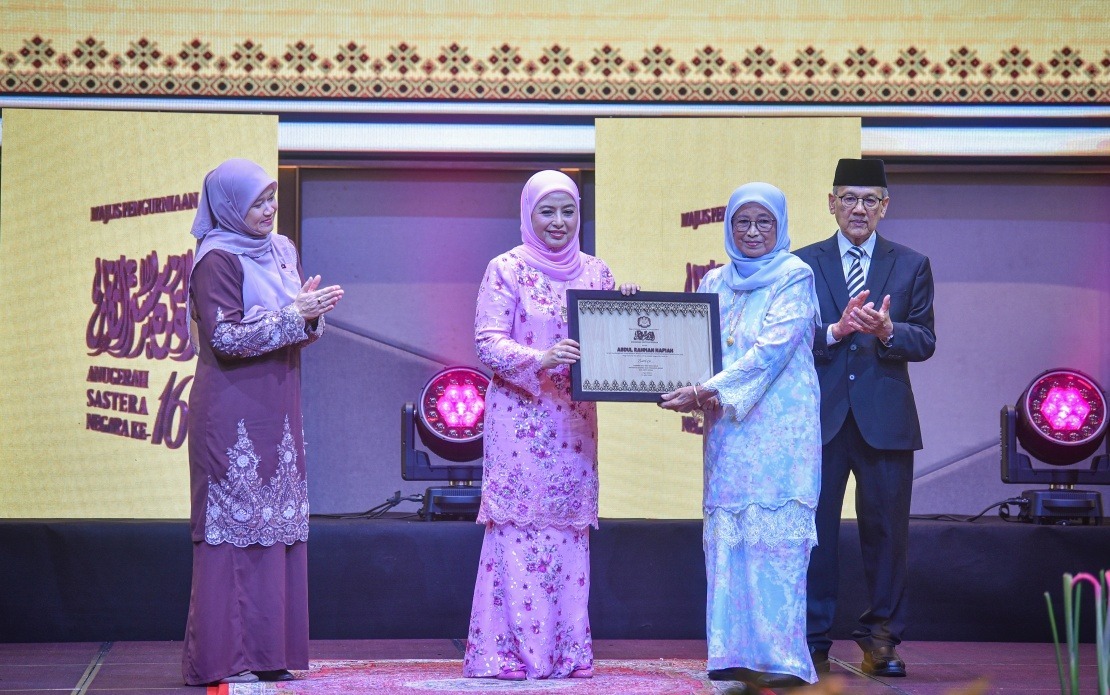
The Malaysian government has accorded its highest literary honour to the late Dr Abdul Rahman Napiah, professionally known as Mana Sikana, recognizing him as the nation's 16th National Laureate. The posthumous award was presented at an official ceremony in Kuala Lumpur, where Her Majesty Raja Zarith Sofia, Queen of Malaysia, handed the accolade to Mana Sikana's widow, Salmah Ali. This recognition underscores the government's commitment to celebrating writers whose contributions have fundamentally shaped Malaysian literary discourse and cultural identity.
Mana Sikana's career spanned more than five decades, during which he established himself as one of the country's most prolific and influential literary voices. Born in Bagan Serai, Perak, on October 9, 1946, he initially pursued teaching before transitioning into academia, where he eventually became a towering figure across multiple universities. His affiliations included Universiti Kebangsaan Malaysia, where he completed his doctorate, Nanyang Technological University in Singapore, and Universiti Pendidikan Sultan Idris, institutions where he mentored generations of students and shaped the trajectory of Malaysian letters.
Education Minister Fadhlina Sidek highlighted during the ceremony how Mana Sikana's extraordinary corpus of work—comprising over 100 publications—consistently championed values that extended beyond mere entertainment. His writings cultivated deeper awareness of Malaysia's multicultural fabric, fostering empathy across different communities while promoting the kind of cultural dialogue increasingly vital in a diverse society. Through his novels, essays, and critical works, Mana Sikana articulated insights into the human condition that resonated with readers seeking authenticity and intellectual substance.
The minister, who chaired the selection panel, emphasized that Mana Sikana's influence manifested across three interconnected dimensions of Malaysian literary development. First, he pioneered innovative approaches to creative writing technique, pushing boundaries and expanding the expressive possibilities available to Malaysian authors. Second, he championed the integration of critical thinking within literary work itself, elevating the intellectual standards of creative discourse. Third, and perhaps most significantly for the nation's long-term literary health, he invested substantially in nurturing younger writers, researchers, and critics through university teaching, academic seminars, and scholarly publications.
Throughout his lifetime, Mana Sikana accumulated numerous accolades that testified to his standing within the literary establishment. His achievements included receiving the Malaysian Literary Prize, the Malaysian Perdana Literary Prize, the Perak Laureate Award, and the Darul Ridzuan Lifetime Literary Achievement Award. These honours reflected recognition from peers and institutions alike, positioning him as a figure whose work transcended commercial success to achieve lasting cultural significance.
The National Laureate designation carries substantial institutional support designed to ensure the recipient's legacy remains accessible to future generations. As the 16th National Laureate, Mana Sikana's estate receives a national letter of honour alongside a cash prize of RM60,000. More consequentially, the government has allocated up to RM500,000 to publish and distribute up to 50,000 copies of his works, with the explicit intention of supplying schools, public libraries, government departments, and agencies nationwide. This distribution strategy represents an investment in making his intellectual and artistic contributions available to students, educators, and the broader reading public.
Mana Sikana's passing in May 2025 at the age of 80 following heart complications deprived Malaysian letters of an active voice at a moment when literary voices remain crucial to national discourse. The decision to confer the National Laureate title posthumously affirms that recognition need not be constrained by mortality, and underscores the government's understanding that literary legacies deserve formal acknowledgement regardless of when assessment occurs. For Malaysian readers and writers, the honour serves as validation that sustained commitment to literary excellence and intellectual rigor continues to be valued within the nation's cultural hierarchy.
The significance of Mana Sikana's elevation extends beyond personal recognition to broader implications for how Malaysian literature positions itself regionally and globally. Throughout Southeast Asia, literary cultures compete for attention and resources in an increasingly digital landscape. By honouring figures like Mana Sikana with comprehensive institutional support including mass distribution programmes, Malaysia signals that it regards literature not as a niche concern but as foundational to cultural identity and social cohesion. This positioning matters for younger writers considering their professional trajectories and for international perceptions of Malaysian intellectual life.
Mana Sikana's career trajectory also illuminates the interconnections between academic work and creative production that characterize serious literary practice. His simultaneous engagement with creative writing, critical theory, academic discourse, and mentorship established a model of literary engagement that refuses artificial boundaries between creation and scholarship. For contemporary Malaysian writers navigating questions about audience, commercial viability, and artistic integrity, Mana Sikana's example demonstrates that intellectual seriousness and creative ambition need not conflict.
The National Laureate programme itself deserves scrutiny as an instrument of cultural policy. By identifying and honouring writers at the pinnacle of achievement, the government creates benchmarks against which literary excellence is measured. The selective nature of the award—only sixteen recipients in the nation's history—establishes that the designation carries genuine prestige. The substantial publishing allocation accompanying the honour represents tangible commitment rather than ceremonial recognition alone, ensuring that the laureate's ideas reach educational institutions where they shape intellectual formation.

