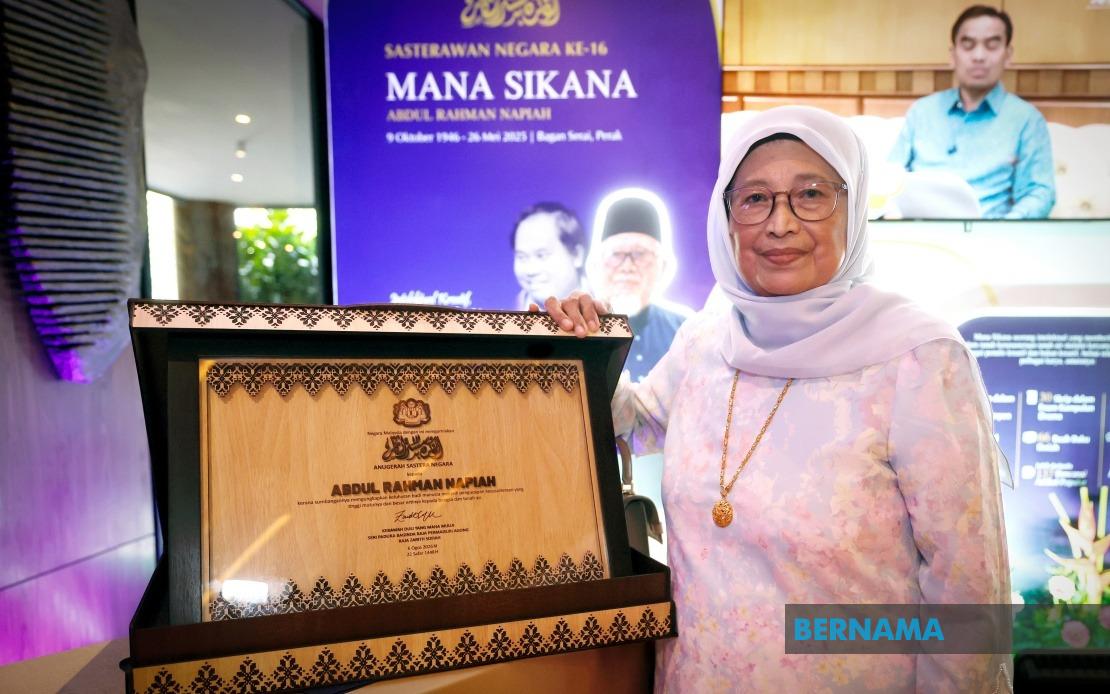
Malaysia's literary establishment has bestowed its highest honour on a departed master of letters. The 16th National Laureate award, presented by Her Majesty Raja Zarith Sofia, Queen of Malaysia, went to the late Dr Abdul Rahman Napiah, whose pen name Mana Sikana became synonymous with excellence in creative writing and literary scholarship across the Malay-speaking world. His widow, Salmah Ali, collected the award at a ceremony in Kuala Lumpur on August 6, accepting recognition that her husband had long anticipated but would not live to witness.
At 82 years old, Salmah Ali carried the emotional weight of accepting an honour her husband desperately wanted during his lifetime. She recounted how Mana Sikana had received notice of the possibility of this award before his death in May last year at age 80 from heart complications. The timing proved tragically ironic: on the very day he passed away, he had been actively engaged in his work, presenting a research paper to Dewan Bahasa dan Pustaka before falling ill. The literary figure had spent his entire adult life accumulating accolades and recognition, beginning with literary awards during his school years, yet this ultimate national distinction eluded him until after his passing.
Mana Sikana's contributions to Malaysian literature extended far beyond the written word. His career trajectory reflected a commitment to nurturing the literary ecosystem across multiple platforms and institutions. Born in Bagan Serai, Perak, on October 9, 1946, he began as a schoolteacher before transitioning into academia, where he would eventually attain professorship. His influence permeated through the broadcasting industry as well; during his years in Johor Bahru, he actively produced drama works for both Singaporean and Malaysian radio and television networks, demonstrating an early understanding that literature thrived in multiple media forms.
His academic credentials spanned several prominent institutions. Mana Sikana served at Universiti Kebangsaan Malaysia (UKM), where he pursued advanced studies that established him as a scholar. He also taught at Nanyang Technological University in Singapore and Universiti Pendidikan Sultan Idris (UPSI), positions that allowed him to shape literary discourse across borders. His reputation extended into Indonesia, where he worked as a visiting lecturer, positioning him as a regional intellectual force rather than merely a national figure.
Education Minister Fadhlina Sidek, who attended the award ceremony, articulated the significance of Mana Sikana's selection. The Ministry recognized that his scholarship encompassed the full spectrum of literary engagement: creative writing itself, the theoretical frameworks underlying literature, critical analysis of texts, and the academic discourse that elevates literary study into intellectual rigour. These four pillars represented a complete vision of how literature strengthens a nation—not merely through the production of artistic works, but through the cultivation of understanding, analysis, and pedagogical excellence.
Salmah Ali's remarks revealed dimensions of her husband's character often invisible in formal biographical records. Despite his demanding career as professor, broadcaster, and writer, Mana Sikana remained deeply invested in transmitting his knowledge to the next generation. He shared his expertise in writing and literature with four children and twelve grandchildren, ensuring that his intellectual legacy extended through familial channels as well as institutional ones. This commitment to family education underscored a philosophy that viewed literary knowledge as patrimony to be passed down, not hoarded within academic circles.
The conferment of this award carries particular significance for Malaysian literature at a moment when questions persist about the health of reading cultures and literary engagement in the digital age. Mana Sikana represented a generation that built the institutional foundations of modern Malaysian literary studies—establishing departments, mentoring scholars, creating platforms for writers, and demonstrating through his own prolific output that literature could be both commercially viable and intellectually serious. His recognition, even posthumously, signals that the nation values such foundational contributions.
For Southeast Asian scholars and cultural commentators, Mana Sikana's career illustrated how regional intellectual networks functioned before digital connectivity made such exchange routine. His work in Singapore, Indonesia, and Malaysia reflected the linguistic and cultural affinities that bound Malay-language communities together. The award thus acknowledges not only his national significance but his role in strengthening literary communities across borders—a contribution increasingly recognized as essential to the region's cultural resilience.
Salmah Ali's emotional acceptance of the award on her husband's behalf highlighted the bittersweet reality of posthumous recognition. She expressed gratitude that his lifetime of service to Malaysian literature had finally received the formal acknowledgement it deserved, yet grief suffused her gratitude. The ceremony represented both vindication and loss: vindication that Mana Sikana's decades of creative and scholarly work had been properly valued, but loss that he could not stand to receive the honour himself, could not experience the public affirmation of his contributions while alive to savour it.
This award also prompts reflection on how literary societies determine whose work endures and receives recognition. Mana Sikana's selection suggests that the National Laureate committee values not merely contemporary popularity or commercial success, but sustained intellectual contribution, mentorship, institutional building, and the creation of frameworks through which literature itself becomes possible. In an era when entertainment and literature increasingly blur, his recognition affirms that literary scholarship and critical discourse remain valued pillars of national culture.
Moving forward, Mana Sikana's legacy presents a template for aspiring writers and scholars throughout Malaysia and the region. His example demonstrates that literary excellence does not require choosing between artistic creation and academic rigour, between local rootedness and regional engagement, or between public broadcasting and scholarly publication. The late professor embodied an integrated vision of literary life that contemporary practitioners would do well to contemplate, even as they navigate a cultural landscape far different from that in which he flourished.

