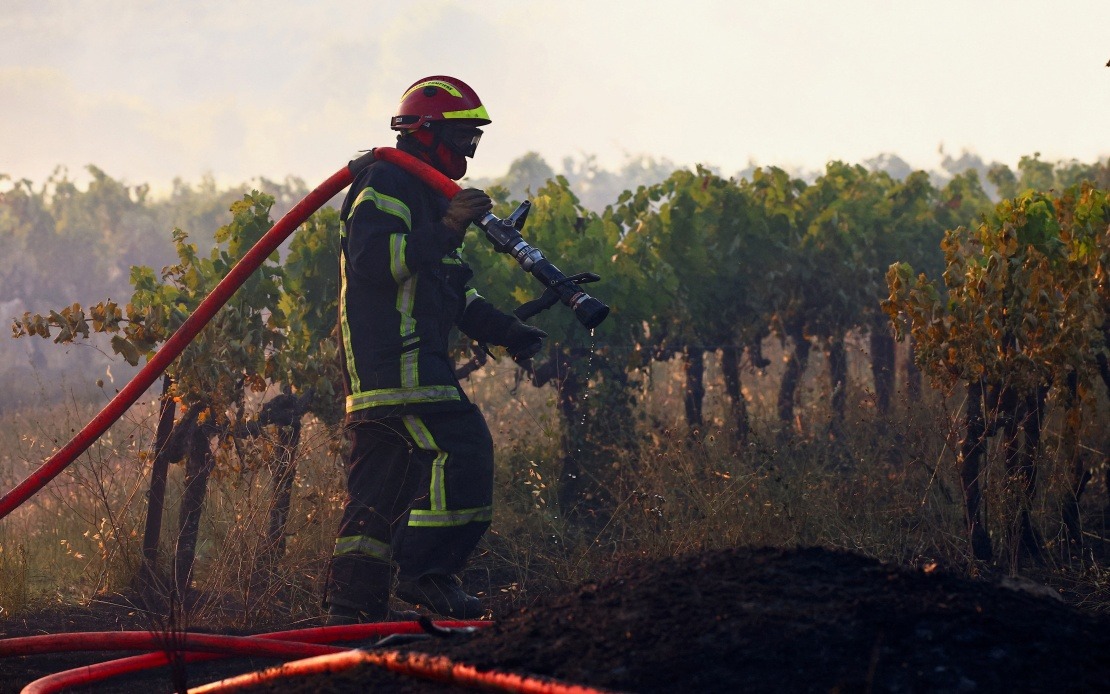
A major wildfire emergency continues unfolding across the Var department in southeastern France, with flames consuming 1,700 hectares of land and triggering widespread disruptions to both residents and infrastructure, according to local authorities. The blaze has necessitated the evacuation of approximately 400 people from multiple communes and severed electrical connections to 2,300 households, predominantly concentrated in the town of Cotignac. The situation represents part of a broader crisis gripping France as unprecedented heat drives a surge in destructive wildfires.
The affected region spans several municipalities including Ponteves, Cotignac, Sillans-la-Cascade, Correns and Montfort-sur-Argens, each requiring coordinated emergency response operations. Local prefecture officials confirmed the extent of damage through Wednesday statements, as firefighting efforts intensified across the affected communes. The evacuation process, while orderly, underscores the velocity at which these fires can advance and threaten populated areas, a concern increasingly familiar to communities across the Mediterranean rim.
Response capabilities have been mobilized at scale, reflecting the severity assessment by regional and national authorities. Approximately 900 firefighters from the Var department and reinforcements from neighbouring jurisdictions have been deployed to contain and suppress the advancing flames. These personnel are supported by 350 vehicles ranging from specialized fire trucks to water-delivery aircraft, alongside 60 gendarmes positioned to manage evacuations and maintain security perimeters around threatened areas. The magnitude of this deployment signals confidence in eventual containment, though wildfire dynamics remain inherently unpredictable.
France faces an escalating wildfire crisis that has extended far beyond the Var incident. President Emmanuel Macron has characterized the summer of 2023 as producing a record-breaking number of wildfires since the conclusion of World War II. This grim milestone reflects systemic climate patterns, as rising temperatures create increasingly favourable conditions for rapid fire propagation across vulnerable landscapes. The statistical severity of the current situation distinguishes it clearly from historical precedent, indicating structural shifts in France's environmental and meteorological baseline.
The underlying meteorological conditions driving this crisis reached critical intensity at the end of June, when France's national weather service issued its highest alert level across 72 of the nation's 96 departments—itself a unprecedented record. Temperature readings during this peak period approached 40°C, with certain locations exceeding this threshold. Such extreme heat creates a tinderbox environment where vegetation dries rapidly and fire initiation becomes easier, while simultaneously accelerating fire spread once ignition occurs. The convergence of sustained high temperatures with dry fuel loads creates compounding risk that challenges even well-resourced emergency services.
For Malaysian and Southeast Asian observers, France's wildfire crisis offers instructive parallels to regional concerns. Much of Southeast Asia faces seasonal fire risks driven by agricultural burning practices, particularly across Sumatra and Kalimantan, combined with increasingly unpredictable weather patterns influenced by climate change. While France's situation stems primarily from natural heating, both contexts demonstrate how modern environmental conditions can overwhelm traditional emergency response infrastructure and planning assumptions. The French experience suggests that scaling firefighting capacity may require international coordination and resource-sharing arrangements.
The power disruptions affecting 2,300 households carry cascading implications beyond simple infrastructure restoration. Summer heat means loss of air conditioning during peak temperatures, creating serious health risks particularly for elderly residents and those with medical vulnerabilities. Water supply systems dependent on electrical pumping face interruption precisely when demand peaks. Communication networks may fail, complicating coordination of evacuations and emergency services. These compounding effects illustrate how single-sector infrastructure failures during natural disasters multiply into multifaceted humanitarian challenges.
The strategic positioning of firefighting resources reflects lessons accumulated from France's evolving wildfire management doctrine. Rather than concentrating assets at single locations, authorities have implemented distributed deployment patterns enabling rapid response to multiple concurrent fire fronts. International assistance mechanisms, increasingly common across Europe, allow departments to request additional personnel and equipment from neighbouring regions. This mutual-aid approach has become essential as fires grow larger and more frequent than historical baselines, exceeding single-jurisdiction capacity.
As climate projections indicate continued warming across southern Europe, France faces difficult long-term planning questions. Infrastructure hardening—burying power lines in high-risk areas, creating firebreaks, managing forest fuel loads—requires sustained investment and political will. Community preparedness including evacuation planning, early-warning systems, and public education assumes greater importance. Regional cooperation through the European Union and bilateral agreements enables resource optimization but cannot substitute for fundamental mitigation through emissions reduction and climate adaptation strategies.
The human dimensions of this crisis extend beyond immediate evacuees to broader impacts on regional economies, tourism, and agricultural productivity. Agricultural lands in the Var region face potential long-term soil degradation from intense heat exposure. Forests that require decades for regrowth disappear in days. Tourist infrastructure and rural livelihoods become vulnerable. These considerations frame wildfire response not merely as emergency management but as questions of economic resilience and long-term regional development in an era of climatic instability.

