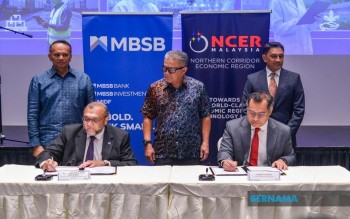
MBSB Bank has pledged RM1 billion in fresh financing through a partnership with the Northern Corridor Implementation Authority, marking a significant injection of capital aimed at unlocking economic potential across Perlis, Kedah, Penang and Perak. The memorandum of understanding, formalised in Petaling Jaya on July 17, represents a coordinated effort to accelerate business expansion and investment flows in one of Malaysia's most dynamic regional economies. The collaboration addresses a critical gap in accessible funding for smaller enterprises seeking to establish or expand operations within the NCER's thriving ecosystem.
The Northern Corridor Economic Region has emerged as a magnet for substantial domestic and foreign investment over the past decade, establishing itself firmly among Malaysia's fastest-expanding economic zones. Its appeal rests on a diversified industrial base spanning electrical and electronics manufacturing, advanced automotive production, logistics hubs, agricultural processing, and increasingly, digital and green technology ventures. By anchoring fresh capital specifically for SME participation in this landscape, the partnership between MBSB Bank and NCIA seeks to democratise access to the opportunities the region offers, extending benefits beyond multinational corporations to locally-rooted businesses with growth ambitions.
MBSB Bank chairman Datuk Wan Kamaruzaman Wan Ahmad framed the initiative as a catalyst for regional dynamism, emphasising how the RM1 billion facility would enable businesses to scale operations, integrate into major supply chains, and contribute durably to the Northern Corridor's economic trajectory. His remarks underscored a strategic shift toward inclusive growth within the NCER, acknowledging that SME participation drives job creation, local innovation, and resilient supply networks. The financing arrangement recognises that mid-sized enterprises, despite their entrepreneurial vigour and market responsiveness, often struggle with collateral requirements and documentation burdens that traditional banking pathways impose.
The signing ceremony brought together MBSB Bank group chief commercial banking officer Noor Mohamed Amin and NCIA chief operating officer Hasri A Hassan, reflecting the administrative weight both institutions assign to the partnership. This structural involvement signals serious implementation intent, moving the agreement beyond symbolic gesture toward operational reality. The presence of senior commercial banking leadership suggests that MBSB Bank views the SME financing stream not as peripheral philanthropy but as a core business opportunity within the bank's expanded commercial mandate.
Group chief executive officer Rafe Haneef articulated an additional dimension to the partnership: international market access. By positioning MBSB Bank as a conduit between Northern Corridor SMEs and Santander Group—a major European banking network—the arrangement creates pathways for export-oriented enterprises to scale internationally. This cross-border dimension proves particularly valuable for Malaysian exporters navigating tariff complexities, currency fluctuations, and logistics costs in reaching developed markets. Rather than merely providing domestic working capital, the partnership offers export finance vehicles and trade facilitation services that smaller companies typically access only through cumbersome correspondent banking arrangements.
The NCER's strategic sectors identified by NCIA chief executive Datuk Mohamad Haris Kader Sultan—electrical and electronics, advanced manufacturing, agri-food, logistics, digital economy and green technology—reflect both current strengths and future-oriented positioning. Each sector carries distinct financing needs and risk profiles. E&E and advanced manufacturing require substantial capital investment in equipment and facilities; agri-food ventures often face working capital constraints during production cycles; logistics operations demand fleet and infrastructure financing; digital economy startups typically seek venture-scale growth capital; green technology enterprises pursue long-term sustainability financing. The RM1 billion facility, if properly structured with sector-specific product variants, can accommodate this heterogeneity.
The partnership emerges amid Malaysia's 13th Malaysia Plan implementation phase, reflecting government prioritisation of regional economic development beyond the Klang Valley and Johor economic corridors. Statements from NCIA leadership explicitly connected the initiative to strategic planning objectives, positioning partnerships like this as essential infrastructure for attracting fresh investments and accelerating project implementation timelines. This ministerial-level framing elevates the MBSB-NCIA collaboration beyond routine commercial arrangement to policy instrument status, suggesting government commitment to sustained capital flows toward the Northern Corridor.
For Malaysian SME entrepreneurs, particularly those clustered in Penang's manufacturing precincts, Perak's industrial zones, or Kedah's emerging tech hubs, the partnership directly addresses financing barriers that have historically constrained scale-up ambitions. Access to RM1 billion earmarked specifically for Northern Corridor operations—with presumed streamlined eligibility criteria compared to conventional bank lending—creates competitive advantage relative to counterparts in other regions lacking equivalent dedicated financing windows. The initiative effectively tilts Malaysia's financial playing field toward regional economic decentralisation, operationalising rhetoric about balanced national development.
The involvement of Santander Group introduces institutional credibility and operational sophistication. European banking groups of Santander's scale bring specialised export finance expertise, international business matching platforms, and trade intelligence resources that smaller Malaysian financial institutions struggle to replicate independently. This knowledge transfer component may prove as valuable as the direct capital injection, particularly in coaching Northern Corridor SMEs toward bankable export standards and international competitive positioning.
Implementation challenges remain substantial. Disbursement velocity will determine actual impact—funding approved but inaccessible to businesses defeats the partnership's purpose. MBSB Bank must establish transparent application processes, realistic assessment timelines, and flexible collateral frameworks that accommodate SME balance sheet constraints. NCIA's role in screening applicants, validating business viability within sectoral priorities, and smoothing approval pathways becomes critical. Without coordinated effort on both sides, even generous financing commitments fail to translate into measurable economic outcomes.
For Southeast Asian observers, the MBSB-NCIA model offers a replicable blueprint for regional development finance. Rather than betting exclusively on foreign direct investment or central government budgetary allocation, the partnership mobilises commercial banking capital toward regionally-prioritised sectors through publicprivate coordination. This approach acknowledges that SMEs, not just multinational enterprises, drive diversified regional growth and employment. Other Southeast Asian nations managing decentralised regional economies might draw lessons from Malaysia's institutional architecture linking regional development authorities with commercial financial institutions through structured, transparent, capital-mobilisation agreements.

