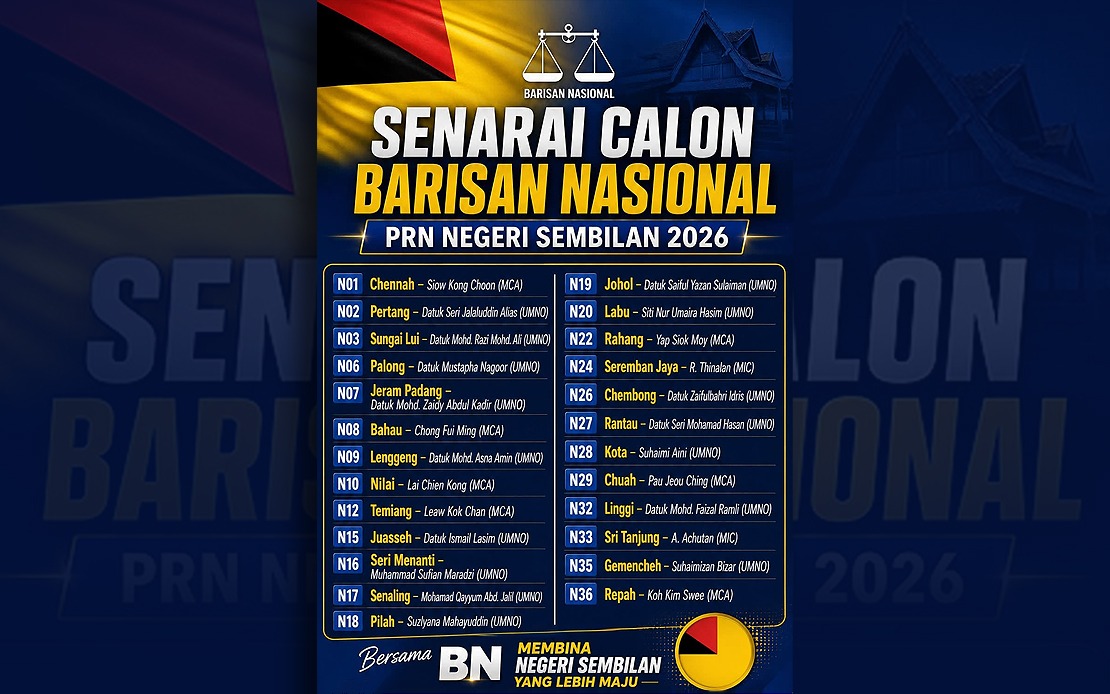
The coalition framework for Negeri Sembilan's upcoming state election took shape on Monday when Barisan Nasional chairman Datuk Seri Dr Ahmad Zahid Hamidi announced the seat allocation among the bloc's component parties. Under the arrangement, the Malaysian Chinese Association will field candidates in seven constituencies while the Malaysian Indian Congress will contest four seats, signalling BN's confidence in its partners' ability to secure victories in their respective strongholds.
Ahmad Zahid, who holds the concurrent position of Deputy Prime Minister, explained that the distribution methodology extended beyond routine political mathematics. Instead, the allocation reflected a strategic assessment of each candidate's capacity to win in their assigned constituencies, a nuanced approach that seeks to maximise the coalition's overall performance in the August 1 polling. This emphasis on electoral viability rather than purely proportional representation underscores the pressure facing BN as it seeks to recover ground lost in the previous state election cycle.
The BN chairman conducted formal proceedings at Wisma UMNO Negeri Sembilan in Seremban, where he met with prospective candidates ahead of the official slate announcement. Each candidate underwent a ceremonial process involving the signing of undertakings and pledges of allegiance directly to Ahmad Zahid as BN chairman. These customary rituals, while serving as symbolic affirmations of party discipline, also function as mechanisms for vetting candidate suitability and ensuring alignment with coalition directives—procedures that Ahmad Zahid noted had become standard practice across state elections, by-elections, and general elections nationwide.
The formal announcement of BN's complete candidate list was scheduled for later that evening at Stadium Tuanku Abdul Rahman Paroi, with Ahmad Zahid presiding over the unveiling ceremony. This public presentation marks the final stage of the coalition's internal selection process and signals the official commencement of the campaign phase for component parties and their candidates. The timing allows parties to mobilise grassroots machinery and begin voter engagement efforts ahead of the electoral calendar.
The Electoral Commission has structured the election timeline with precision, setting July 18 as nomination day for all candidates contesting the 36 State Legislative Assembly seats across Negeri Sembilan. Early voting has been scheduled for July 28, providing flexibility for voters unable to cast ballots on the main polling day. The concentrated timeline—spanning roughly three weeks from nominations to the final vote—represents a compressed campaign period that rewards parties with established organisational infrastructure and name recognition in their respective districts.
Negeri Sembilan's electoral landscape has undergone considerable transformation in recent years, with the 15th state election delivering a fragmented outcome that fundamentally altered the state's political balance. In that contest, Barisan Nasional secured 14 seats, while Pakatan Harapan captured 17 seats and Perikatan Nasional won five seats, resulting in a Pakatan-led government. The mathematics of that election underscored the coalition's weakened position in the state, where demographic shifts and changing voter preferences have gradually eroded BN's traditional dominance.
For Malaysian readers and observers of regional politics, Negeri Sembilan represents a microcosm of broader BN revival efforts across the peninsula. The coalition faces mounting pressure to demonstrate resurgent appeal after years of internal turmoil and electoral reverses. The seat allocation strategy—vesting substantial faith in MCA's capacity to deliver wins in seven constituencies—reflects calculations about where BN possesses competitive advantage. MCA's participation reflects the importance of maintaining multi-ethnic representation within the coalition framework, though the party's electoral fortunes have become increasingly variable across different state and parliamentary constituencies.
The allocation to MIC of four seats acknowledges the Indian Malaysian community's historical association with BN while also recognising MIC's uneven performance across different electoral contexts. These distributional decisions reveal how coalition partners must balance party pride against realistic expectations of electoral performance. Negotiations within BN typically balance representation desires with pragmatic assessments of ground strength, and the Negeri Sembilan formula appears calibrated to maximise BN's seat count rather than perfectly mirror the demographic composition of the state's electorate.
The upcoming election occurs amid broader conversations about BN's long-term positioning within Malaysia's evolving political ecosystem. The coalition has undertaken substantial internal restructuring and party discipline measures aimed at recapturing voter confidence, particularly among Bumiputera and rural constituencies where its support has traditionally been deepest. Negeri Sembilan, while not a bellwether state, nonetheless provides important indicators about whether BN's revival narrative resonates with voters or remains largely aspirational among party leadership.
For voters in Negeri Sembilan and observers across Southeast Asia tracking Malaysian politics, the election offers insights into coalition dynamics and the mechanics of multi-party cooperation in Westminster-influenced systems. How MCA and MIC perform in their allocated seats will shape perceptions of BN's viability as an electoral force and whether component parties retain meaningful influence in determining outcomes. The campaign period ahead will test whether Ahmad Zahid's confidence in candidate viability translates into actual victories or whether Negeri Sembilan voters, like those in other recent contests, continue to express preferences for alternative political arrangements.

