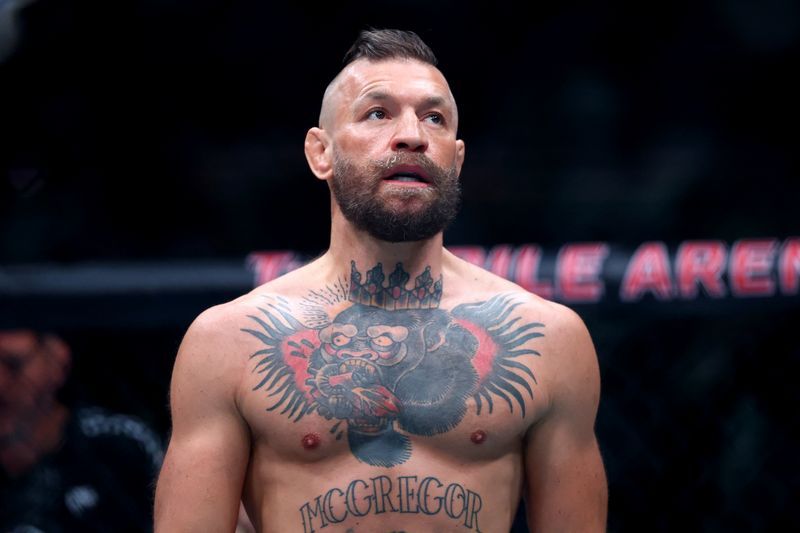
The curtain came down swiftly on Conor McGregor's much-anticipated return to competitive mixed martial arts on Saturday evening in Las Vegas. What was billed as a significant moment in the sport—the Irishman's first bout since July 2021—lasted merely 60 seconds at the UFC 329 event. During the opening moments of his featherweight showdown with former champion Max Holloway, McGregor attempted an aggressive flying kick but landed awkwardly, instantly putting his knee in jeopardy. The damage was immediately apparent; after fighting briefly while clearly in distress, McGregor signalled to the referee that he could not continue, effectively ending his comeback attempt before it had truly begun.
McGregor, a former titleholder across two weight divisions, had spent nearly four years away from competitive action following a catastrophic leg fracture sustained against Dustin Poirier in mid-2021. That injury marked the beginning of an extended period of turbulence for the Dublin native, as multiple setbacks—both sporting and personal—prevented him from returning to the sport that made him one of the most recognizable athletes globally. The fighter's trajectory during this absence revealed the precarious nature of elite athletic careers and the compounding difficulties faced when injuries intersect with off-cage complications.
The cancellation of his scheduled June 2024 clash with Michael Chandler due to a training-camp broken toe represented another frustrating setback in McGregor's quest to reclaim his place atop mixed martial arts. This particular incident underscored how even minor injuries can derail carefully orchestrated comeback plans, especially in a sport where precision timing and conditioning are paramount. At 37 years old, McGregor's physical recovery window was narrower than during his prime years when he earned his standing as one of the sport's biggest draws.
Beyond the sporting realm, McGregor's career faced additional complications that extended into legal territories. An Irish civil court jury determined in a ruling that McGregor bore liability in connection with alleged misconduct in 2018, adding another layer of complexity to his public standing. Later that same year, in October 2025, McGregor accepted an 18-month suspension from anti-doping authorities following repeated failures to provide biological samples for testing—a compliance issue that represented a significant regulatory violation within professional combat sports governance.
The doping violation carried particular weight within the fighting community, as whereabouts failures demonstrate a pattern of non-cooperation with testing protocols. McGregor's acceptance of the punishment, though backdated to permit early expiration in March, nonetheless highlighted the broader governance challenges that professional athletes face when managing their obligations to sports authorities. These cumulative difficulties painted a portrait of an athlete struggling to maintain compliance with multiple systems simultaneously while attempting a comeback at an advanced age for elite combat sports.
Holloway, the former featherweight champion who faced McGregor on Saturday, extended an olive branch toward a potential rematch once the Irish fighter recovers from his injury. The veteran fighter acknowledged the substantial promotional build-up surrounding their encounter and expressed willingness to revisit the matchup. Their previous meeting in 2013 ended decisively in McGregor's favour through unanimous decision, making a return bout a compelling narrative prospect from a commercial standpoint. Holloway's measured response suggested that despite the anticlimactic nature of Saturday's contest, the UFC would likely prioritize staging a competitive rematch once medical clearance permitted McGregor's return to training.
The rapid conclusion of McGregor's bout stood as a microcosm of the unpredictability inherent in mixed martial arts, where even meticulously planned comebacks can unravel in moments. His opponent, Holloway, represented a competent challenger—a former divisional champion with substantial credentials—yet the contest never developed into a genuine competition. This contrasted sharply with the promotional expectations that had accompanied the event's marketing, as the UFC had positioned the bout as a marquee attraction for paying customers and broadcasters.
On the same card at the T-Mobile Arena, British fighter Paddy Pimblett delivered a more decisive outcome, securing victory through submission over Frenchman Benoit Saint-Denis in their lightweight contest. Pimblett's submission required less than 60 seconds, executed through a choking technique that forced immediate capitulation. The rapid succession of quick finishes on Saturday's event raised questions about fighter preparation, venue conditions, or simple fortune in combat sports, where split-second positioning and timing determine outcomes.
For Malaysian and Southeast Asian combat sports enthusiasts, McGregor's injury carries significance beyond mere spectacle. The incident underscores the physical toll of professional fighting and the complex intersection of recovery, aging, and competitive sport at the highest levels. McGregor's struggles to maintain elite performance after approaching 40, combined with the regulatory and legal complications surrounding his career, provide sobering perspective on the challenges facing aging athletes in physically demanding disciplines.
The injury also raises practical questions about medical clearance protocols and fighter safety in combat sports governance. That a competitor of McGregor's experience and resources could sustain a catastrophic knee injury within 60 seconds raises concerns about whether pre-bout medical assessments adequately evaluate functional stability and injury risk. These considerations remain relevant to broader discussions within combat sports communities across Asia regarding athlete welfare and appropriate medical oversight.
Looking forward, McGregor faces an uncertain path to competitive return. The knee injury, depending on its severity, could require months or years of rehabilitation. At an age where recovery windows narrow considerably, and with the various regulatory and legal complications surrounding his profile, the trajectory of his comeback remains genuinely unpredictable. Whether he can overcome these compounded obstacles to stage a meaningful competitive return—or whether Saturday's 60-second appearance represented the effective conclusion of his professional career—will emerge as one of combat sports' enduring questions.

