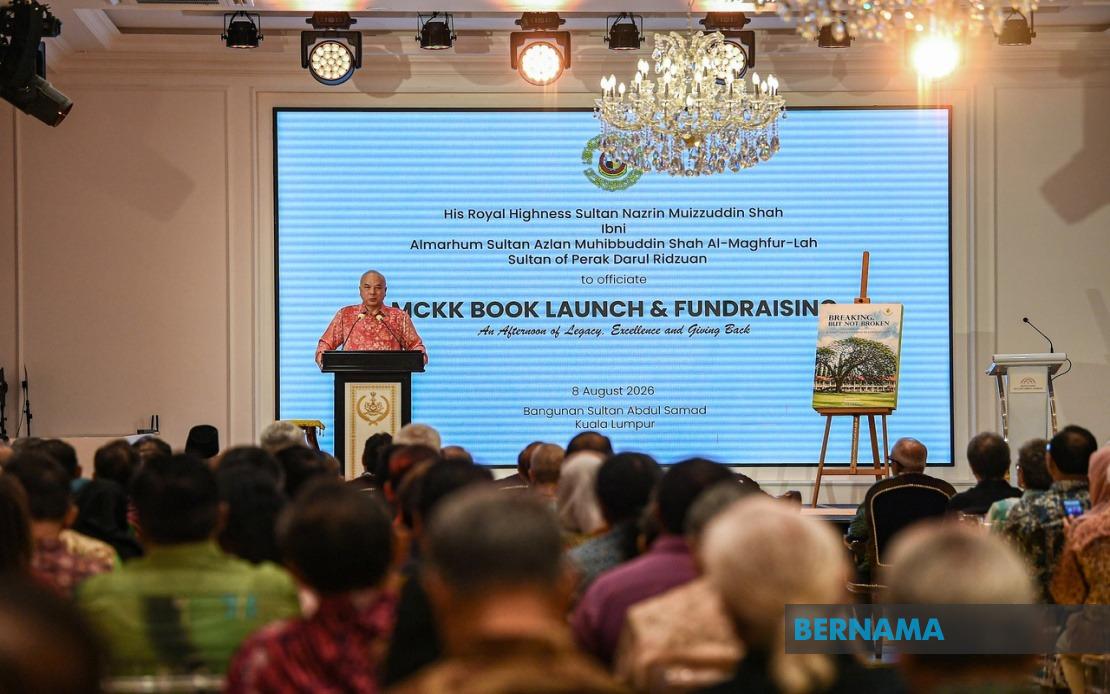
Malaysia's premier heritage schools, including the Malay College Kuala Kangsar, retain the capacity to flourish in the contemporary world provided they fundamentally reimagine their purpose and operations, according to Sultan Nazrin Shah, the Sultan of Perak. Speaking at a book launch here on August 8, the Ruler, who serves as Royal Patron of the MCKK Board of Governors, underscored that institutions of this calibre cannot simply perpetuate past models; instead, they must deliberately reshape themselves to address the profound shifts reshaping education and the workforce.
Sultan Nazrin identified the rapid advancement of artificial intelligence and sweeping technological disruption as defining features of the landscape in which today's schools must operate. Rather than viewing these forces as threats, he framed them as imperatives demanding structural educational reform. The Ruler stressed that the education system itself requires comprehensive reimagining and resource redeployment to equip learners with capabilities suited to an AI-dominated tomorrow. This assertion carries weight given Malaysia's broader economic transition and the nation's stated ambitions to position itself as a technology hub within Southeast Asia.
The Perak Ruler articulated a dual educational mission that extends beyond conventional academic achievement. Young graduates must possess not merely practical skills attuned to evolving employment markets, but equally cultivated character, intellectual habits, and value systems that enable meaningful societal participation. Sultan Nazrin characterised this balanced approach as increasingly vital during periods of uncertainty and rapid transformation. The emphasis on intangible qualities—ethical grounding, critical reasoning, and a sense of civic responsibility—reflected mounting concerns that narrow technical competence alone proves insufficient for navigating complex societal challenges.
At the heart of Sultan Nazrin's remarks lay an unflinching acknowledgement of decline among Malaysia's celebrated residential schools. These institutions, once reliably producing graduates of exceptional calibre, have noticeably lost institutional prestige and educational effectiveness. The Ruler pointed to observable deficiencies in language proficiency, analytical reasoning, and commitment to public service among contemporary alumni—a departure from the schools' storied reputations. This candid assessment reflected the substance of a newly launched book authored by Ghazally Ismail, Ahmad Ibrahim, and Hisham Badrul Hashim, whose analysis reportedly confronts the challenges facing MCKK and peer institutions with deliberate severity.
Sultan Nazrin specifically commended the authors for their willingness to examine sensitive institutional failings without obfuscation. He acknowledged their diagnosis as encompassing not merely MCKK but the broader cohort of elite boarding schools designated as "power schools," whose historical influence and reputational authority have dimmed considerably. The Ruler's endorsement of such forthright institutional critique signals receptiveness to honest reassessment—a prerequisite for meaningful reform. His public validation of the authors' unflinching approach carries symbolic importance in Malaysian governance culture, where deference to established institutions often dampens critical examination.
The financial mobilisation undergirding MCKK's transformation represents a substantial undertaking. Tan Sri Dr Ahmad Tajuddin Ali, chairman of the MCKK Board of Governors, revealed that the MCKK Foundation has accumulated donations and contributions exceeding RM36 million since its establishment in 2008. This capital has been strategically deployed across multiple strategic priorities, reflecting deliberate choices about institutional modernisation. Physical infrastructure improvements, including the IB Complex and the auditorium named after Tun Abdul Razak, consumed more than RM19 million, while restoration and refurbishment of facilities such as hostels, gymnasia, and swimming amenities accounted for an additional RM3.5 million.
Beyond bricks-and-mortar development, the Foundation has constructed a sustainable endowment mechanism designed to ensure long-term operational viability and programme expansion. The endowment portfolio currently exceeds RM16 million, supported by contributions from major institutional benefactors including PETRONAS and the Sultan of Brunei Darussalam, Hassanal Bolkiah. This diversified funding base insulates the college from annual budgetary volatility and demonstrates the institution's capacity to attract philanthropic commitment from regional powers. The accumulated investment income from these endowed funds—exceeding RM7 million to date—creates a recurring revenue stream dedicated to core educational initiatives.
The deployment of endowment returns illustrates MCKK's prioritisation within the broader transformation framework. Scholarship provision and financial assistance for academically capable but economically disadvantaged students exemplify the institution's commitment to widening access and diversity. Concurrent investments in staff professional development, participation in international academic competitions, and curricular enrichment through global engagement reflect recognition that competitive advantage now derives from intellectual exposure and cross-cultural competence. These allocations suggest institutional leadership understands that contemporary educational excellence requires sustained investment in human capital development and institutional connectivity to global knowledge networks.
For Malaysian policymakers and the broader Southeast Asian education sector, Sultan Nazrin's intervention carries important implications. The Perak Ruler's public emphasis on technological adaptation and character development offers implicit guidance regarding national education strategy. His acknowledgement that elite institutions face legitimate performance criticism creates space for wider institutional introspection across the region's boarding school system. Malaysia's residential schools have historically served as training grounds for national leadership; their effectiveness therefore carries consequences extending well beyond individual alumni success to broader governance capacity and social cohesion.
The challenge articulated by Sultan Nazrin ultimately reflects a fundamental tension within heritage education systems globally. Institutions built upon traditions and established practices must simultaneously honour their historical identities while embracing transformative change. MCKK and its peer institutions cannot simply modernise in isolation; they must do so while maintaining the ethical and intellectual standards that justified their historical prominence. The convergence of substantial financial resources, institutional willingness to confront shortcomings frankly, and royal patronage positioning the conversation within national discourse suggests the conditions for meaningful institutional renewal exist. Whether MCKK and comparable schools can translate this alignment into sustained educational excellence, however, remains contingent upon implementation rigour and sustained commitment from stakeholders across Malaysia's education ecosystem.

